Stormont Parties Reject Bryant's Budget Offer as £100 Million Gap Leaves Crisis Unresolved
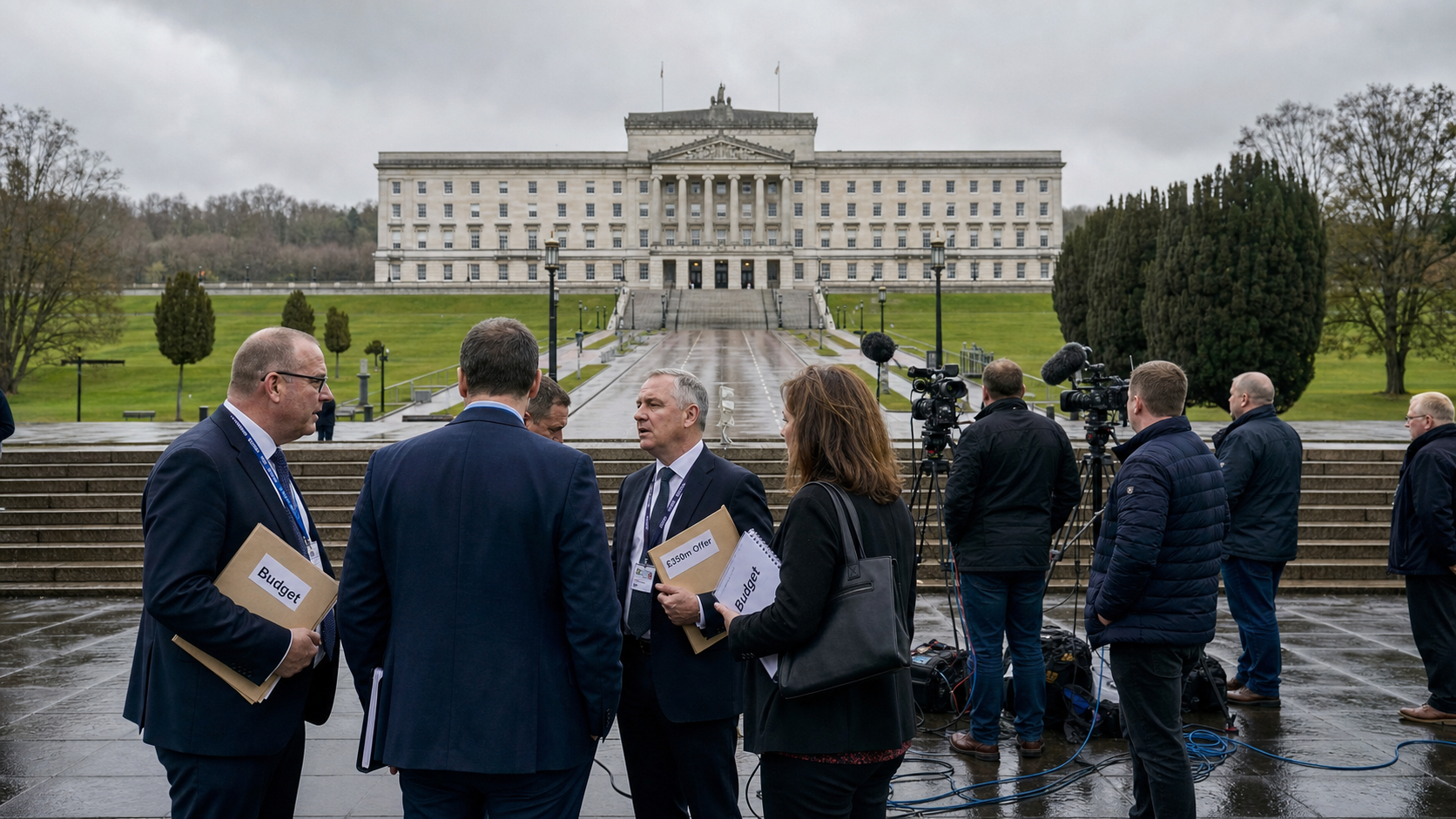
Northern Ireland's five main political parties have rejected the UK government's proposed financial package of £350 million per year to resolve Stormont's budget crisis, insisting that the offer falls £100 million short of the £450 million annually that the Executive requires to address mounting pressures in health, education, and other public services. NI Secretary Sir Chris Bryant's first official visit to Stormont, which concluded on Monday, has opened a new phase of negotiations but has not produced the breakthrough that the Executive urgently needs.
Background
Northern Ireland's budget crisis has been building since the beginning of the current financial year in April 2026. The Executive failed to agree a formal budget before the April deadline, and departments have since been operating under contingency arrangements that allow them to spend up to 95 per cent of the previous year's funding. That arrangement, which was given legal backing following the expiration of an August deadline, is not a sustainable basis for running public services, and the pressure on departments — particularly health and education, which together account for the majority of the Executive's spending — has been intensifying throughout the summer.
The roots of the crisis lie in a combination of factors: the structural underfunding of Northern Ireland's public services relative to need, the legacy of years of political instability that prevented long-term planning and investment, and the specific pressures created by the cost-of-living crisis and the post-pandemic recovery. The Executive's own analysis suggests that it faces a structural deficit of several hundred million pounds per year — a gap that cannot be closed through efficiency savings alone and that requires additional funding from Westminster.
Sir Chris Bryant arrived at Stormont on Monday for his first official visit as Secretary of State, holding a series of meetings with the five largest parties — Sinn Féin, the DUP, the Alliance Party, the SDLP, and the UUP — as well as with the Executive as a whole. The visit was framed by the UK government as a genuine attempt to break the deadlock, and Bryant arrived with a financial offer that he described as substantial. The parties, however, were not persuaded.
Key Developments
The UK government's offer of £350 million per year over three years was rejected by all five main parties, who argued that the package falls significantly short of what is needed. First Minister Michelle O'Neill and DUP leader Gavin Robinson both emphasised that accepting the offer in its current form would require the Executive to make cuts to public services that would be deeply damaging to communities across Northern Ireland. The Alliance Party and the SDLP, while broadly supportive of the Secretary of State's engagement, also indicated that the financial package was insufficient.
The parties' position is that the Executive requires £450 million per year — a figure that reflects the combined pressures on health, education, and other departments. The £100 million gap between the government's offer and the parties' demand is not a trivial sum in the context of Northern Ireland's public finances, and bridging it will require either additional funding from Westminster or a willingness on the part of the Executive to accept cuts that it has so far resisted.
In addition to the immediate budget negotiations, Bryant used his visit to consult with parties on potential reforms to the Stormont institutions. The Alliance Party and the SDLP have long advocated for structural changes to the power-sharing arrangements that would prevent future collapses of the Executive. Sinn Féin has put forward proposals to remove the "veto" on Executive formation, while the DUP has shown less enthusiasm for institutional reform at this stage. Bryant indicated that he would consider the parties' proposals carefully, but gave no commitment on the timeline or scope of any reform process.
Why It Matters
The budget crisis at Stormont is not simply a financial problem — it is a governance crisis that has real consequences for the people of Northern Ireland. Departments operating under contingency arrangements cannot make long-term commitments, cannot hire staff, and cannot plan capital projects. The health service, which is already under severe pressure from record waiting lists and workforce shortages, is particularly vulnerable to the uncertainty created by the absence of a formal budget. The education system, which is facing its own set of pressures including the SEN crisis and the need for school building investment, is similarly constrained.
The £100 million gap between the government's offer and the parties' demand is significant, but it is not insurmountable. For context, the UK government's total spending on Northern Ireland in 2025-26 was approximately £15 billion, of which the block grant — the funding that the Executive controls — was around £14 billion. An additional £100 million per year represents less than one per cent of that total. The political will to bridge the gap exists on the Stormont side; the question is whether Westminster is prepared to provide it.
The parallel discussions on institutional reform add a further dimension of complexity. The parties that are most enthusiastic about reform — Alliance and the SDLP — are also the parties that are most committed to making the current institutions work. The parties that are most resistant to reform — the DUP and, to a lesser extent, Sinn Féin — are the parties whose cooperation is most essential to any settlement. Bryant's challenge is to find a package that addresses both the immediate financial crisis and the longer-term institutional questions in a way that all five parties can accept.
Local Impact
Across Northern Ireland, the budget crisis is being felt in concrete ways. In Belfast, the Belfast Health and Social Care Trust has warned that it may need to close wards and reduce services if additional funding is not forthcoming before the end of the financial year. In Derry/Londonderry, the Western Health and Social Care Trust has indicated that its deficit is growing and that it cannot sustain current service levels without additional resources. In rural areas across Antrim, Armagh, Fermanagh, Tyrone, and Down, community services that depend on Executive funding are operating under severe uncertainty. The Education Authority has warned that it cannot meet its statutory obligations to children with Special Educational Needs without additional funding — a warning that has particular resonance given the SEN crisis that has been building for several years. Translink, which operates bus and rail services across Northern Ireland, has also flagged concerns about its ability to maintain current service levels without a budget settlement.
What's Next
Further talks between the Secretary of State and the Stormont parties are expected in the coming days. Bryant has indicated that he will return to Westminster to consult with the Treasury on the possibility of improving the financial offer, though he has given no commitment on the scale of any improvement. The Executive is due to meet again later this week to assess the current financial position and to consider contingency measures if a budget settlement is not reached before the end of October. The Assembly is expected to debate the budget crisis when it sits later this month, with all parties likely to use the debate to press their respective positions. Prime Minister Andy Burnham, who has pledged to restore functional governance to Stormont, is expected to be briefed on the outcome of Bryant's visit before the end of the week.