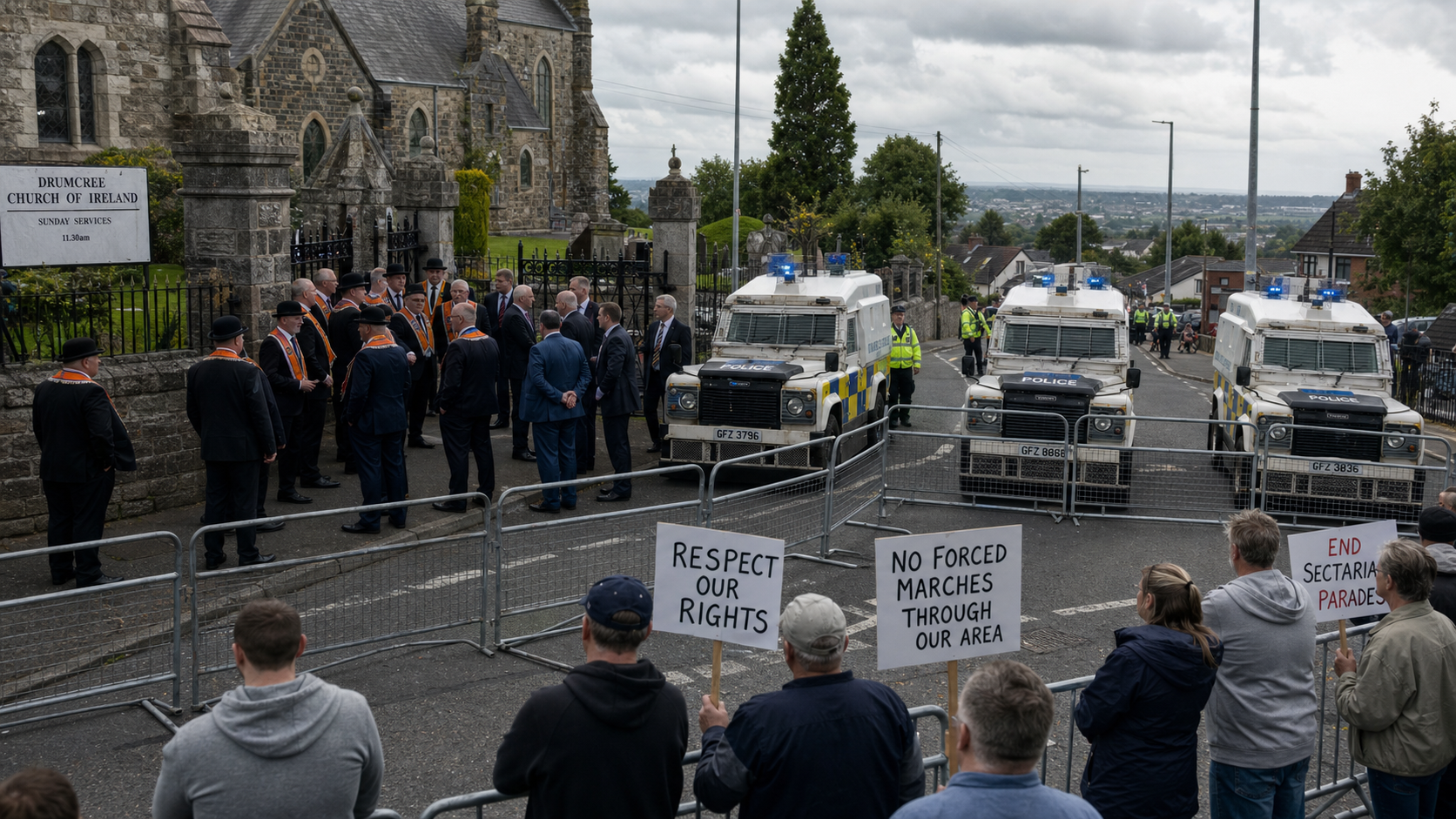
DUP Rejects Bryant's Drumcree Framework as Residents Launch Fresh Legal Bid to Block March
The Democratic Unionist Party has publicly rejected Northern Ireland Secretary Chris Bryant's proposed framework for resolving the Drumcree parading dispute as "not acceptable", while lawyers for the Garvaghy Road Residents Coalition have simultaneously lodged a fresh legal challenge to prevent the Orange Order from marching down the road — leaving the standoff in its fourth day with no resolution in sight and political tensions at Stormont reaching a new intensity.
Background
The Drumcree dispute is one of the most enduring and emotionally charged conflicts in Northern Ireland's post-Good Friday Agreement history. The Orange Order's annual parade from Drumcree Church in Portadown to the town centre has been blocked from passing through the predominantly nationalist Garvaghy Road since 1998, when the Parades Commission ruled against the route following years of violent confrontation. The standoff in the late 1990s — which saw the British Army deployed, roads blockaded, and widespread civil unrest — left deep scars on both communities and on the broader peace process.
The current crisis began when the Parades Commission issued a ruling that allowed the parade to proceed with certain restrictions, a decision that was immediately contested by Garvaghy Road residents who argued it violated their rights and the spirit of previous agreements. The residents' protest — which has drawn significant political support, including the presence of First Minister Michelle O'Neill and Sinn Féin president Mary Lou McDonald — has been described by the PSNI as an "unlawful protest", and police are now conducting a criminal investigation into the events of Sunday.
Northern Ireland Secretary Chris Bryant has been engaged in intensive shuttle diplomacy between the Orange Order, the residents' coalition, and the political parties, attempting to broker a framework that could provide a path to resolution. His proposal, the details of which have not been fully disclosed, was presented to all parties on Tuesday evening.
Key Developments
A DUP MP publicly rejected Bryant's proposal on Wednesday morning, describing it as "not acceptable" and indicating that the party would not support a framework that, in their view, rewarded what they characterised as unlawful behaviour by the residents and their political supporters. The DUP's Gregory Campbell said the party was "not doing any deal" that did not fully uphold the Parades Commission's original ruling.
Simultaneously, lawyers for the Garvaghy Road Residents Coalition lodged a fresh legal challenge in the courts, seeking an injunction to prevent the Orange Order from marching down the road. The legal bid adds a judicial dimension to a dispute that has already engaged the political, policing, and diplomatic machinery of both the UK and Irish governments.
The PSNI chief constable has warned that "mob rule must not be allowed to win", while also stating that upholding the Parades Commission's ruling does not come "at any cost" — a formulation that has been interpreted differently by different parties. The Orange Order has called for the resignations of senior PSNI officers over their handling of the dispute.
Catholic and Protestant archbishops issued a joint appeal for calm and compromise, urging all parties to engage in dialogue and warning that the standoff risks damaging the peace process that has been built over nearly three decades.
Why It Matters
The Drumcree dispute matters far beyond the specific question of a parade route in Portadown. It is a test of whether the institutions and mechanisms of the Good Friday Agreement — the Parades Commission, the power-sharing executive, the rule of law — can manage the most difficult intercommunal conflicts without descending into the kind of violence that characterised the 1990s. The involvement of senior Sinn Féin figures in the residents' protest has been seized upon by unionists as evidence of bad faith; the DUP's rejection of Bryant's framework has been characterised by nationalists as intransigence. Both narratives contain elements of truth, and neither is sufficient on its own.
The crisis also exposes the fragility of Stormont's power-sharing arrangements. The DUP's threat to pursue a no-confidence motion against First Minister O'Neill — over her participation in the Garvaghy Road protest — has raised the spectre of another collapse of the executive, a prospect that would have serious consequences for public services and political stability in Northern Ireland.
Local Impact
In Portadown, the standoff has created significant disruption to daily life, with road closures, a heavy police presence, and the constant threat of disorder affecting businesses and residents across the town. In the Garvaghy Road area itself, the atmosphere remains tense, with large crowds gathering nightly in support of the residents' position. In Belfast, the political fallout is being felt at Stormont, where the Assembly has been consumed by the crisis and normal legislative business has been largely suspended. Translink has been operating modified services in the Portadown area due to the security situation.
What's Next
The fresh legal challenge lodged by the residents' coalition is expected to be heard in the coming days, and its outcome could significantly alter the dynamics of the dispute. If the court grants an injunction blocking the march, the immediate pressure on the Orange Order and the PSNI is reduced; if it refuses, the question of how the march is to be managed — or whether it proceeds at all — returns to the political and policing arena. Bryant has indicated he will continue his mediation efforts, and there are reports that an international mediator may be brought in to assist. The Taoiseach has urged all parties to "dial back" and engage in dialogue, while making clear that the Irish government will not intervene directly in what it regards as a matter for the Northern Ireland authorities.