Staff and Students Stage Protest at Carlow College as Closure Plans Proceed Without Transparency
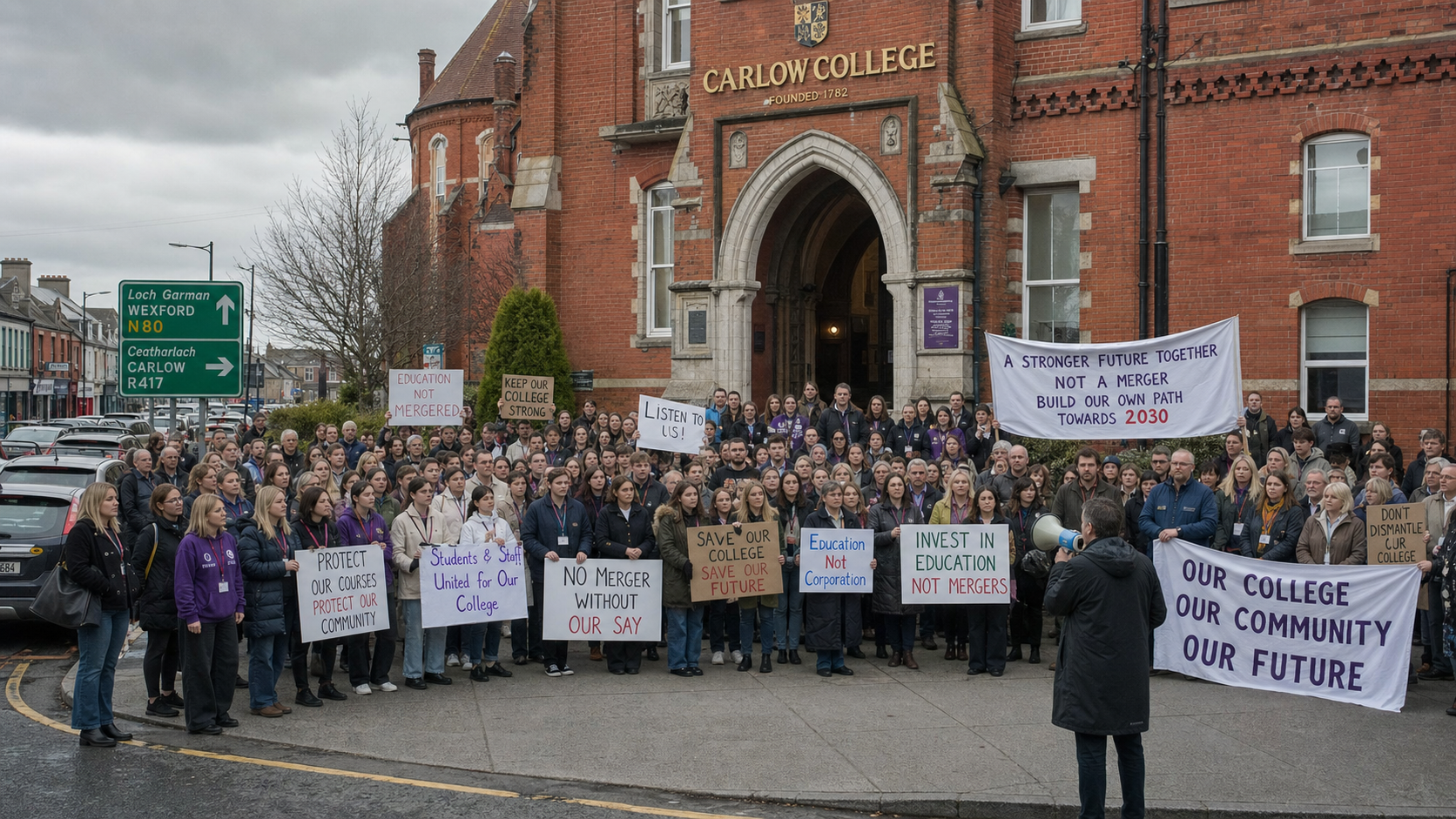
Around 80 to 100 staff and students gathered at Carlow College on Monday to protest the institution's planned phased closure and transfer to South East Technological University by 2028, carrying placards reading "This is what transparency looks like" and demanding the release of a heavily redacted Mazars consultancy report that they say has been withheld on spurious commercial grounds.
Background
Carlow College, St Patrick's, is one of Ireland's oldest third-level institutions, having been established in 1782 as a seminary and evolving over more than two centuries into a liberal arts college with a particular strength in humanities, social sciences, and theology. It is a small institution by modern standards, but its longevity and its distinctive character — rooted in the Catholic intellectual tradition but open to students of all backgrounds — have given it a significance in the Irish higher education landscape that is disproportionate to its size.
In May 2026, the college announced that it would wind down operations over a two-year period, with its campus to be transferred to South East Technological University by 2028. The decision was presented as the result of a strategic review conducted by the Mazars consultancy firm, but the full report has not been made available to staff or students. A heavily redacted version was released following a Freedom of Information request, with SETU citing commercial sensitivity and potential prejudice to ongoing negotiations as grounds for withholding the full document.
The college is not accepting new students for the current academic year, and current students are expected to complete their qualifications during the two-year "teach-out" period. Staff face an uncertain future, with questions about redundancy terms, workload during the wind-down period, and the possibility of transfer to SETU remaining unresolved.
Key Developments
Monday's demonstration was organised by the Carlow College Staff Action Group and drew participants from across the college community, including academic staff, administrative workers, and students who are completing their degrees during the teach-out period. Protesters carried placards referencing the redacted Mazars report and called on Minister for Further and Higher Education James Lawless and Minister of State Jennifer Murnane O'Connor to visit the campus and engage directly with the college community.
Academic staff member Dr John McHugh expressed frustration at the exclusion of staff from the decision-making process. "We were told there would be engagement," he said. "What we got was a decision that had already been made, presented to us as a fait accompli. The two-year teach-out should not simply be a countdown to redundancy — it should be an opportunity to explore alternatives."
Staff representative Steph Hanlon called for transparent, ring-fenced redundancy arrangements and sustainable workloads during the wind-down period, warning that the current uncertainty was affecting staff wellbeing and the quality of the student experience.
Why It Matters
The closure of Carlow College raises important questions about the future of small, specialist higher education institutions in Ireland. The Irish higher education landscape has been undergoing significant consolidation in recent years, with the creation of technological universities and the merger of smaller institutions into larger entities. This process has brought genuine benefits in terms of research capacity and programme breadth, but it has also resulted in the loss of distinctive institutional cultures and the particular educational experiences they offer.
Carlow College's humanities and social sciences programmes serve a student population that might not otherwise access higher education — students from the south-east region who benefit from the college's small class sizes, pastoral support, and community ethos. The transfer of the campus to SETU may preserve the physical infrastructure, but it is unlikely to preserve the distinctive character of the institution that has served the region for nearly two and a half centuries.
Local Impact
In Carlow town, the college's closure is being felt as a significant loss. The institution has been a central part of the town's cultural and intellectual life for generations, and its wind-down will have economic consequences for local businesses that depend on the student population. The college's library, its arts facilities, and its community engagement programmes have all contributed to the town's identity in ways that are difficult to quantify but easy to feel. Local TDs from across the political spectrum have expressed concern about the closure, though the government's position remains that the transfer to SETU is the appropriate path forward.
What's Next
The Staff Action Group has indicated that further protests are planned if the government does not engage meaningfully with their concerns. A meeting between college representatives and the Department of Further and Higher Education is expected in the coming weeks, though staff have expressed scepticism about whether the government is genuinely open to reconsidering the closure decision. The full Mazars report remains withheld, and legal advice is being sought about whether the grounds for redaction are sustainable under freedom of information law.