Sinn Féin Makes History with First Mayor of Antrim and Newtownabbey as Party Extends Local Government Reach
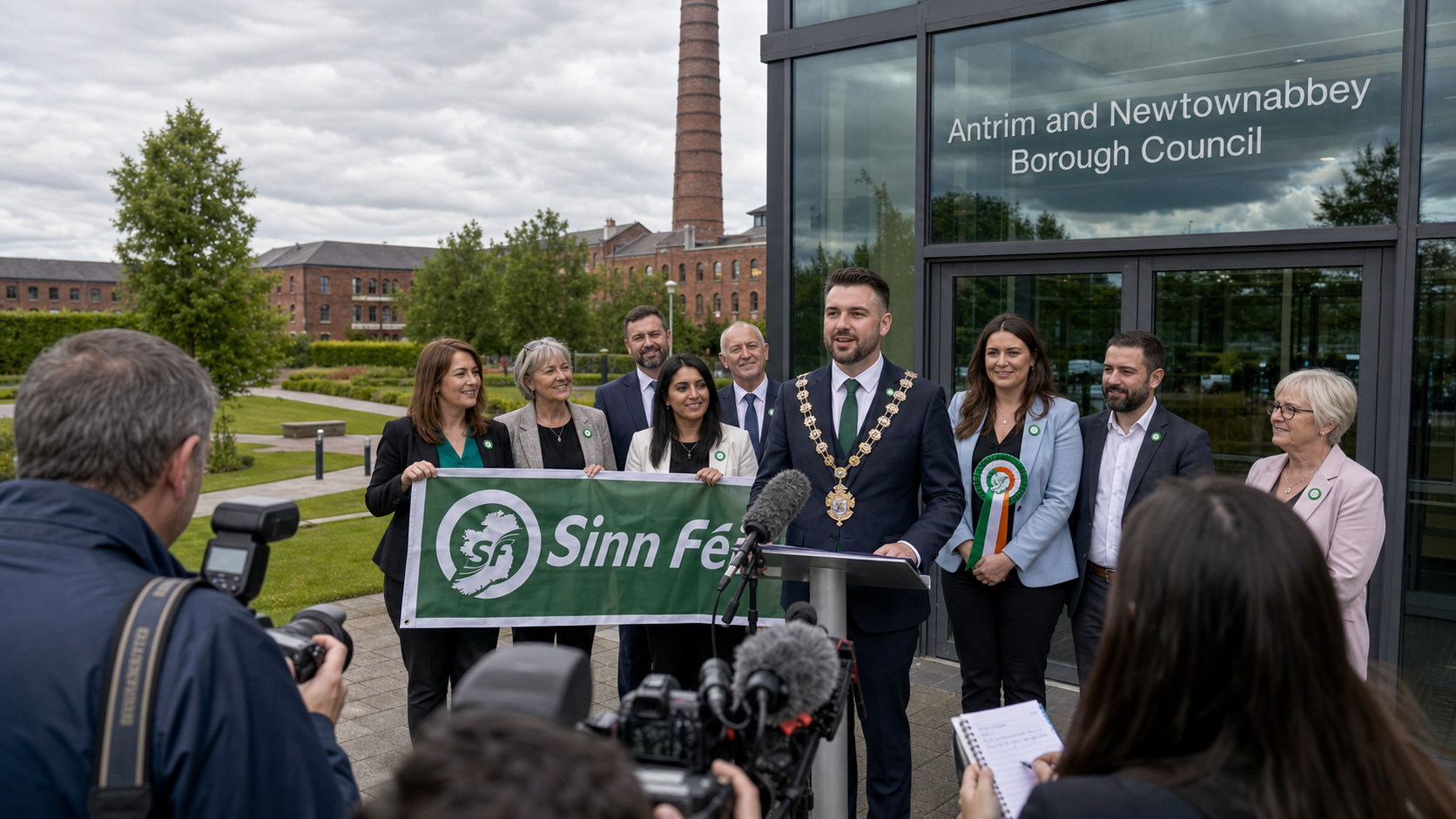
Sinn Féin has secured the mayoralty of Antrim and Newtownabbey Borough Council for the first time in the council's history, marking a significant milestone in the party's expansion beyond its traditional republican heartlands and reflecting the shifting electoral geography of a council area that encompasses some of Northern Ireland's most rapidly growing suburban and commuter communities.
Background
Antrim and Newtownabbey Borough Council was created in 2015 as part of the reform of local government in Northern Ireland, merging the former Antrim Borough Council and Newtownabbey Borough Council into a single authority covering a large swathe of County Antrim to the north and north-east of Belfast. The council area includes the town of Antrim, the suburban communities of Newtownabbey, Glengormley, Ballyclare, and Randalstown, and a significant rural hinterland stretching towards the shores of Lough Neagh.
The council area has historically been one of the most strongly unionist in Northern Ireland, with the DUP and Ulster Unionist Party dominating local politics since the council's creation. The demographic profile of the area — predominantly Protestant and unionist in its older established communities, with a growing proportion of younger, more diverse residents in the newer suburban developments — has been changing gradually, reflecting broader demographic trends across Northern Ireland.
Sinn Féin's electoral performance in Antrim and Newtownabbey has improved steadily over successive council elections, reflecting both the party's growing appeal to younger voters and the demographic changes in the council area. The 2023 local government elections saw Sinn Féin make significant gains in the council, positioning the party to compete for the mayoralty for the first time.
Key Developments
The election of a Sinn Féin mayor in Antrim and Newtownabbey represents a significant political achievement for the party, which has been working systematically to extend its reach into council areas that were previously considered unionist strongholds. The new mayor, whose election was confirmed at the council's annual general meeting, becomes the first Sinn Féin representative to hold the mayoralty in the council's history.
The achievement has been welcomed by Sinn Féin's leadership as evidence of the party's growing electoral breadth and its ability to win support from voters across the community divide. The party has pointed to its record in government at Stormont — where it holds the First Minister's office — as evidence that it can govern effectively for all communities, not just its traditional republican base.
Unionist parties on the council have responded with varying degrees of acceptance. The DUP, which has the largest number of seats on the council, has acknowledged the democratic outcome while making clear its intention to hold the new mayor to account on issues of concern to the unionist community. The Ulster Unionist Party has taken a more measured approach, congratulating the new mayor and expressing a willingness to work constructively with the new administration.
Why It Matters
The Sinn Féin mayoralty in Antrim and Newtownabbey matters for several reasons that go beyond the immediate political symbolism. It demonstrates that the party's electoral growth is not confined to areas with large nationalist or republican populations but is extending into mixed and predominantly unionist communities — a development that has significant implications for the long-term political balance in Northern Ireland.
The achievement also reflects the changing nature of Sinn Féin's electoral appeal. The party has worked hard in recent years to present itself as a party of government rather than a party of protest, emphasising its record in delivering public services and economic development rather than its traditional constitutional agenda. This repositioning appears to be resonating with a broader range of voters, including some who would not identify as nationalist or republican.
For unionist parties, the Sinn Féin mayoralty in Antrim and Newtownabbey is a wake-up call about the changing electoral landscape. The DUP in particular faces the challenge of maintaining its position as the dominant force in unionist politics while also adapting to a Northern Ireland in which the traditional community boundaries are becoming less determinative of voting behaviour.
Local Impact
For residents of Antrim and Newtownabbey, the change in the mayoralty is likely to have limited immediate practical impact — the mayor's role in Northern Ireland's council system is primarily ceremonial, with executive power resting with the council's chief executive and the elected members collectively. However, the symbolic significance of the change should not be underestimated in a society where political representation and recognition carry considerable weight.
The council area's communities — from the predominantly unionist estates of Newtownabbey to the more mixed communities of Antrim town and the rural areas around Lough Neagh — will be watching closely to see how the new mayor conducts the role and whether the Sinn Féin administration can demonstrate that it is genuinely committed to serving all communities in the council area.
What's Next
The new mayor will serve a one-year term, with the mayoralty expected to rotate among the council's parties in subsequent years. Sinn Féin has indicated that the new mayor will prioritise economic development, housing, and community relations during the term of office. The party is also expected to use the mayoralty as a platform to advance its broader political agenda in the council area, including its position on constitutional issues and its approach to cross-community relations. The next local government elections in Northern Ireland are scheduled for 2027, and the performance of the Sinn Féin administration in Antrim and Newtownabbey will be closely watched as an indicator of the party's prospects in that contest.