Simon Harris Signals Income Tax Threshold Rise in Budget 2027 as Government Targets 'Making Work Pay'
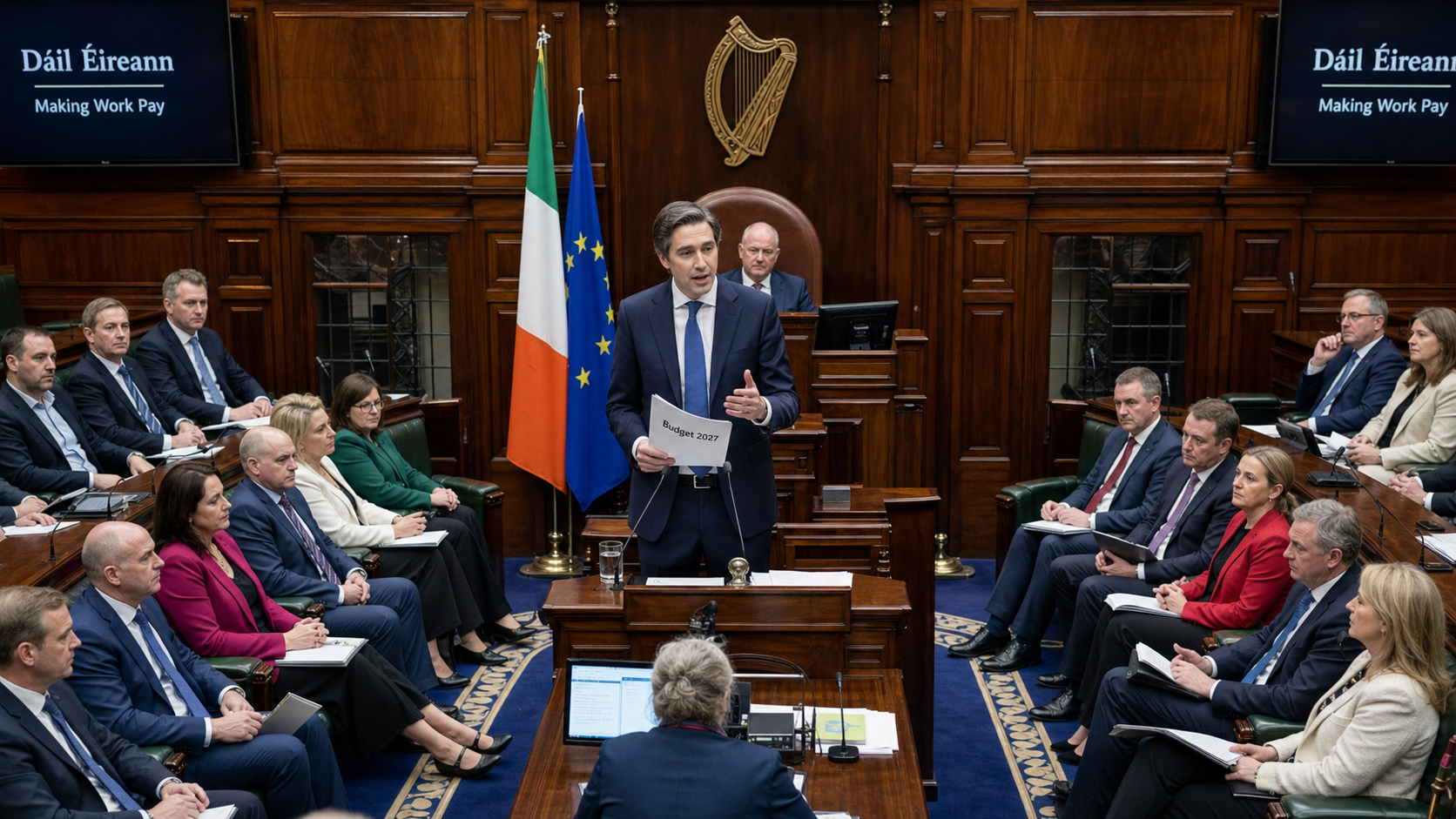
Taoiseach Simon Harris has indicated that Budget 2027 will deliver an increase in the income tax threshold, framing the measure as central to the government's commitment to ensuring that work pays for middle-income earners — a signal that comes as the government navigates a complex fiscal environment marked by significant departmental overspends and a projected overall budget of €125.5 billion.
Background
Income tax policy has been one of the most politically sensitive areas of Irish budgetary planning for more than a decade. The standard rate cut-off point — the income level at which workers begin paying the higher rate of income tax at 40% — has been a consistent focus of lobbying from business groups, trade unions, and opposition parties who argue that too many middle-income workers are paying the higher rate on too large a proportion of their earnings. The government has made incremental increases to the threshold in recent budgets, but critics argue that the pace of change has not kept up with wage growth, leaving workers effectively paying more tax in real terms even as nominal thresholds have risen.
The broader fiscal context for Budget 2027 is one of considerable complexity. The government is managing significant departmental overspends — including a €250 million HSE overrun in Q1 2026 and a €646 million education overspend — while also facing demands for increased investment in housing, health, and infrastructure. The projected overall budget spend of €125.5 billion represents a substantial increase on previous years, reflecting both the growth of the Irish economy and the expansion of public services.
Harris's signals on income tax come against this backdrop of fiscal pressure, and they represent a political choice: to prioritise tax relief for workers over additional public spending, or to find a balance between the two. The government's coalition partners — Fianna Fáil and the Green Party — have their own priorities for the budget, and the final package will reflect a negotiation between those competing demands.
Key Developments
Harris's income tax signal was accompanied by a separate announcement on rural housing policy that he described as the most significant change in two decades. The proposed overhaul would remove caps on the number of homes that can be built on family farm holdings in rural areas — a change that has been sought by rural communities and farming organisations for many years, and that Harris framed as a response to the housing crisis that goes beyond the urban focus of most housing policy debate.
The rural housing announcement carries a named ministerial commitment and a clear policy direction, making it one of the more concrete pre-budget signals to emerge from government in recent months. The detail of how the cap removal would work in practice — including planning requirements, design standards, and the relationship with existing rural planning guidelines — is expected to be set out in a formal policy document before the end of the summer.
On the broader budget, Harris indicated that the government's approach would be guided by the principle of making work pay — a phrase that has become something of a political touchstone for Fine Gael, reflecting the party's traditional emphasis on rewarding enterprise and employment. The income tax threshold increase, if delivered, would benefit workers across the income spectrum, though the gains would be proportionally larger for those earning above the current threshold.
Why It Matters
Budget signals from a Taoiseach carry significant weight, even when they are framed as indications rather than commitments. Harris's income tax signal will be read by workers, employers, and financial planners as a strong indication of the direction of travel for October's budget. The rural housing announcement is potentially more immediately significant: the removal of caps on farm-holding development could unlock a significant supply of rural housing in counties across Connacht, Munster, and Ulster, addressing a shortage that has been particularly acute in areas where young people are leaving because they cannot afford to build or buy locally. The combination of income tax relief and rural housing reform represents a coherent political narrative for Fine Gael — one that positions the party as the champion of working people and rural communities ahead of the next general election cycle.
Local Impact
The income tax threshold increase, if delivered, will benefit workers across the country, but its impact will be felt most acutely by those earning between €40,000 and €60,000 — a bracket that includes many public sector workers, teachers, nurses, and Garda members. In Dublin, where the cost of living is highest, the relief will be welcome but may be insufficient to address the fundamental affordability challenges facing workers in the capital. In rural counties — Roscommon, Leitrim, Longford, Cavan — the rural housing announcement may have a more transformative effect, potentially enabling families to build homes on land they already own and reversing the pattern of rural depopulation that has been a persistent concern for decades. Bus Éireann and Irish Rail connections to rural areas will also be relevant to the housing discussion, as the viability of rural living depends in part on transport connectivity.
What's Next
Budget 2027 is expected to be presented to the Dáil in October, following the traditional pre-budget consultation process over the summer months. The Department of Finance will publish its summer economic statement in July, setting out the fiscal parameters within which the budget will be framed. The rural housing policy document is expected before the end of August. Coalition negotiations on the budget package are expected to intensify after the Dáil summer recess, with Fianna Fáil and the Green Party both seeking to secure their own priorities in the final package.