Seán Farrell Wins John McGahern Prize for Debut Novel Frogs for Watchdogs, Praised as 'Pitch-Perfect'
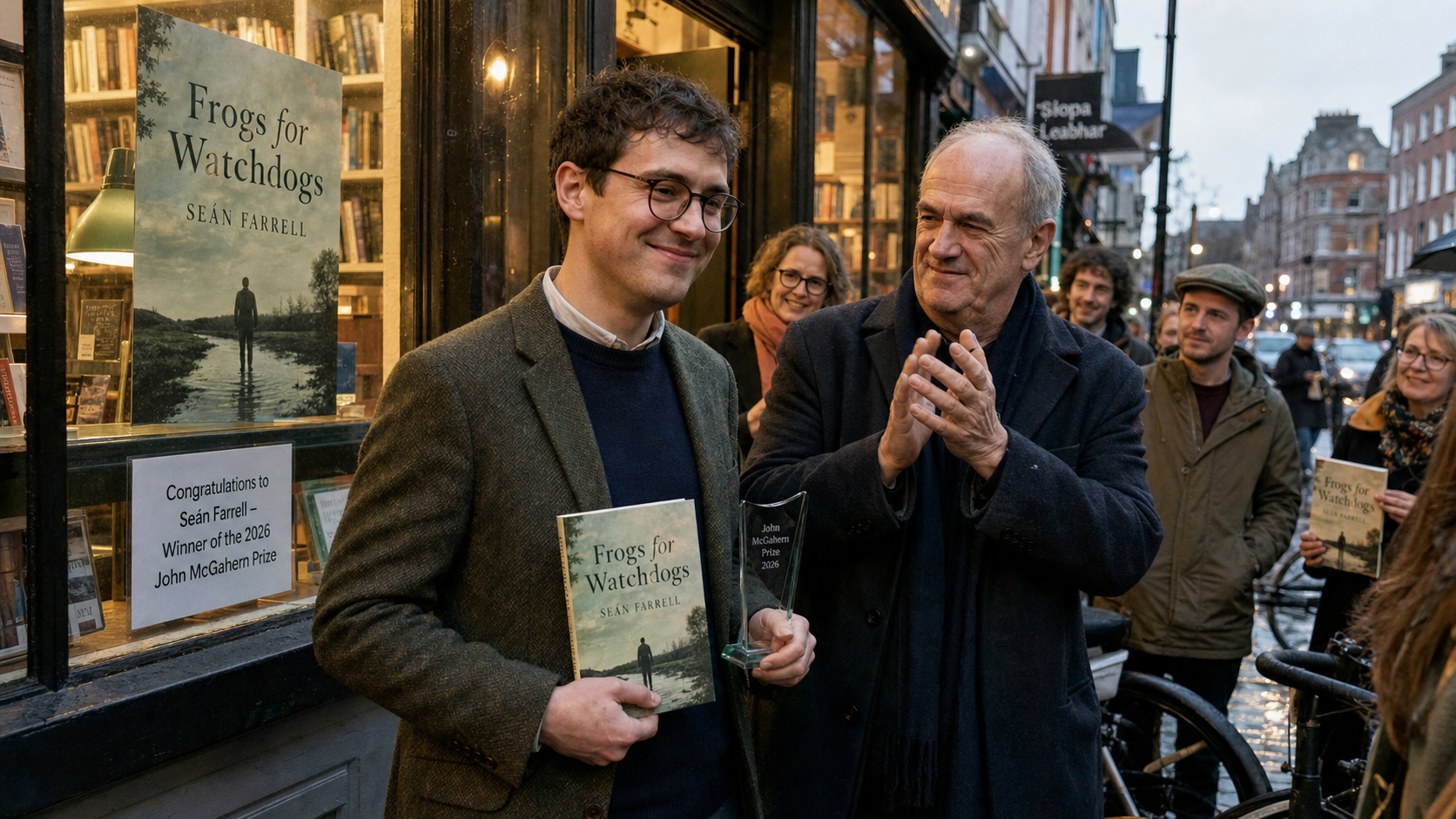
Seán Farrell has won the 2026 John McGahern Annual Book Prize for his debut novel Frogs for Watchdogs, a meticulous study of a young boy's inner life in rural County Meath in the late 1980s, with judge Colm Tóibín praising the work as "pitch-perfect, tonally seamless, and utterly immersive" — a verdict that has immediately elevated Farrell to the front rank of emerging Irish fiction writers.
Background
The John McGahern Annual Book Prize, administered by the University of Liverpool's Institute of Irish Studies, is one of the most prestigious awards available to debut Irish fiction writers. Named in honour of John McGahern — the Leitrim-born novelist whose work, including The Barracks, The Dark, and Amongst Women, is widely regarded as among the finest Irish fiction of the twentieth century — the prize carries a value of £5,000 and is awarded annually to the best debut novel or short story collection by an Irish writer or a writer resident in Ireland.
The prize has a particular significance because of its connection to McGahern's own literary values: a commitment to precision of language, psychological depth, and the faithful rendering of Irish rural life in all its complexity and beauty. McGahern's fiction was characterised by an unflinching honesty about the interior lives of his characters and by a prose style of extraordinary economy and power, and the prize that bears his name seeks to recognise work that carries forward those qualities in contemporary Irish fiction.
Farrell's debut novel Frogs for Watchdogs was selected from a shortlist that also included Water in the Desert, Fire in the Night by Gethan Dick and Every One Still Here by Liadan Ní Chuinn — a strong field that reflects the vitality of contemporary Irish debut fiction.
Key Developments
In his assessment of Frogs for Watchdogs, judge Colm Tóibín — himself one of the most celebrated Irish novelists of his generation — described the novel as "pitch-perfect, tonally seamless, and utterly immersive," further characterising it as "a meticulous and intense study of the inner life of a young boy." The novel is set in rural County Meath in the late 1980s and follows a young, observant protagonist navigating the complex dynamics of his family and community during a period of significant social change in Ireland.
Tóibín's praise is significant not merely because of his stature as a literary judge but because of the specific qualities he identifies in the novel. "Pitch-perfect" and "tonally seamless" are precisely the qualities that McGahern himself exemplified, and the suggestion that Farrell has achieved these qualities in a debut novel is a remarkable endorsement. The comparison to McGahern's own early work — which was also set in rural Ireland and focused on the interior lives of young protagonists — is implicit but unmistakable.
Farrell will receive the £5,000 prize and is scheduled to read from his work at the Liverpool Literary Festival on October 18, 2026, as part of the award conditions. The prize is expected to generate significant interest in Frogs for Watchdogs from readers and publishers internationally, with translation rights likely to attract attention following the announcement.
Why It Matters
The John McGahern Prize is one of the clearest signals available in Irish literary culture that a debut writer has produced work of genuine and lasting significance. Previous winners have gone on to establish themselves as major figures in Irish and international fiction, and the prize's association with McGahern's name gives it a weight that few comparable awards can match. For Farrell, the recognition comes at a critical moment in a debut writer's career — the period immediately after publication when critical attention can make the difference between a novel finding its audience and disappearing without trace.
The setting of Frogs for Watchdogs in rural County Meath in the late 1980s places it in a rich tradition of Irish fiction that uses the specific textures of rural life to explore universal themes of family, identity, and the formation of the self. This is precisely the territory that McGahern mapped so memorably in his own work, and Tóibín's assessment suggests that Farrell has found his own distinctive voice within that tradition rather than merely imitating his predecessors.
Local Impact
In County Meath, where the novel is set, the prize has been welcomed as recognition of the literary richness of a county that is perhaps better known for its ancient monuments — Newgrange, the Hill of Tara, the Battle of the Boyne site — than for its contemporary cultural output. The novel's evocation of rural Meath life in the late 1980s will resonate with readers who grew up in the county during that period, and the prize is expected to generate local pride and interest in Farrell's work. The Meath County Library Service has indicated that it will be stocking the novel prominently in its branches across the county.
What's Next
Seán Farrell will read from Frogs for Watchdogs at the Liverpool Literary Festival on October 18, 2026. The novel is expected to be widely reviewed in the coming weeks following the prize announcement, and Farrell is likely to be invited to appear at a number of Irish literary festivals in the autumn season, including the Dublin Book Festival and the Ennis Book Club Festival. His publisher has indicated that a second novel is already in progress, and the literary community will be watching with considerable interest to see how Farrell develops following this remarkable debut.