'Stations' by Louise Kennedy: A Debut Novel That Announces a Major New Voice in Irish Fiction
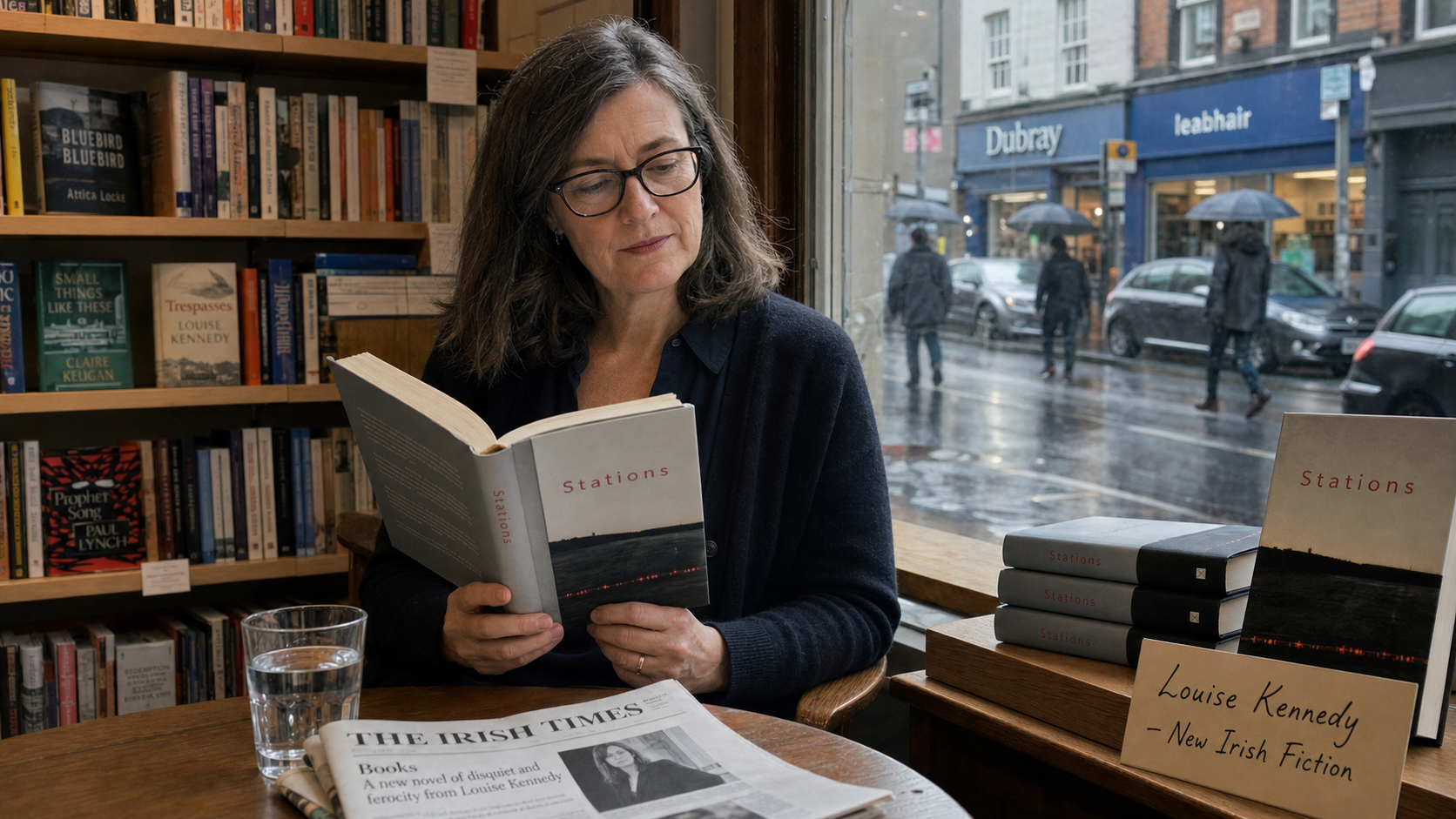
Irish author Louise Kennedy's debut novel Stations has been hailed as a masterwork by the Irish Times, with critics describing her as the heir to Edna O'Brien's "agile indignation" — a comparison that places Kennedy in the most distinguished company in Irish literary history and signals the arrival of a major new voice in Irish fiction at a moment when the country's literary culture is in particularly vibrant health.
Background
Louise Kennedy is a Holywood, County Down-born writer who came to fiction relatively late, having worked as a chef for many years before turning to writing in her forties. Her short story collection, The End of the World Is a Cul de Sac, published in 2021, announced her as a writer of exceptional talent — precise, unsentimental, and deeply attuned to the textures of Irish life, particularly in the north of Ireland and in the borderlands between the Republic and Northern Ireland. The collection won the Sunday Times Audible Short Story Award and was longlisted for the Edge Hill Short Story Prize, establishing Kennedy as one of the most exciting new voices in Irish fiction.
Stations is Kennedy's first novel, and it has been anticipated with considerable excitement by readers and critics who were captivated by the short stories. The novel is set in rural Ireland and explores themes of faith, community, moral compromise, and the weight of the past — territory that is deeply familiar in Irish fiction but that Kennedy approaches with a freshness and precision that makes it feel entirely new. The comparison to Edna O'Brien — one of the greatest Irish writers of the 20th century, whose work was characterised by its unflinching examination of women's lives and its fierce moral intelligence — is not made lightly by the Irish Times, and it reflects the scale of the achievement that Stations represents.
The novel arrives at a moment when Irish fiction is enjoying a period of extraordinary vitality. Writers like Sally Rooney, Claire Keegan, Donal Ryan, and Kevin Barry have brought Irish fiction to global attention in recent years, and Kennedy's emergence as a major talent adds another significant name to a list that is already remarkable for its depth and diversity.
Key Developments
The Irish Times review of Stations, published this week, describes the novel as "a masterwork from the heir to Edna O'Brien's agile indignation" — a formulation that captures both the quality of the writing and the moral seriousness that underpins it. The review praises Kennedy's prose style — spare, precise, and capable of extraordinary emotional resonance — and her ability to render the complexity of Irish rural life without sentimentality or condescension.
The novel has also attracted significant attention from publishers and literary agents in the United Kingdom and the United States, where Kennedy's short story collection had already established a following. Rights deals for Stations are understood to have been concluded in several major markets, suggesting that the novel will reach a global audience in the coming months.
Kennedy has spoken in interviews about the experience of writing a novel after years of working in short fiction, describing the transition as both liberating and demanding. The longer form allowed her to develop characters and situations with a depth that the short story does not permit, but it also required a different kind of discipline and a willingness to sustain a narrative over a much longer arc.
Why It Matters
The emergence of Louise Kennedy as a major Irish novelist matters for Irish literary culture for several reasons. First, it demonstrates that the tradition of Irish fiction — which has produced some of the greatest writers in the English language, from James Joyce and Samuel Beckett to Edna O'Brien and Colm Tóibín — continues to renew itself through the work of new writers who bring fresh perspectives and fresh voices to enduring themes. Second, Kennedy's background — a late starter who came to fiction after a career in a completely different field — is an inspiring story that challenges the assumption that literary talent must be identified and nurtured from an early age. Third, the comparison to Edna O'Brien places Kennedy in a tradition of Irish women writers who have used fiction to examine the lives of women in Ireland with a honesty and moral courage that has sometimes made them controversial but has always made them essential.
The autumn awards season — which includes the Booker Prize, the Irish Book Awards, and a range of other major literary prizes — will provide the next test of Stations' standing. If the critical reception is matched by awards recognition, Kennedy's position as one of the most important Irish writers of her generation will be firmly established.
Local Impact
In Holywood, County Down, where Kennedy grew up, the success of Stations has been received with pride and excitement. The town has a strong literary culture — it is also the birthplace of the poet Michael Longley — and Kennedy's emergence as a major novelist adds to its literary heritage. In Belfast, where Kennedy has lived and worked, the literary community has been enthusiastic in its support for her work, and Stations is expected to be a prominent title in the city's bookshops and libraries in the weeks ahead. The novel's themes — faith, community, and the weight of the past in rural Ireland — will resonate with readers across the island, and its publication is expected to generate significant discussion in book clubs, literary festivals, and cultural events throughout the autumn.
What's Next
Stations is published this week and is available in bookshops across Ireland and the United Kingdom. Kennedy is expected to undertake a programme of readings and events in the coming weeks, including appearances at the Dublin Theatre Festival and at literary events in Belfast, Cork, and Galway. The novel will be submitted for consideration for the major autumn literary prizes, and its chances of recognition are regarded as strong by those who have read it. A paperback edition is expected to follow in spring 2027, which will broaden the novel's reach to a wider readership.