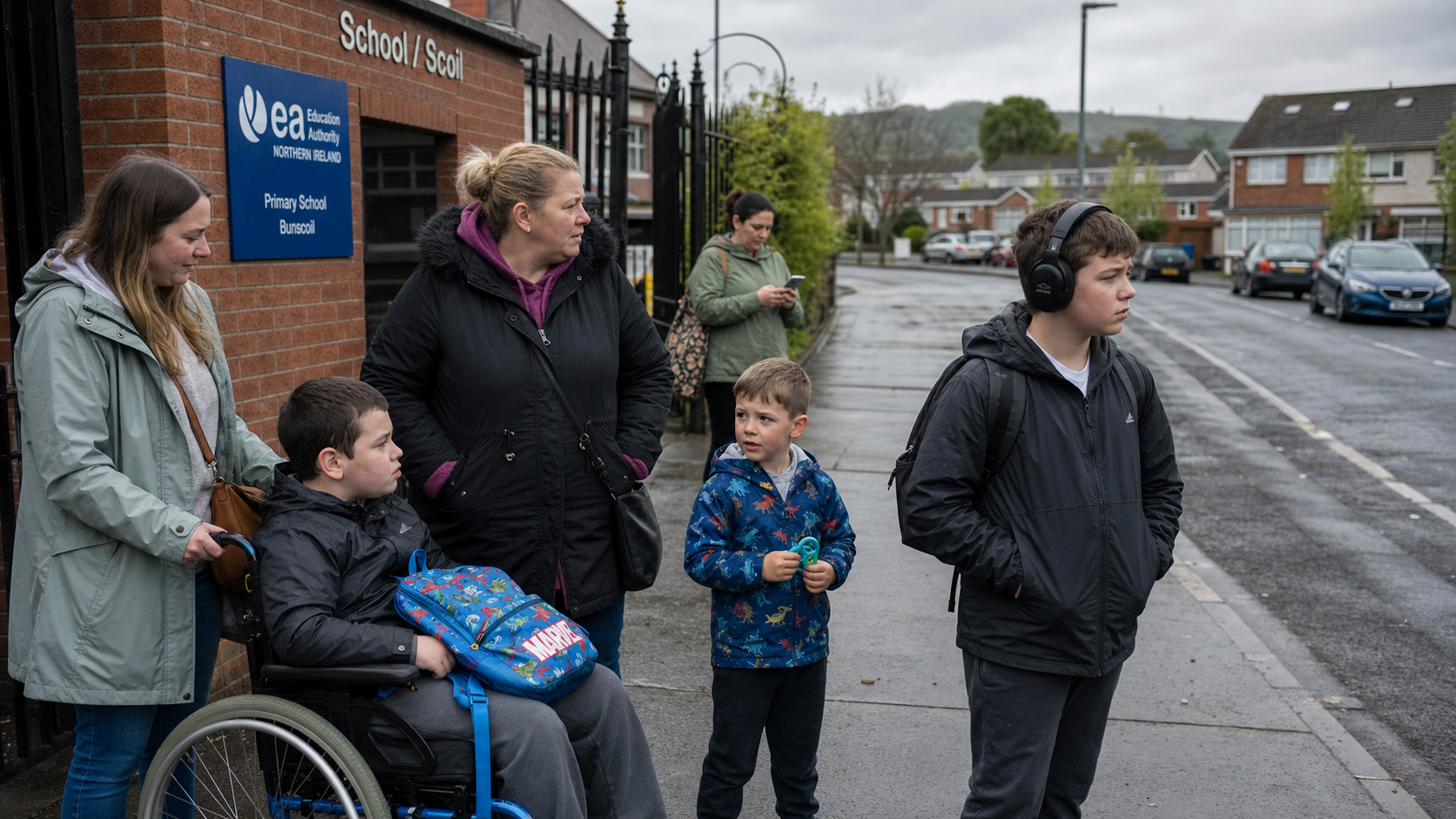
SEN Taxi Uncertainty Leaves Families 'Heartbroken' as New School Year Looms for Vulnerable Children
Families of children with special educational needs across Northern Ireland are entering the new school year in a state of deep anxiety, with parents describing the Education Authority's handling of the SEN taxi transport situation as 'hurtful and frustrating', as the authority's cost-cutting measures have left some of the most vulnerable children in the system facing uncertainty over how they will get to school.
Background
The provision of taxi transport for pupils with special educational needs has become one of the most contentious and costly elements of the Education Authority's budget in recent years. Over the past decade, the number of children in Northern Ireland with a statutory statement of SEN has risen by approximately 85%, reaching more than 34,000 pupils by early 2026. This surge in demand has driven a corresponding increase in the cost of specialist transport, with annual expenditure on school taxi fares doubling since the 2020-21 academic year to reach nearly £40 million.
The Education Authority, which is facing a projected funding shortfall of approximately £300 million, has been seeking ways to reduce this expenditure. Earlier in 2026, the authority issued a directive to taxi operators requesting a voluntary 10% reduction in their rates, warning that contracts could be terminated and routes re-tendered for those who refused. The move provoked immediate opposition from operators, who argued that many had not raised their fares in six years and were already operating at the margins of viability.
For parents of children with SEN, the prospect of any disruption to transport arrangements is not merely an inconvenience — it can be genuinely destabilising for children whose conditions make routine and familiarity essential to their wellbeing. Many children with autism, for example, develop strong attachments to specific drivers and specific routes, and any change can trigger significant distress.
Key Developments
As the new school year begins, a number of families have reported that they have not received confirmation of their children's transport arrangements, leaving them unable to prepare their children for the return to school. Columba Mailey, whose daughter relies on SEN taxi transport, described the situation as "hurtful and frustrating", telling BBC NI that "familiarity with the driver is crucial" for his daughter's ability to manage the school day. Without that certainty, he said, the family had been left in a state of limbo that was affecting the entire household.
The Education Authority has acknowledged the difficulties and has said it is working to resolve outstanding transport arrangements as quickly as possible. However, the authority has also been clear that it cannot continue to fund the current level of expenditure without significant reform, and Education Minister Paul Givan has indicated that the long-term solution lies in increasing the provision of specialist SEN support within mainstream schools, reducing the need for children to travel long distances to access appropriate education.
Why It Matters
The SEN transport crisis is a symptom of a much deeper problem: the chronic underfunding of special educational needs provision in Northern Ireland. The 85% increase in the number of children with statutory SEN statements over the past decade reflects both a genuine rise in need and an improved ability to identify and diagnose conditions that might previously have gone unrecognised. But the system has not kept pace with this growth, and the result is a service that is stretched to breaking point.
The Education Authority's approach — seeking to reduce costs by pressuring taxi operators — addresses the symptom rather than the cause. The fundamental issue is that too many children are travelling too far to access specialist provision because that provision is not available locally. Until the government invests in building specialist capacity within mainstream schools across Northern Ireland, the demand for long-distance SEN transport will remain high, and the associated costs will continue to grow.
Local Impact
The impact of the uncertainty is being felt across Northern Ireland, from Belfast to rural areas in Fermanagh, Tyrone, and Armagh where children may travel significant distances to reach specialist schools. In areas served by the Western Education and Library Board and the Southern Education and Library Board, where specialist provision is more geographically dispersed, the disruption has been particularly acute. Parents' groups, including SEN Reform NI, have called on the Education Authority to provide immediate clarity to all affected families and to commit to a moratorium on any further changes to transport arrangements until a comprehensive review of SEN provision has been completed.
What's Next
The Education Authority has said it expects to have all outstanding transport arrangements confirmed within the coming days. Education Minister Paul Givan is expected to make a statement to the Assembly on the broader SEN transport situation when Stormont returns from recess. The minister has indicated that a consultation on the future of SEN provision in Northern Ireland — including the question of how specialist support can be delivered more locally — will be launched before the end of the year. For families currently waiting for confirmation of their children's transport, however, the immediate priority is simply knowing that their child will be able to get to school.