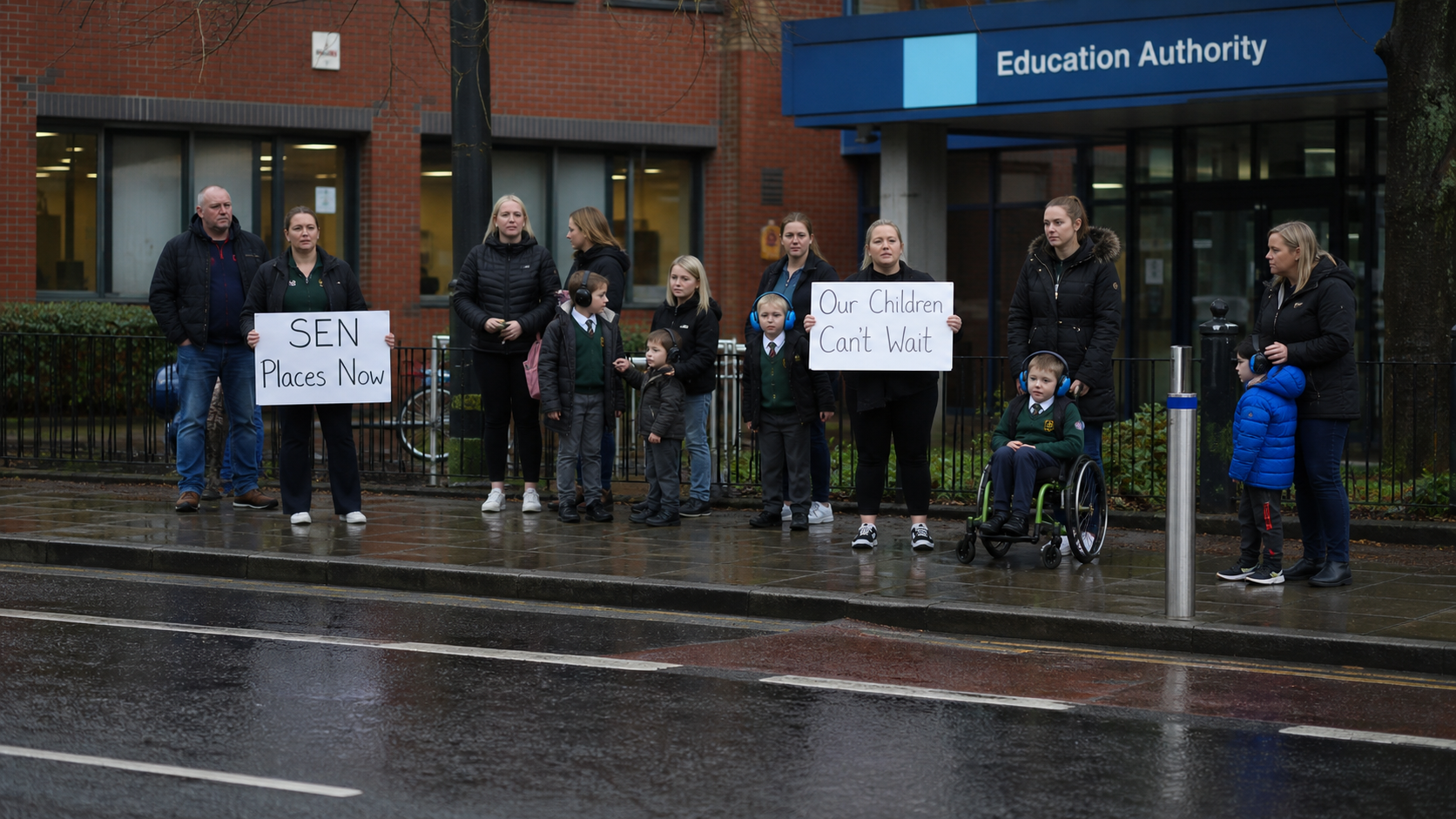
SEN Parents 'Frustrated and Anxious' as Northern Ireland's Special Needs Education Crisis Deepens Amid 50% Surge in Demand
Parents of children with Special Educational Needs across Northern Ireland have described their experiences of the annual school placement process as deeply distressing, as the Education Authority confirms that demand for SEN places has risen by more than 50 per cent over the past five years — a surge that has consistently outpaced the creation of new provision and left the system, in the EA's own words, "running out of road."
Background
Special Educational Needs provision in Northern Ireland operates through a combination of special schools, specialist units within mainstream schools, and mainstream placements with additional support. The Education Authority is responsible for assessing children's needs, issuing Statements of Special Educational Needs, and securing appropriate placements — a process that, in theory, should result in every child having a confirmed school place well before the start of the academic year.
In practice, the system has been under severe strain for several years. The number of children with Statements of SEN has grown substantially, driven by a combination of factors including improved diagnostic practices, greater awareness of conditions such as autism spectrum disorder and ADHD, and genuine increases in the prevalence of complex needs among the school-age population. The EA has created more than 6,000 additional SEN places since 2020, but demand has consistently outpaced supply, leaving a residual shortfall that is resolved — often at the last minute — through intensive engagement with individual schools.
The annual cycle of uncertainty has become a source of significant anxiety for families. Parents describe spending the summer months not knowing whether their child will have a school place in September, unable to make childcare arrangements, plan transport, or prepare their child for the transition. For children with complex needs, uncertainty about school placement can itself be destabilising, with consequences for behaviour and wellbeing that extend into the academic year.
Key Developments
The Education Authority confirmed this week that it has secured more than 4,400 school placements for children with SEN for the 2026-27 academic year. As of early September, the number of outstanding placements was described as fewer than 15 — a significant improvement on the position in May, when a shortfall of approximately 350 placements had been identified. The EA engaged with more than 400 mainstream schools during the summer, resulting in 101 schools establishing new or pathway classes for September 2026, including 49 schools that had no prior specialist provision.
However, the EA has acknowledged that some of the placements secured are "less than ideal" — instances where children have been placed in specialist provision rather than special schools, or where travel outside their local neighbourhood is required. For families in rural areas of Antrim, Fermanagh, and Tyrone, long daily journeys to access appropriate provision are a significant burden. The EA has also expressed frustration that some schools in areas of high need have "stonewalled" efforts to introduce specialist provision, placing a disproportionate burden on a minority of schools willing to accommodate children with complex needs.
BBC NI has reported that parents across the province have described the annual process as causing "significant distress," with families feeling that the system treats their children's needs as an afterthought rather than a statutory obligation. The EA has acknowledged the criticism and indicated that systemic reform is necessary to address needs at an earlier stage in the annual cycle.
Why It Matters
The SEN placement crisis is a symptom of a broader failure to plan adequately for the needs of a growing and changing school-age population. The 50 per cent increase in demand over five years was not unpredictable — the diagnostic trends that drive it have been visible for a decade. Yet the system's capacity has not kept pace, leaving families to absorb the consequences of institutional under-preparation in the form of annual uncertainty and last-minute scrambles.
The contrast with the Republic of Ireland is instructive. The HSE and Department of Education in the South have also struggled with SEN provision, but the introduction of the NCSE's school inclusion model and the expansion of autism classes in mainstream schools have provided a more structured framework for managing demand. Northern Ireland's devolved education system has not developed an equivalent strategic response, leaving the EA to manage a crisis that is structural rather than incidental.
For children with complex needs, the quality of their school placement is not a peripheral concern — it is foundational to their development, their wellbeing, and their long-term life outcomes. A system that routinely fails to confirm placements until weeks before the start of term is not meeting its statutory obligations to some of the most vulnerable children in Northern Ireland.
Local Impact
The impact of the SEN placement crisis is felt most acutely in areas where special school capacity is limited and mainstream schools have been slow to develop specialist provision. In parts of Fermanagh and Tyrone, families report travelling significant distances to access appropriate placements, with some children spending more than an hour each way on school transport. In Belfast, the concentration of special schools in certain areas of the city means that children from north and east Belfast may be placed in schools far from their home communities. The Education Authority's Derry and Strabane office has been working with schools in the north-west to develop additional provision, but progress has been slower than families and advocacy groups would like.
What's Next
The Education Authority has indicated that it will publish a review of SEN provision in Northern Ireland before the end of 2026, setting out proposals for expanding capacity and reforming the annual placement process. The review is expected to address the role of mainstream schools in providing specialist provision, the adequacy of funding for SEN support, and the need for earlier identification and assessment of children's needs. Education Minister Paul Givan has indicated that additional capital funding for special school expansion will be sought as part of the budget discussions currently under way at Stormont.