Russia Strikes Ukraine as Colombia Bus Bomb Kills 13 in Deadly Weekend of International Violence
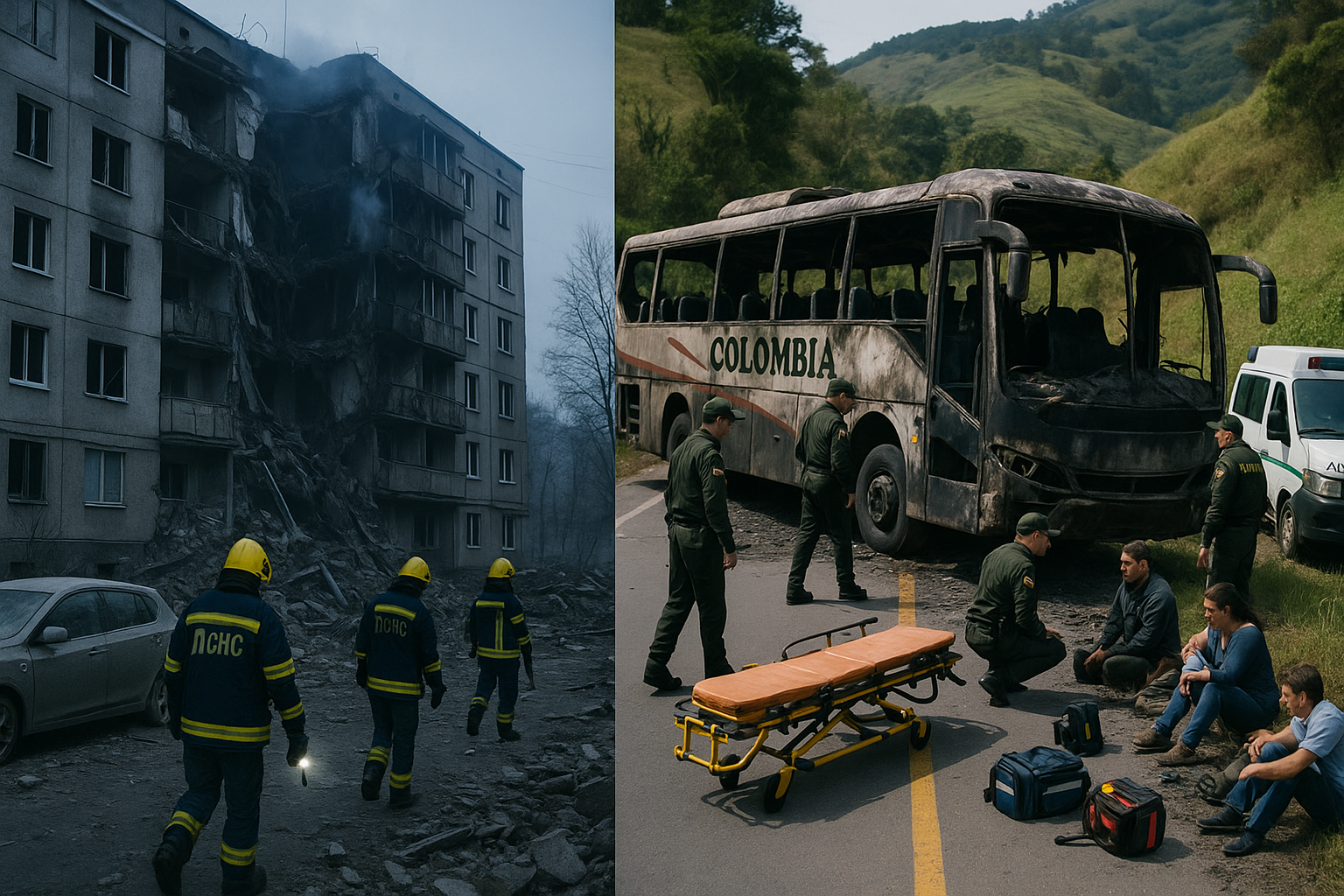
A deadly weekend of international violence saw Russian drone and missile strikes kill at least 16 people across Ukraine while a bomb attack on a bus in Colombia claimed at least 13 lives and injured 38 others including five children — two geographically distant atrocities that together underscored the brutal and persistent nature of multiple simultaneous global conflicts.
The Russian strikes, which targeted the cities of Dnipro, Chernihiv, Odesa, and Kharkiv, involved a combination of Shahed drones and cruise and ballistic missiles in a strategy designed to exhaust Ukraine's air defence systems. In Colombia, a bus laden with explosives was detonated on the Pan-American Highway in the department of Cauca, with FARC dissident factions blamed for the attack by President Gustavo Petro.
Background
By April 2026, the war in Ukraine had settled into a pattern of attritional warfare, with a relatively stable front line but a relentless Russian campaign of aerial bombardment targeting civilian infrastructure and residential areas. Russia's strategy has involved large-scale strikes to terrorise the population and degrade Ukraine's energy and transport networks, while its ground forces have made only marginal gains at enormous cost. Ukraine has responded with long-range drone strikes on strategic targets deep within Russian territory, impacting oil production and military logistics.
In Colombia, the 2016 peace accord with the FARC did not end violence. Dissident groups who rejected the deal continue to operate, funding their insurgency through drug trafficking and illegal mining. These groups, particularly the faction led by Néstor Gregorio Vera — known as "Iván Mordisco" — represent a major security challenge to the Colombian state and its "Total Peace" policy, frequently targeting both military and civilian objectives to assert control over valuable territory in the country's southwest.
Key Developments
In Dnipro, Russian forces employed a particularly callous "double-tap" tactic, striking a residential area and then hitting the same location again as first responders arrived at the scene — a war crime under international humanitarian law. The city suffered a prolonged attack that killed at least nine people and injured over 45. Ukrainian President Volodymyr Zelenskyy reiterated urgent calls for international partners to supply more advanced air defence systems to protect civilians.
The Colombia bus bombing occurred in the El Túnel sector of Cajibío on 25 April, killing at least 13 people — with some reports citing a higher toll of 20 — and wounding 38 others, including five children. The victims were civilians travelling on the crucial Pan-American Highway. President Petro condemned the perpetrators as "terrorists, fascists and drug traffickers" and ordered an increased military and police presence in the region. The attack was seen as part of a wider campaign by the dissidents to disrupt peace talks and retaliate against government pressure on their criminal operations.
The United Nations High Commissioner for Human Rights condemned the Colombia bombing and called for a thorough investigation and justice for the victims. President Petro also sought cooperation with neighbouring Venezuela to combat transnational criminal groups operating along their shared border.
Why It Matters
The juxtaposition of these two attacks — one in Eastern Europe, one in South America — is a reminder that the world is simultaneously managing multiple serious conflicts, each with its own complex history and dynamics. The international community's capacity to respond to all of them simultaneously is being stretched, and there is a real risk that conflicts in one region receive less attention and resources because of crises elsewhere.
For Ukraine, the continued Russian bombardment of civilian areas represents an ongoing humanitarian catastrophe. The "double-tap" tactic used in Dnipro is particularly alarming, as it is specifically designed to kill the emergency responders who rush to help the initial victims — a deliberate targeting of those trying to save lives. For Colombia, the bus bombing represents a setback for the peace process and a reminder of the enormous challenges involved in ending decades of armed conflict.
Local Impact
For the United Kingdom, both conflicts carry direct implications. The UK has been one of Ukraine's most steadfast supporters, providing military aid, training, and diplomatic backing, and the continued Russian bombardment of civilian areas will intensify pressure on the government to do more. The Colombia bombing, while more distant, affects UK interests through its impact on drug trafficking routes and the broader stability of Latin America.
The weekend's violence also serves as a sobering context for the domestic political debates in the UK about defence spending, foreign aid, and the country's role in the world. With Reform UK calling for a more isolationist foreign policy and the government under pressure on multiple fronts, the case for sustained international engagement has rarely been more important to make.
What's Next
In Ukraine, the focus will be on rebuilding damaged infrastructure and pressing international partners for more air defence capabilities. In Colombia, the government faces the difficult task of responding to the attack without derailing the broader peace process. As CNN reports, the Colombia bombing has prompted urgent calls for a renewed security response in Cauca. The Institute for the Study of War's assessment of the Russian offensive provides detailed analysis of the military situation in Ukraine.