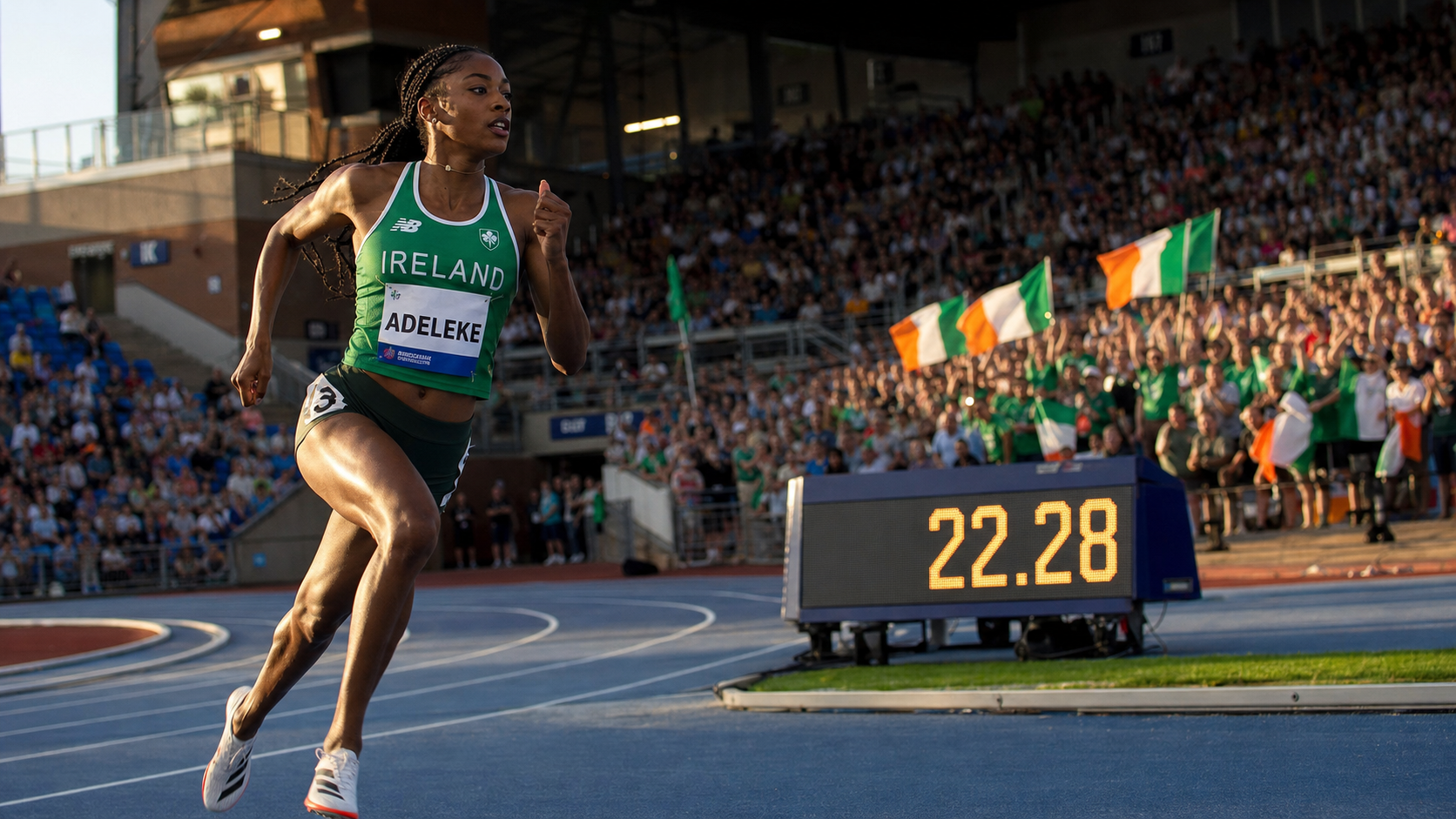
Rhasidat Adeleke Wins Historic European 200m Silver with New Irish Record in Birmingham
Rhasidat Adeleke delivered one of the finest performances in Irish athletics history on Thursday evening, claiming silver in the women's 200m final at the European Athletics Championships in Birmingham with a new Irish national record of 22.28 seconds — becoming the first Irish athlete to win a European Championship medal in the event and completing an extraordinary double for Irish athletics alongside Mark English's gold in the 800m.
Background
Adeleke's road to Birmingham was anything but straightforward. The 23-year-old Tallaght native, who represents Ireland having previously competed for the United States at underage level, endured a difficult 2025 season hampered by hamstring and hip injuries that disrupted her training and confidence. Her early 2026 campaign was similarly inconsistent, and she failed to meet the qualifying standard for the 200m at a meeting in Lucerne in June.
The turning point came at the Irish National Championships in Santry, where Adeleke produced a performance of sufficient quality to earn her European Championships selection in the 200m — the event she has always described as her "first love." The decision to focus on the shorter sprint rather than the 400m, in which she won silver at the 2024 European Championships in Rome, proved inspired.
Adeleke arrived in Birmingham with a point to prove, and the Alexander Stadium provided the perfect stage. Her semi-final performance — a season's best of 22.43 seconds — confirmed she was in the form of her life, and she carried that momentum into the final with a composure that belied her difficult season.
Key Developments
In the final, Adeleke drew lane six and produced a powerful, technically excellent run that saw her close strongly over the final 60 metres. Great Britain's Amy Hunt, competing on home soil, won the race in 22.19 seconds to complete a sprint double, while Adeleke's 22.28 seconds secured silver ahead of Dina Asher-Smith, who took bronze in 22.29 seconds — a margin of just one hundredth of a second separating silver from bronze.
The new Irish record of 22.28 seconds surpassed the previous mark and confirmed Adeleke's status as one of the fastest women in European sprint history. Her achievement also made her only the second Irish athlete — after Sonia O'Sullivan — to win European Championship medals in two different individual disciplines, following her 400m silver in Rome two years ago.
After the race, Adeleke spoke with characteristic warmth and honesty about the journey that had brought her to the podium. "It's been a tough year," she said. "But I believed in myself and I kept working. To be on this podium means everything."
Why It Matters
Adeleke's silver is historic in the most literal sense: no Irish athlete had previously won a European Championship medal in the 200m. The achievement places her in rarefied company and confirms that Irish sprinting — long considered a secondary discipline behind middle-distance running — has arrived at the highest level of European competition. Her record of 22.28 seconds is a benchmark that will stand as a target for Irish sprinters for years to come.
The broader significance of Thursday evening cannot be overstated. English's gold and Adeleke's silver on the same night represents the most successful single session for Irish athletics at a European Championships in the modern era. It is a moment that will be replayed and celebrated for decades, a reminder of what Irish athletics can achieve when talent, preparation, and determination align.
For young Irish sprinters watching from home, Adeleke's story — of injury, setback, and ultimate triumph — is as instructive as it is inspiring. She did not arrive at the podium despite her difficulties; she arrived because of how she responded to them.
Local Impact
In Tallaght, where Adeleke grew up and first developed her love of sprinting, the reaction to her silver medal was one of enormous pride. The Tallaght Athletics Club, which played a formative role in her development, celebrated the achievement as a reflection of the quality of coaching and support available in the community. Dublin Athletics Board noted that Adeleke's success would inspire a new generation of young sprinters across the capital's athletics clubs, from Clonliffe Harriers to Raheny Shamrocks.
Athletics Ireland confirmed that Adeleke would be honoured at a national celebration event following the conclusion of the European Championships, with the governing body describing Thursday evening as a landmark in the history of Irish athletics.
What's Next
Adeleke will complete her European Championships programme before returning to Ireland for a period of rest and recovery. Her autumn schedule is expected to include Diamond League appearances, where her new Irish record will attract invitations to the sport's most prestigious meetings. Looking further ahead, the 2027 World Athletics Championships in Tokyo represents the next major target, with Adeleke now firmly established as a genuine medal contender in both the 200m and 400m. The question of which event she prioritises for Tokyo will be one of the most interesting storylines in Irish athletics over the coming months.