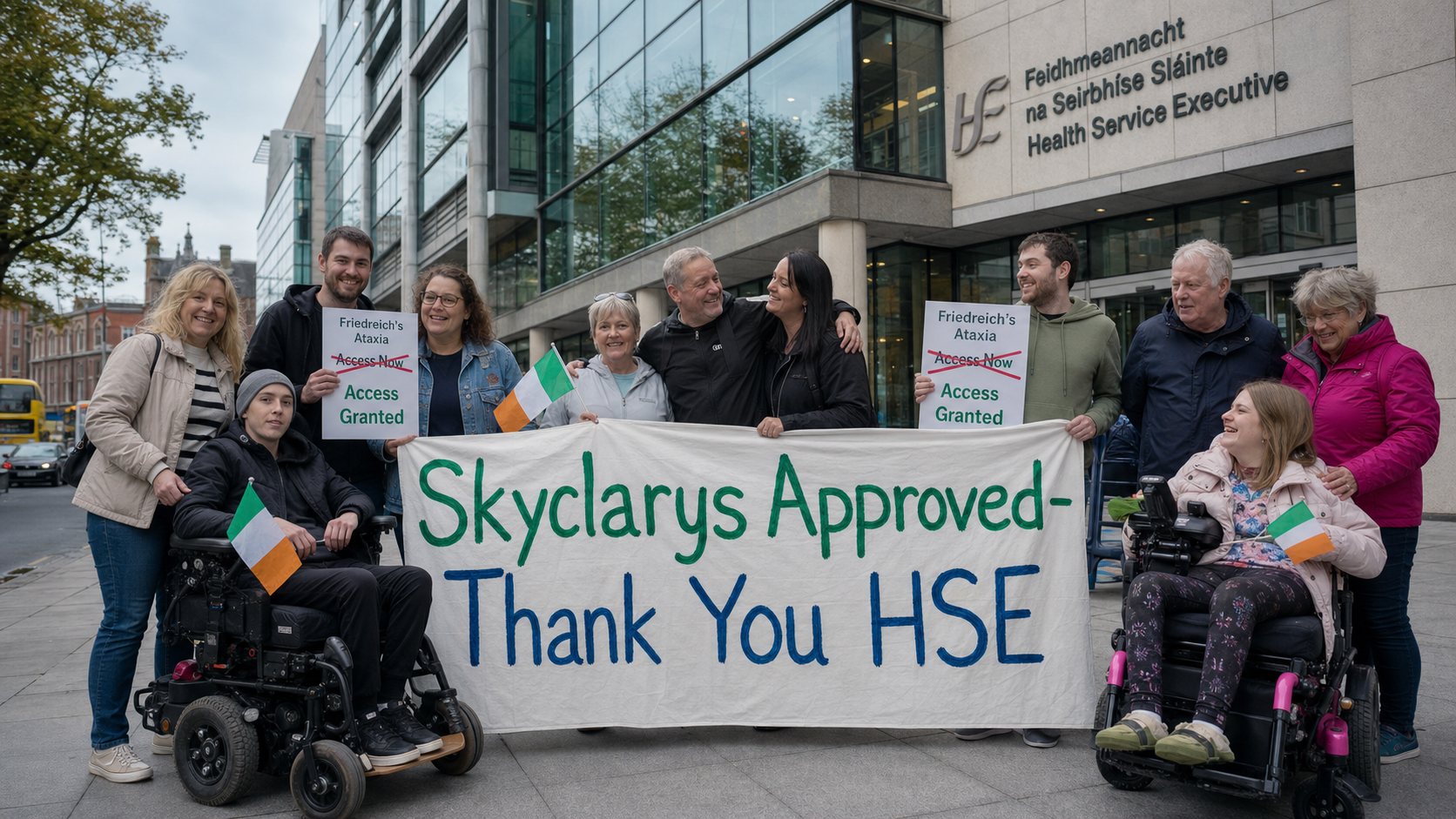
HSE Approves Skyclarys for Friedreich's Ataxia Patients After Two-Year Campaign
The Health Service Executive has approved the reimbursement of Skyclarys — the first drug capable of slowing the progression of Friedreich's ataxia — following a two-year campaign by Irish patients and their families that included a high-profile march through Dublin city centre and sustained political pressure on the Department of Health.
Background
Friedreich's ataxia is a rare, progressive neuromuscular disorder caused by a genetic mutation that disrupts the production of a protein called frataxin, leading to nerve damage, muscle weakness, loss of coordination, and, in many cases, heart disease. Approximately 200 people in Ireland live with the condition, which typically presents in childhood or adolescence and gradually robs patients of their ability to walk, speak clearly, and perform everyday tasks. There is no cure.
Skyclarys, known generically as omaveloxolone and manufactured by the American biotechnology company Biogen, was approved by the European Medicines Agency and the US Food and Drug Administration following clinical trials that demonstrated it could slow the rate of neurological decline. It is not a cure, but for patients facing a condition that progresses relentlessly, even a reduction in the rate of deterioration represents a meaningful improvement in quality of life and long-term prognosis.
The path to reimbursement in Ireland was protracted and, at times, deeply frustrating for patients. In December 2025, the National Centre for Pharmacoeconomics recommended against reimbursement, citing concerns about cost-effectiveness at an estimated annual price of approximately €280,000 per patient. The HSE Drugs Group subsequently declined to recommend the drug on multiple occasions in 2026, citing the high cost and uncertainties in the clinical data. Patients and advocacy groups, including Rare Disease Ireland, argued that the standard cost-effectiveness framework was ill-suited to rare diseases affecting small populations, where the absence of alternatives makes any meaningful treatment invaluable.
Key Developments
The breakthrough came when Biogen submitted a new, substantially improved commercial offer to the HSE. The HSE Senior Management Team reviewed the revised proposal on Monday, August 25, and decided to approve reimbursement, acknowledging that while the drug remained expensive and its clinical efficacy was limited, the substantial unmet need for patients — combined with the complete absence of alternative treatments — necessitated a positive decision.
Minister for Health Jennifer Carroll MacNeill welcomed the announcement, describing it as a significant step forward for patients who had waited far too long for access to a treatment already available in other European jurisdictions. Taoiseach Micheál Martin also praised the outcome, emphasising the importance of allowing the scientific and statutory processes to reach their conclusion. The HSE is now engaging with Biogen to finalise the administrative arrangements required to begin providing the drug to eligible patients.
The decision was preceded by a demonstration in Dublin in which patients — many in wheelchairs — marched to demand access to the medication, with advocates describing the delay as a human rights issue. The campaign drew significant media attention and cross-party political support, with TDs from multiple parties raising the matter in the Dáil.
Why It Matters
The Skyclarys approval is significant not only for the 200 Irish patients who stand to benefit directly, but for what it signals about Ireland's approach to rare disease reimbursement more broadly. The standard cost-effectiveness threshold used by the NCPE — typically around €45,000 per quality-adjusted life year — is widely regarded as poorly calibrated for orphan drugs, where small patient populations make it mathematically impossible to achieve the same cost-per-patient ratios as treatments for common conditions.
Ireland has historically lagged behind other European countries in approving rare disease treatments, a pattern that Rare Disease Ireland has documented in successive annual reports. The Skyclarys case took two years from EMA approval to Irish reimbursement — a delay that, for a progressive condition, translates directly into irreversible neurological decline for patients who could not access the drug privately. The HSE's eventual decision, while welcome, has prompted renewed calls for a dedicated rare disease reimbursement pathway that does not force patients to mount public campaigns simply to access treatments their doctors have prescribed.
This is the second high-profile rare disease reimbursement decision in Ireland in 2026, following the approval of a treatment for spinal muscular atrophy earlier in the year. The pattern suggests that sustained patient advocacy, combined with improved commercial offers from manufacturers, can overcome the structural barriers in the current system — though critics argue that patients should not have to fight this hard for treatments that are standard of care elsewhere in Europe.
Local Impact
For the approximately 200 people living with Friedreich's ataxia in Ireland — spread across all four provinces, with clusters in Dublin, Cork, and Galway — the approval means that their neurologists can now prescribe Skyclarys through the standard GMS and Drug Payment Scheme channels. Patients who have been accessing the drug through compassionate use programmes or paying out of pocket will be able to transition to reimbursed supply. The HSE has indicated that it will work with treating centres, including the National Neuroscience Centre at Beaumont Hospital in Dublin, to establish clear prescribing protocols and patient monitoring arrangements.
What's Next
The HSE expects to finalise the administrative arrangements with Biogen within the coming weeks, with the drug expected to be available through the reimbursement scheme by October 2026. Rare Disease Ireland has called on the Department of Health to use the Skyclarys case as a catalyst for a comprehensive review of the rare disease reimbursement framework, with a view to establishing a dedicated pathway that reduces the time from EMA approval to Irish patient access. A Dáil debate on rare disease policy is expected in the autumn session.