Rent Surge Was a 'One-Off': Daft Report Shows Irish Rental Inflation Slowing After Record Q1 Spike
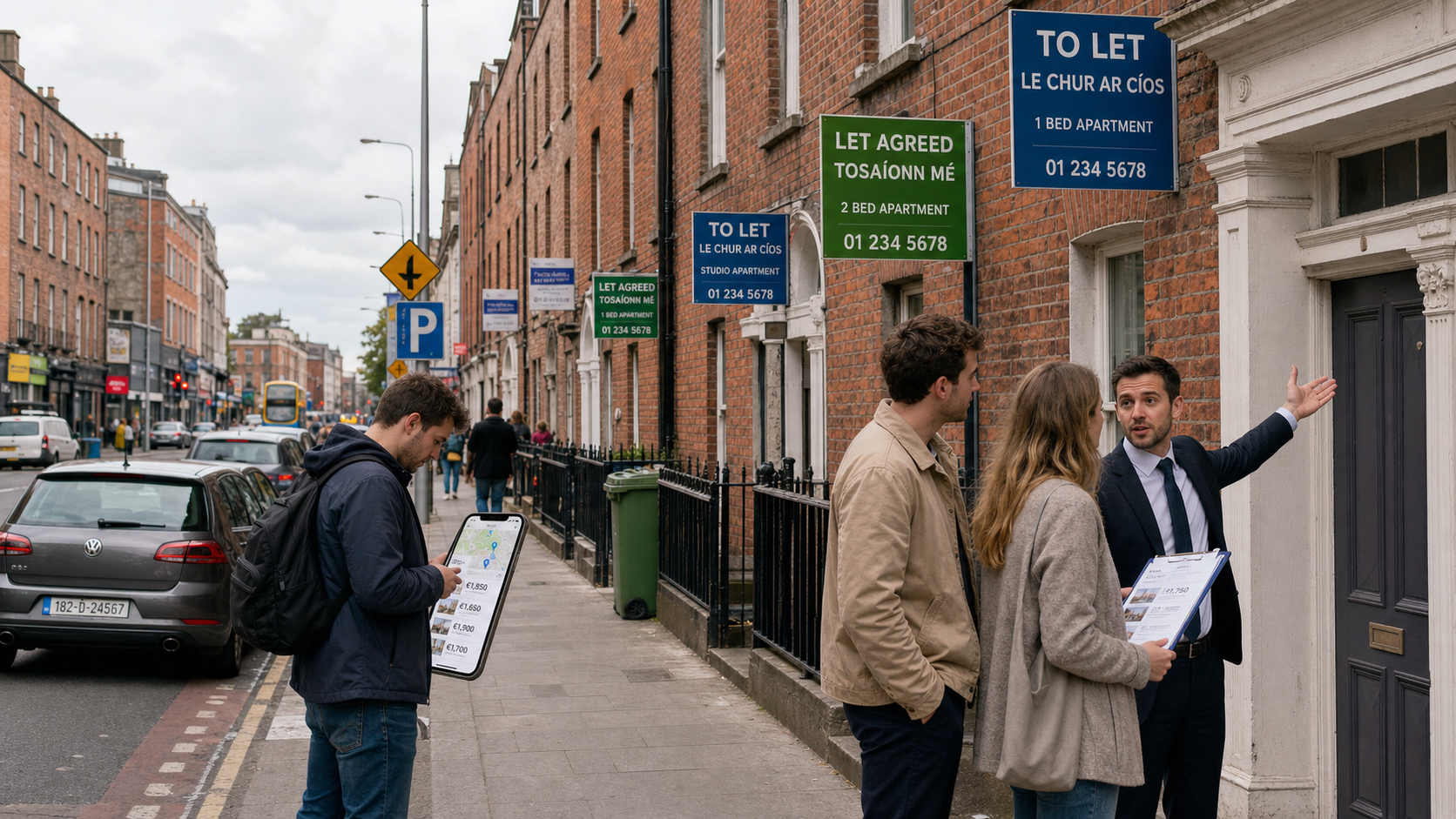
The latest Daft.ie rental report, published on Monday, shows that the record 4.4% quarterly surge in Irish rents in the first quarter of 2026 — the largest single-quarter increase since the series began in 2002 — was a "one-off" correction linked to new government rental regulations, with inflation slowing sharply to 1.4% between March and June. The average open-market rent for a two-bedroom apartment has reached €2,204 per month, 42% higher than pre-Covid levels and 78% higher than a decade ago.
Background
Ireland's rental market has been in a state of chronic stress for more than a decade, driven by a fundamental imbalance between supply and demand that successive governments have struggled to address. The introduction of rent pressure zones in 2016 was intended to limit annual rent increases, but the system has been criticised for creating perverse incentives — including encouraging landlords to exit the market rather than accept below-market rents — and for failing to address the underlying supply shortage.
The new rental regulations that came into effect in March 2026 represented a significant policy shift, allowing landlords to reset rents to market levels when a tenancy ends. The rationale was that the previous system had created a two-tier market in which long-term tenants paid significantly below-market rents while new tenants faced eye-watering open-market prices. By allowing a reset, the government hoped to reduce the incentive for landlords to evict tenants in order to re-let at higher rates.
Professor Ronan Lyons of Trinity College Dublin, who authors the Daft.ie rental report, had warned in advance that the new regulations would likely trigger a short-term surge in rents as landlords took the opportunity to realign their rents with market levels. That is precisely what happened in the first quarter of 2026.
Key Developments
The Q2 2026 report confirms that the adjustment process is largely complete in Dublin, where rents rose just 0.8% in the second quarter, and in other cities, where the increase was 1.1%. The adjustment is still working through other regions, with Leinster up 2.9% and Munster up 2.8% in the quarter. On an annual basis, rent inflation stands at 7.7% — higher than the 4.4% recorded a year earlier, but expected to moderate as the one-off correction effect fades.
The supply picture remains deeply concerning. At the start of August 2026, there were just under 2,400 homes available for rent nationwide — a 5% increase on the same time in 2025, but still far below the pre-pandemic norm of over 4,300. The situation in Dublin is particularly acute, with availability falling 18% year-on-year to fewer than 1,150 homes. Outside the capital, availability has risen 40%, suggesting that the supply crisis is becoming increasingly concentrated in Dublin.
The cities outside Dublin are experiencing the highest annual rent inflation: Galway at 13%, Cork at 12%, and Limerick at 11%. These figures reflect both the relative tightness of supply in those cities and the fact that the one-off correction effect has been more pronounced in markets where rents had been most constrained by the previous regulations.
Why It Matters
The Daft report's finding that the Q1 surge was a "one-off" will provide some reassurance to renters who feared that the new regulations had permanently accelerated the rate of rent increases. But the underlying picture remains deeply troubling. Average rents of €2,204 per month for a two-bedroom apartment in the open market are simply unaffordable for a large proportion of the workforce, particularly in Dublin and the other major cities. The 78% increase over a decade represents a fundamental deterioration in housing affordability that has driven emigration, suppressed household formation, and contributed to the homelessness crisis.
The government's housing strategy has focused primarily on increasing supply through the Land Development Agency, the Housing for All plan, and various planning reforms. The July 2026 commencement figures — 3,028 new homes in a single month, the second-highest monthly total since records began — suggest that supply is finally beginning to respond. But the gap between current supply and the level needed to bring rents down to affordable levels remains enormous, and it will take years of sustained construction activity to close it.
Local Impact
In Dublin, the combination of falling availability and continued rent inflation is placing enormous pressure on workers in essential services — nurses, teachers, Garda members, and care workers — who cannot afford to live in the city where they work. The HSE has reported difficulties recruiting and retaining staff in Dublin hospitals partly because of housing costs, and Dublin City Council has acknowledged that the rental crisis is undermining the city's ability to attract and retain the workforce it needs. In Cork, Galway, and Limerick, the situation is increasingly mirroring Dublin's, with young professionals and families being priced out of city centres and into longer commutes.
What's Next
Professor Lyons has indicated that rent inflation should continue to moderate through the second half of 2026 as the one-off correction effect fades. The next Daft report, covering Q3 2026, will be published in November and will provide the first clear picture of whether the market has stabilised. The government's housing targets for 2026 — 33,000 completions — are unlikely to be met, with the pace of construction still falling short of what is needed to make a meaningful dent in the supply deficit.