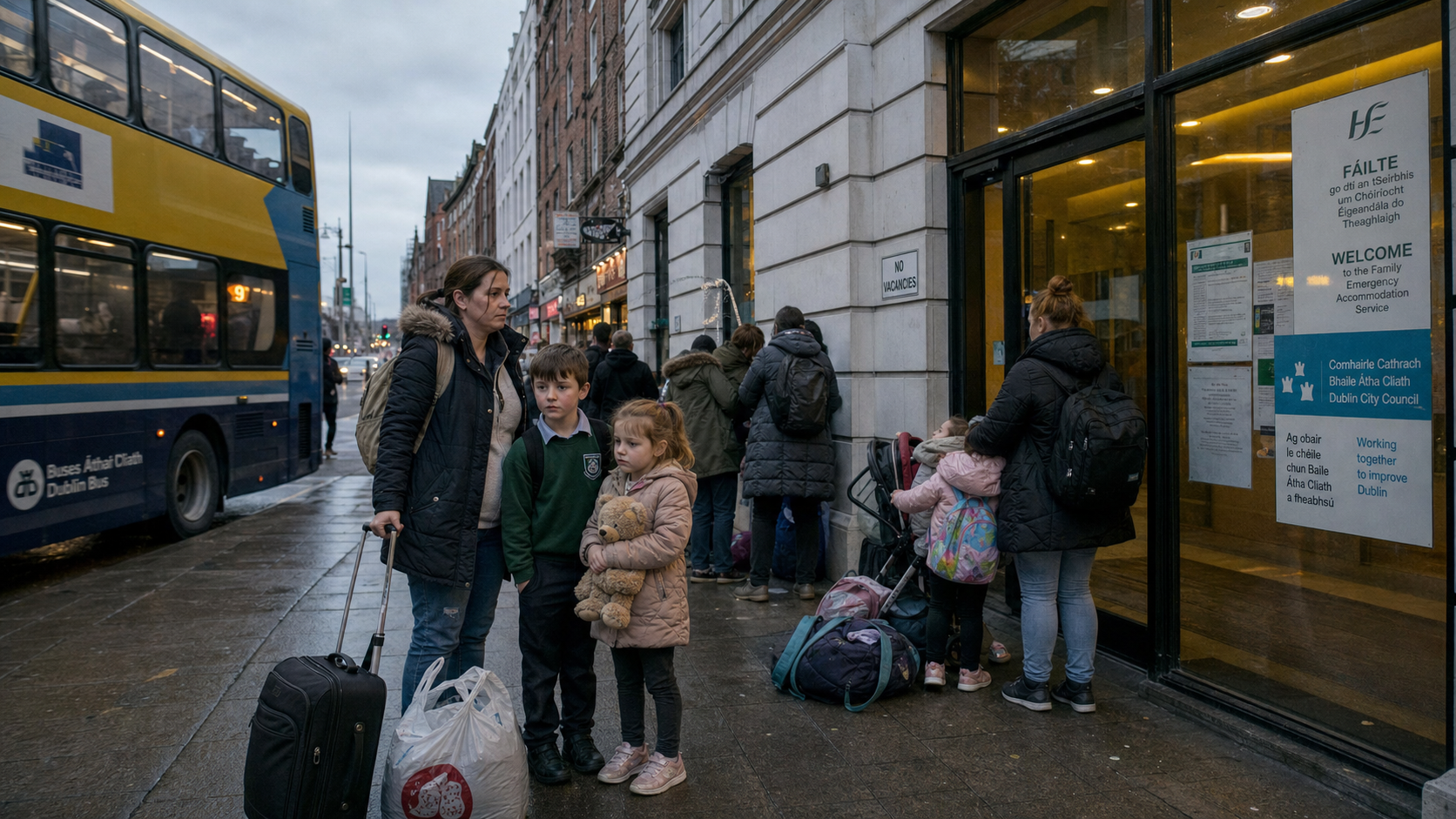
Record 5,659 Children in Emergency Accommodation as Ireland's Homelessness Crisis Deepens to 17,527
The number of people in emergency accommodation in Ireland reached 17,527 in July 2026, with a record 5,659 children now living in emergency housing — the highest figure ever recorded for child homelessness in the State — as advocacy groups warn that the crisis is deepening at a pace that demands immediate and sustained government intervention beyond the emergency measures deployed so far.
Background
Ireland's homelessness crisis has been building for over a decade, driven by a combination of chronic undersupply of housing, rising rents, the end of pandemic-era eviction protections, and the pressures created by increased migration. The figures published by the Department of Housing represent only a partial picture of the true scale of the problem: they do not include people sleeping rough, those in domestic violence refuges, individuals sofa-surfing with friends or family, or those in overcrowded housing — all of whom are experiencing forms of homelessness that the official statistics do not capture.
The 17,527 figure for July 2026 represents an increase of 45 individuals compared to June 2026 and is approximately 9% higher than the number recorded in July 2025. The total includes 11,868 adults and 5,659 children, with the latter figure representing a record high that has shocked housing advocates and opposition politicians alike. The 5,659 children were residing in 2,724 families, many of whom have been in emergency accommodation for extended periods — in Dublin, a significant proportion of homeless families have been in the system for over a year, with some having been homeless for more than two years.
Dublin remains the epicentre of the crisis, with 12,298 people in emergency accommodation in the capital, including 8,209 adults and 4,089 children. While the total number of homeless people in Dublin saw a slight decrease of 20 compared to June, the number of homeless families in the capital rose, reflecting the particular difficulty that families face in accessing suitable emergency accommodation and in transitioning out of the system into permanent housing.
Key Developments
The publication of the July figures has prompted an immediate response from housing advocacy organisations. Focus Ireland has highlighted the impact of the crisis on children returning to school and college, noting that thousands of children will begin the new academic year without a stable home. The organisation has pointed out that the government's decision to recall the Dáil to address fuel excise duties — while leaving the housing crisis to be managed through existing mechanisms — reflects a troubling set of political priorities.
The Simon Communities of Ireland have called for an emergency housing summit, arguing that the scale of the crisis now demands a response commensurate with a national emergency rather than the incremental policy adjustments that have characterised the government's approach to date. The communities have also highlighted the demographic breakdown of those in emergency accommodation: approximately 49.8% are Irish nationals, 18.8% are from the UK or the European Economic Area, and 31.4% are from outside the EEA — a distribution that reflects the complexity of the crisis and the inadequacy of responses that focus on any single cause.
The record high for total homelessness in 2026 was reached in April, when the number hit 17,548. The July figure of 17,527 is just 21 people short of that peak, suggesting that the crisis has not meaningfully improved despite the government's stated commitment to addressing it.
Why It Matters
The record number of children in emergency accommodation is not merely a statistical milestone — it represents a profound failure of the State's obligation to protect its most vulnerable citizens. Research consistently shows that homelessness in childhood has lasting negative effects on educational attainment, mental health, and long-term life outcomes. Children who spend extended periods in emergency accommodation — often in hotels, bed-and-breakfasts, or family hubs — face disruption to their schooling, social relationships, and sense of security that can take years to overcome.
For context, Ireland's child homelessness rate is now among the highest in Western Europe relative to population size. The Republic's approach to housing provision has historically relied heavily on the private rental market to house those who cannot afford to buy, a model that has proven deeply inadequate in the face of sustained demand and constrained supply. Unlike Northern Ireland, where social housing provision has historically been more substantial relative to population, the Republic has a structural deficit in social housing that successive governments have failed to address at the scale required.
Local Impact
In Dublin, where the crisis is most acute, the impact is visible in the city's hotels, which continue to house significant numbers of homeless families alongside paying guests — an arrangement that is costly for the State, disruptive for the families involved, and unsustainable as a long-term solution. In Cork, Galway, and Limerick, the numbers in emergency accommodation have also risen, reflecting the spread of the crisis beyond the capital. HSE community healthcare organisations in all regions have reported increased demand for mental health and social support services from families experiencing homelessness, placing additional pressure on already stretched services. Bus Éireann and Irish Rail have noted increased use of their services by families travelling between emergency accommodation and schools, a logistical challenge that adds to the daily burden of homeless families.
What's Next
The Department of Housing is expected to publish its next monthly homelessness figures in late September. The government has indicated that it will bring forward additional housing measures as part of Budget 2027, which is scheduled for October. Housing advocacy groups have called for a specific commitment to ending family homelessness within a defined timeframe, arguing that the record child homelessness figures make the status quo morally and politically untenable. A Dáil debate on housing is expected in September, with opposition parties likely to use the July figures to press the government on the pace and scale of its response.