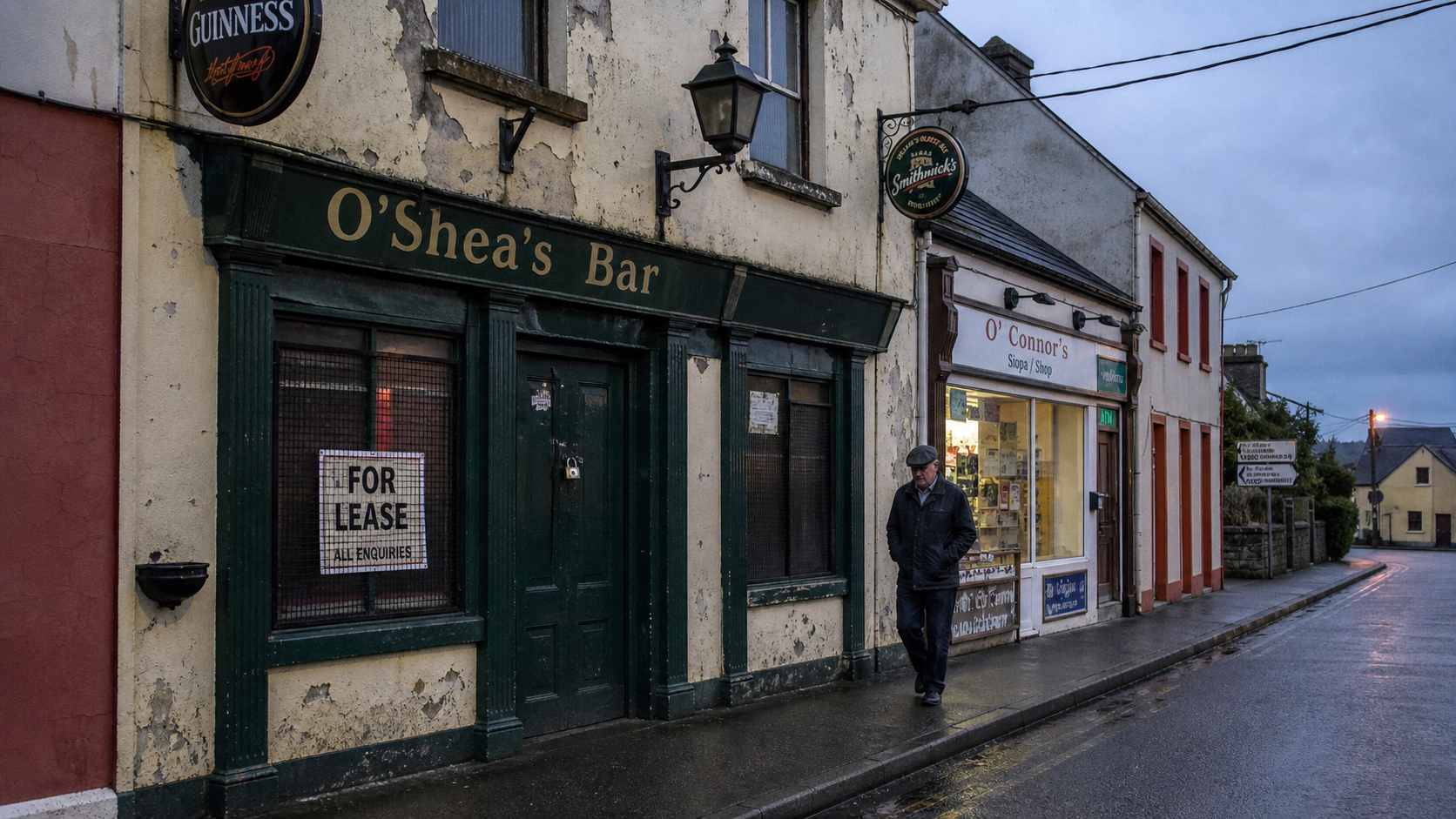
One in Four Irish Pubs Has Closed Since 2005 as Rural Communities Bear the Brunt of Accelerating Decline
Ireland has lost one in four of its public houses since 2005, with 2,205 pubs closing across the Republic over the past two decades in a decline that has accelerated in recent years and is now threatening the social fabric of rural communities that have long depended on the local pub as a centre of community life, according to a comprehensive new report commissioned by the Drinks Industry Group of Ireland.
Background
The Irish pub has occupied a unique place in the country's social and cultural life for centuries. More than a place to drink, the traditional pub has functioned as a community hub, a venue for music and conversation, a space where news was shared and disputes were settled, and — in rural Ireland in particular — often the only public gathering place within miles. The decline of the pub is therefore not merely an economic story but a social one, with implications for community cohesion, mental health, and the vitality of rural life that extend well beyond the balance sheets of individual licensees.
The report, authored by Dublin City University economist Anthony Foley and commissioned by the Drinks Industry Group of Ireland (DIGI), provides the most comprehensive picture yet of the scale and pace of that decline. Between 2005 and 2025, the number of licensed public houses in the Republic fell from 8,617 to approximately 6,412 — a reduction of 2,205 premises, or 25.6 per cent. The rate of closure has not been uniform: in the most recent year for which data is available, 86 pubs closed, up from 65 in the previous year, though below the peak of 117 closures recorded in 2023.
The causes are multiple and well documented. Rising operational costs — energy, insurance, wages — have squeezed margins that were already thin. Changing consumer habits, particularly among younger generations who drink less and socialise differently, have reduced footfall. The smoking ban, introduced in 2004, accelerated the shift away from the traditional pub model. And Ireland's excise duty regime, which is the second highest in the European Union, has made it increasingly difficult for smaller, family-owned pubs to compete with off-licences and supermarkets on price.
Key Developments
The geographic distribution of closures reveals a stark urban-rural divide. Dublin, with its large and relatively affluent population and its concentration of younger, higher-spending consumers, has seen a decline of just one per cent in pub numbers over the twenty-year period. Wicklow and Meath have fared only slightly worse. But in rural counties, the picture is dramatically different: Limerick has lost 37.2 per cent of its pubs, Offaly 34.1 per cent, Cork 32.7 per cent, Roscommon 32.3 per cent, and Tipperary 32 per cent. In these counties, the closure of a pub often means the loss of the last public gathering space in a village or townland.
The report projects that between 600 and 1,000 additional pubs will close over the next decade if government policy remains unchanged. The industry is lobbying for a 10 per cent reduction in alcohol excise duty in the upcoming Budget 2027, arguing that Ireland's current rates — a pint of beer attracts €0.55 in excise duty, compared to €0.05 in Spain and Germany — are unsustainable for smaller operators. The Vintners Federation of Ireland has also proposed an "On-Trade Sustainability Scheme" that would provide a tax credit linked to draught product purchases.
Why It Matters
The decline of the rural Irish pub is a proxy for a broader set of challenges facing rural Ireland: depopulation, the erosion of local services, and the growing sense that the state's investment in infrastructure and amenities is concentrated in urban centres. The pub closure data maps almost exactly onto the areas that have experienced the greatest population loss and the greatest reduction in other public services — post offices, Garda stations, schools. For communities in rural Limerick, Offaly, or Roscommon, the loss of the local pub is often the final stage in a process of hollowing out that has been under way for decades. The Irish Times noted this week that the rise of the "passionfruit martini" in urban cocktail bars is happening in a different country from the one where the last pub in a Tipperary village is closing its doors.
Local Impact
In practical terms, the closure of a rural pub removes a space that serves functions that no other institution replicates. It is where the local GAA club holds its post-match gathering, where the IFA branch meets, where the community comes together after a funeral. In many rural parishes, the pub is also the only venue available for community events, fundraisers, and social occasions. Its loss forces communities to travel further for social interaction, which in turn accelerates the isolation that is already a significant public health concern in rural Ireland. The HSE's rural mental health strategy has identified social isolation as one of the primary risk factors for poor mental health outcomes in rural communities, and the loss of the pub is a direct contributor to that isolation.
What's Next
The DIGI report will be formally presented to the Minister for Finance ahead of Budget 2027, which is scheduled for October. The Vintners Federation of Ireland and the Licensed Vintners Association have both requested meetings with the Minister to make the case for excise duty relief. The Oireachtas Committee on Enterprise, Trade and Employment has indicated that it will hold hearings on the future of the pub sector in October. A government response to the report is expected before the end of the month.