Oireachtas Committee Recommends Decriminalisation of Drugs for Personal Use in Landmark Health-Led Report
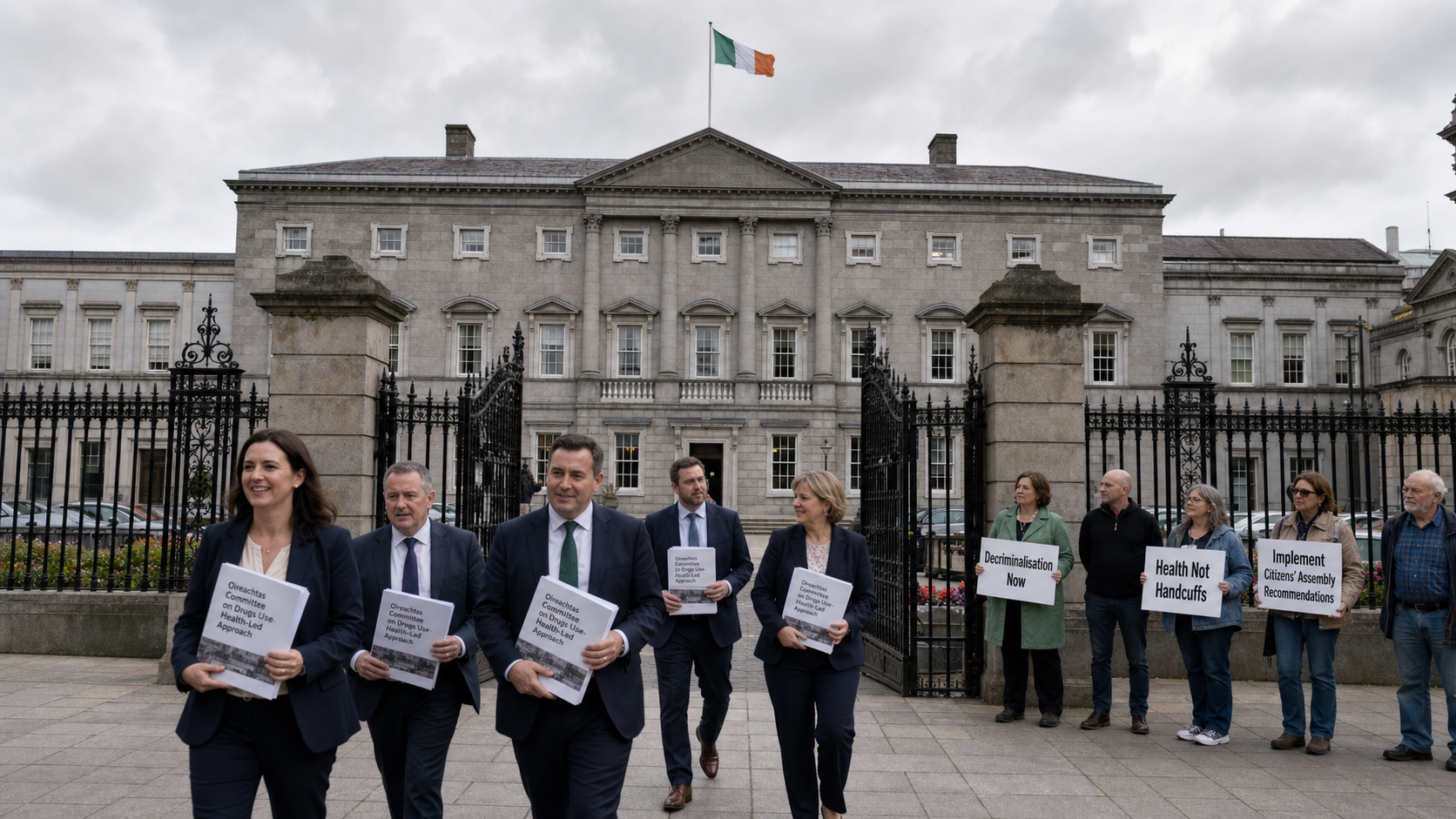
An Oireachtas committee has published a landmark report formally recommending the decriminalisation of drugs for personal use in Ireland, in what represents the most significant shift in the State's approach to drug policy in a generation. The report, which endorses a health-led model of addiction treatment over criminal prosecution, follows the recommendations of the 2024 Citizens' Assembly on Drugs Use and marks a decisive move away from the punitive approach that has characterised Irish drug policy since the 1970s.
Background
Ireland's approach to drug use has long been characterised by a tension between the criminal justice system's instinct to prosecute and the public health system's recognition that addiction is a health condition rather than a moral failing. The Misuse of Drugs Act 1977, which remains the primary legislative framework governing drug offences in Ireland, treats the possession of controlled substances for personal use as a criminal offence, carrying potential penalties of fines and imprisonment. In practice, the enforcement of these provisions has been inconsistent, with significant variation in how An Garda Síochána exercises its discretion across different parts of the country.
The 2024 Citizens' Assembly on Drugs Use, which brought together a representative sample of Irish citizens to deliberate on drug policy over several months, produced a report that was striking in its clarity and ambition. The assembly recommended, by a substantial majority, that the possession of drugs for personal use should be decriminalised, and that the resources currently devoted to prosecuting drug users should be redirected towards treatment, harm reduction, and social support. The assembly's report drew heavily on the experience of Portugal, which decriminalised the personal possession of all drugs in 2001 and has since seen significant reductions in drug-related deaths, HIV infections, and incarceration rates.
The Oireachtas committee's report, published on Tuesday, represents the formal legislative response to the Citizens' Assembly's recommendations. It is a significant document not merely for its policy content but for what it signals about the direction of travel in Irish social policy more broadly — a willingness to follow the evidence and the public's expressed preferences, even when they challenge long-established orthodoxies.
Key Developments
The committee's report recommends that the possession of drugs for personal use be removed from the criminal statute book and treated instead as a public health matter. Under the proposed framework, people found in possession of small quantities of controlled substances would be referred to a health assessment rather than prosecuted. Local authorities would be empowered to manage public drug consumption through by-laws, allowing them to designate specific areas where consumption is prohibited and to enforce those prohibitions through civil rather than criminal penalties.
The report also calls for a significant expansion of harm reduction services, including the provision of drug consumption rooms in cities where open drug use is most prevalent — a measure that has been successfully implemented in cities including Amsterdam, Lisbon, and Glasgow. An Garda Síochána would receive mandatory trauma-informed training to equip officers to respond to drug-related incidents in a way that prioritises the health and welfare of the individual rather than their prosecution.
The report links addiction explicitly to broader societal issues including poverty, trauma, and social exclusion, arguing that effective drug policy must address these underlying determinants rather than focusing narrowly on the substances themselves. It calls for increased investment in community-based addiction services, particularly in areas of high deprivation where drug use is most concentrated.
Why It Matters
The committee's recommendation represents a fundamental reorientation of the State's relationship with drug users — from adversary to ally. The evidence from Portugal and other jurisdictions that have adopted health-led approaches is compelling: decriminalisation, when accompanied by investment in treatment and harm reduction, reduces drug-related deaths, decreases the burden on the criminal justice system, and improves health outcomes for people who use drugs. Ireland's drug-related death rate has been among the highest in the European Union in recent years, a statistic that reflects both the scale of the problem and the inadequacy of the current response. The committee's report is also significant in the context of the broader social policy reforms being advanced by the current government — the vote to abolish the abortion waiting period, the approval of pharmacist-prescribed contraception — which together suggest a government willing to make substantive changes to the social policy landscape rather than merely tinkering at the margins. Unlike the UK, where drug policy remains firmly in the grip of a punitive orthodoxy, Ireland appears to be charting a genuinely different course.
Local Impact
The practical impact of decriminalisation would be felt most acutely in Dublin's inner city, where open drug use in areas including the north inner city, Ballymun, and parts of the south inner city has been a persistent and visible problem for decades. In Cork, Limerick, and Waterford, similar concentrations of drug use in deprived urban areas have placed enormous strain on local health and social services. The proposed drug consumption rooms, if implemented, would be most likely to be located in Dublin initially, with the potential to expand to other cities as the model is evaluated. For An Garda Síochána, the shift to a health-led approach would represent a significant change in operational practice, requiring investment in training and in the development of new referral pathways to health services.
What's Next
The committee's report will now be considered by the full Oireachtas, with a debate expected in the Dáil in September. The government has indicated that it will publish a formal response to the report's recommendations within three months. Legislation to implement decriminalisation, if approved by the government, would need to amend the Misuse of Drugs Act 1977 — a process that is expected to take at least 12 to 18 months. The Department of Health has been asked to develop a detailed implementation plan, including proposals for the expansion of harm reduction services, by the end of the year.