Northern Ireland's Sign Language Act Becomes Law in Landmark Moment for Deaf Community
The Sign Language Act (Northern Ireland) 2026 has officially entered the statute books, delivering a moment decades in the making for the deaf community across the six counties and making Northern Ireland the only jurisdiction in the United Kingdom to provide statutory recognition for both British Sign Language and Irish Sign Language simultaneously.
Background
Advocacy for formal recognition of sign language in Northern Ireland stretches back to the 1970s and 1980s, when deaf community organisations first began lobbying for the linguistic rights that hearing citizens took for granted. For generations, deaf people in Northern Ireland navigated public services, healthcare, and education without any legal guarantee that their preferred language would be accommodated. The absence of statutory protection meant that access to interpretation services depended on the goodwill of individual institutions rather than enforceable rights.
The journey toward legislation accelerated in the 2020s as comparable measures were introduced elsewhere in the United Kingdom. Scotland enacted a British Sign Language Act in 2015, and Westminster followed with its own BSL Act in 2022. Northern Ireland's unique position — straddling two sign language communities, with BSL dominant in the unionist tradition and Irish Sign Language more prevalent in nationalist and republican communities — made the legislative challenge more complex but also more significant. The resulting bill, introduced directly by the Executive through the Department for Communities under Minister Gordon Lyons, was notable for its dual recognition of both languages, a feature without precedent in UK law.
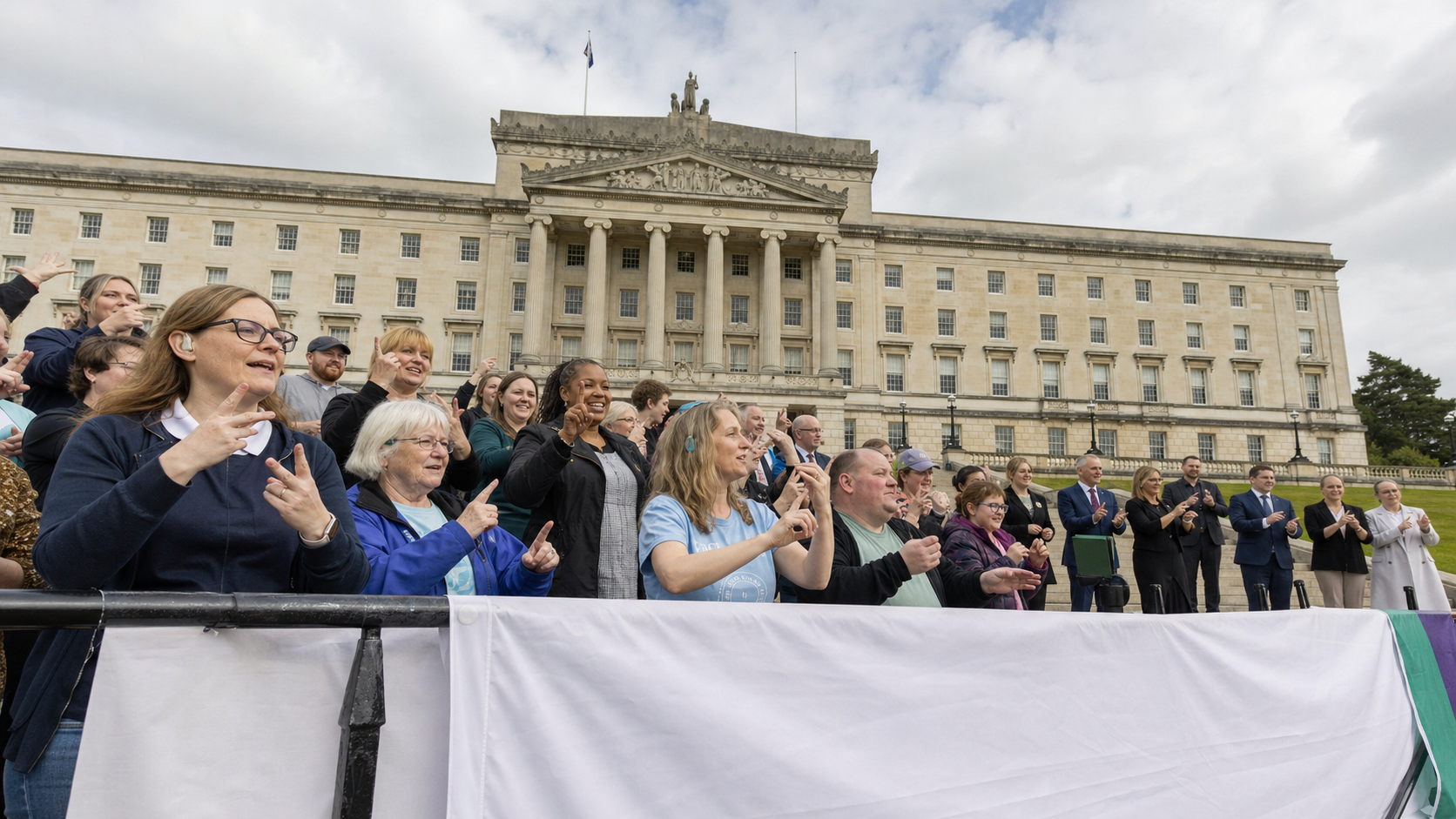
The bill passed its final stage at the Northern Ireland Assembly on 28 April 2026 following a unanimous vote across all political traditions — a rare display of cross-community consensus at Stormont. Communities Minister Gordon Lyons delivered part of his address in BSL to the public gallery, a gesture that drew sustained applause from deaf community members who had waited a lifetime for the moment.
Key Developments
The Act, which formally entered law in August 2026, contains several provisions that advocates describe as genuinely transformative. At its core, the legislation provides statutory recognition for both BSL and ISL as the languages of the deaf community in Northern Ireland, establishing their status in law for the first time. Public bodies are now required to take reasonable steps to ensure that their information and services are fully accessible to deaf citizens, including the provision of qualified BSL and ISL interpretation.
A central pillar of the Act is the formalisation of free sign language classes for deaf children, young people under the age of 25, and their families. While Northern Ireland had provided such services for the previous twelve years, the new legislation places that provision on a permanent statutory footing, protecting it from future budget pressures. The British Deaf Association and Action Deaf Youth, two of the organisations that campaigned most persistently for the legislation, described the Act as "rights-bearing" in a way that previous voluntary arrangements could never be.
The dual-language approach has been praised by experts as particularly sensitive to Northern Ireland's divided cultural landscape. Unlike England and Scotland, where BSL is the sole recognised sign language, Northern Ireland's Act acknowledges that ISL — which developed independently on the island of Ireland and shares more in common with French Sign Language than with BSL — is the preferred language of a significant portion of the deaf community, particularly in nationalist areas of Belfast, Derry, and rural counties.
Why It Matters
The significance of this legislation extends well beyond the deaf community itself. Northern Ireland has a population of approximately 1.9 million people, of whom an estimated 40,000 are deaf or have significant hearing loss. For those who rely on BSL or ISL as their primary language, the absence of statutory protection has historically meant exclusion from full participation in civic life — from court proceedings to hospital appointments to interactions with government departments. The Act changes that calculus fundamentally.
What makes Northern Ireland's approach distinctive is the explicit recognition that sign language is not a disability accommodation but a language in its own right. This framing — consistent with the United Nations Convention on the Rights of Persons with Disabilities — represents a philosophical shift in how the state relates to the deaf community. Unlike the Republic of Ireland, which has yet to enact comparable legislation despite years of advocacy, Northern Ireland now has a legal framework that other jurisdictions may look to as a model. The cross-community nature of the Assembly vote also demonstrates that disability rights can serve as a unifying issue in a legislature more often defined by division.
Local Impact
In practical terms, the Act will have immediate consequences for public bodies across Northern Ireland. Belfast City Council, the five health and social care trusts, the Education Authority, and Translink will all be required to review their accessibility provisions and develop plans to meet the new statutory duties. For families in areas such as West Belfast, the Bogside in Derry, and South Armagh — where ISL has historically been the dominant sign language — the guarantee of ISL interpretation in public services represents a particularly meaningful change. Schools across the province will be required to ensure that deaf pupils and their families can access support in their preferred sign language, a provision that advocates say will help prevent the language deprivation that has affected generations of deaf children.
What's Next
The Department for Communities is expected to publish implementation guidance for public bodies in the autumn of 2026, setting out the specific steps required to comply with the new statutory duties. A review of the Act's operation is planned for 2028. Advocacy organisations have already indicated that they will monitor compliance closely and are prepared to use the legal framework to challenge public bodies that fail to meet their obligations. The deaf community in Northern Ireland, having waited decades for this moment, is determined to ensure that the law delivers in practice what it promises on paper.