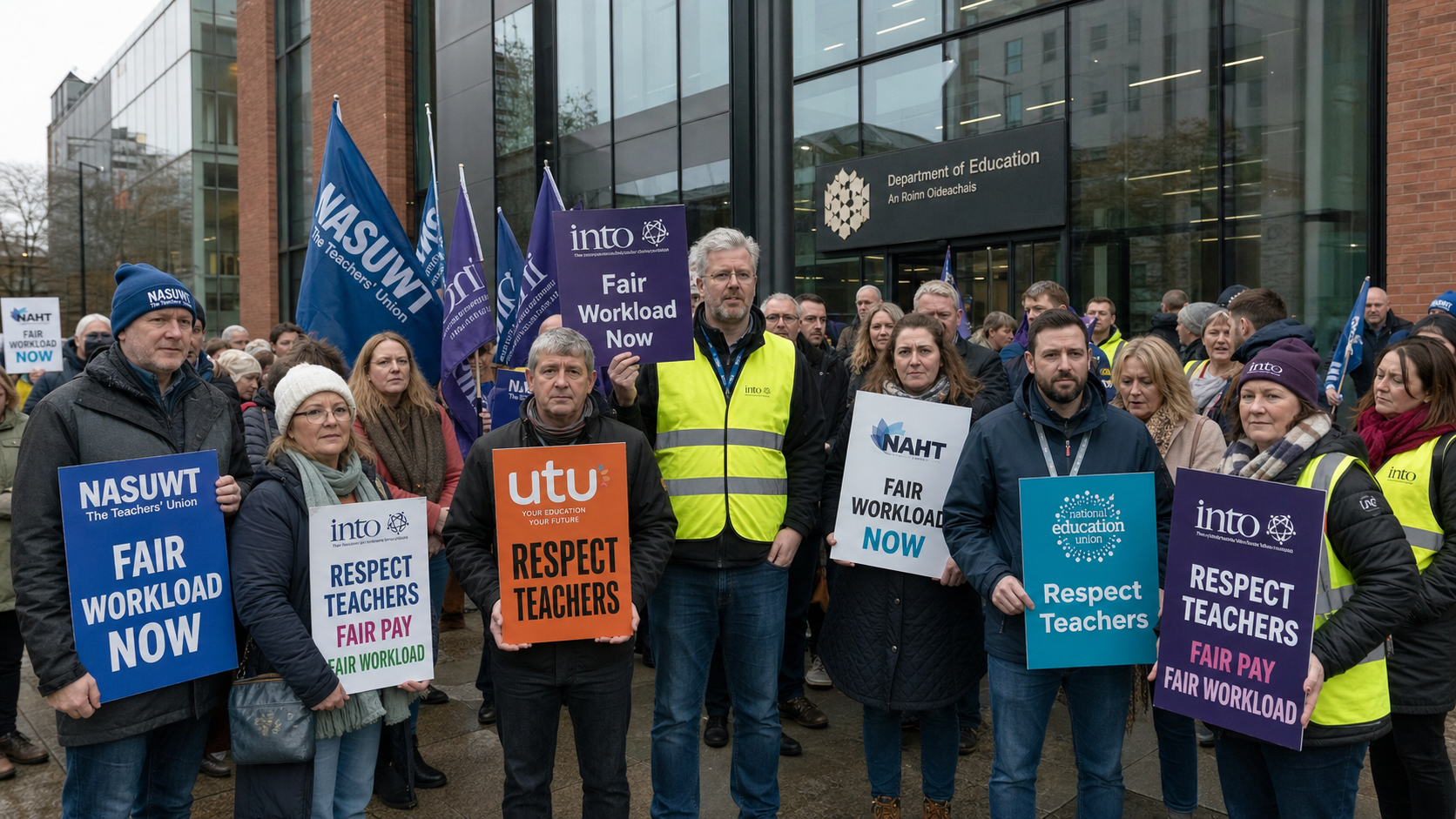
Northern Ireland's Five Teaching Unions Secure Strike Mandates as Workload Dispute with Department of Education Escalates
All five major teaching unions in Northern Ireland have secured decisive mandates for industrial action, including potential strikes, after accusing the Department of Education of a sustained failure to address the crushing workload burden facing teachers and school leaders across the six counties.
Background
The dispute has its roots in a growing crisis of teacher wellbeing and retention that has been building in Northern Ireland's schools for several years. Teachers and school leaders have consistently reported that the demands placed upon them — administrative burdens, increasing pupil needs, inadequate support structures, and the relentless pressure of inspection regimes — have reached a point that is no longer sustainable. The problem is not unique to Northern Ireland; similar pressures have driven industrial action in England, Scotland, and the Republic of Ireland in recent years. But the specific context of Northern Ireland, with its divided school system, its particular demographic challenges, and the chronic underfunding that has characterised Stormont's education budget, has given the crisis a distinctive character.
In November 2025, the Department of Education commissioned an independent review of teacher and school leader workloads, which produced 27 specific recommendations for reducing unnecessary administrative burden and improving working conditions. The review was broadly welcomed by the unions, who saw it as an acknowledgement of the scale of the problem. However, the welcome quickly turned to frustration as the months passed and the Department's response to the recommendations was judged by union leaders to be inadequate.
In June 2026, the five unions — the NASUWT, the Irish National Teachers' Organisation (INTO), the Ulster Teachers' Union (UTU), the National Association of Head Teachers (NAHT), and the National Education Union (NEU) — announced their intention to ballot members for industrial action. The ballots were conducted over the summer, with results announced on 1 September 2026.
Key Developments
The ballot results were unambiguous. The NASUWT reported that 92.04% of members voted for strike action on a 54% turnout, with 98.63% supporting action short of a strike. The INTO reported 91% in favour of strike action on a 46% turnout, with 99% supporting action short of a strike. The UTU reported 71% in favour of strike action and 95% for action short of a strike. The NAHT described its result as an "unmistakable mandate," with 81% voting for strike action and 96% for action short of a strike. The NEU indicated its intention to join the other unions in preparing for industrial action.
Union leaders were unsparing in their assessment of the situation. "Our members are exhausted," said NASUWT Northern Ireland secretary Graham Gault. "They came back to school this September carrying the same impossible workload they left with in June. The Department has had months to show us tangible progress on the 27 recommendations, and what we have seen falls far short of what teachers need and deserve."
INTO Northern Ireland director Gerry Murphy described the ballot result as "a clear signal that teachers have reached their limit." He added that the union remained open to negotiation but that any talks would need to produce "concrete, time-bound commitments" rather than further promises of future action.
Education Minister Paul Givan responded by expressing "genuine disappointment" at the ballot outcome. He argued that the ballots had been initiated before the commencement of what he described as constructive negotiations facilitated by the Labour Relations Agency over the summer, and that significant progress had been made. "I remain committed to implementing the panel's recommendations," he said. "I urge the unions to continue engaging in dialogue. Strikes will not benefit our children or our schools."
Why It Matters
The prospect of coordinated strike action across all five teaching unions would represent an unprecedented level of industrial disruption in Northern Ireland's schools. Unlike previous disputes, which have typically involved one or two unions acting independently, the unified front presented by the five unions significantly increases the likelihood that any action would be both widespread and sustained. For context, the last major teachers' strike in Northern Ireland, in 2019, involved a smaller coalition of unions and lasted for a single day; the current dispute has the potential to be far more disruptive.
The timing is also significant. Northern Ireland's schools are already under pressure from a range of challenges, including rising pupil numbers in some areas, a shortage of substitute teachers, and the ongoing impact of budget constraints on support services. A prolonged period of industrial action would compound these pressures and could have lasting consequences for pupil attainment, particularly for those in the most vulnerable circumstances.
The dispute also raises broader questions about the governance of education in Northern Ireland. The Department of Education's handling of the workload review recommendations has been criticised not only by the unions but by school leaders and education commentators, who argue that the pace of implementation has been too slow and the commitments too vague.
Local Impact
Across Northern Ireland's 1,200 schools — from primary schools in the Shankill and Falls areas of Belfast to secondary schools in Derry, Newry, Armagh, and Enniskillen — teachers and principals are watching the dispute with a mixture of solidarity and anxiety. Many school leaders have expressed sympathy with the unions' position while also worrying about the impact of strikes on their pupils, particularly those with special educational needs who depend on consistent routines and support.
Parents' groups have called on both the Department and the unions to return to the negotiating table as a matter of urgency. The Northern Ireland Council for Integrated Education has warned that any disruption to the school year would be particularly damaging for integrated schools, which are already navigating the challenges of the minister's new position on transformation.
What's Next
No specific dates for strike action have been set as of 2 September 2026. The unions have indicated that they will meet in the coming weeks to agree a coordinated plan for industrial action, which could include work-to-rule measures, selective strikes, or full strike days. The Labour Relations Agency has offered to facilitate further talks between the unions and the Department, and both sides have indicated a willingness to engage — though the unions have made clear that any talks must produce substantive outcomes rather than further delay. A further meeting between union leaders and Department officials is expected before the end of September.