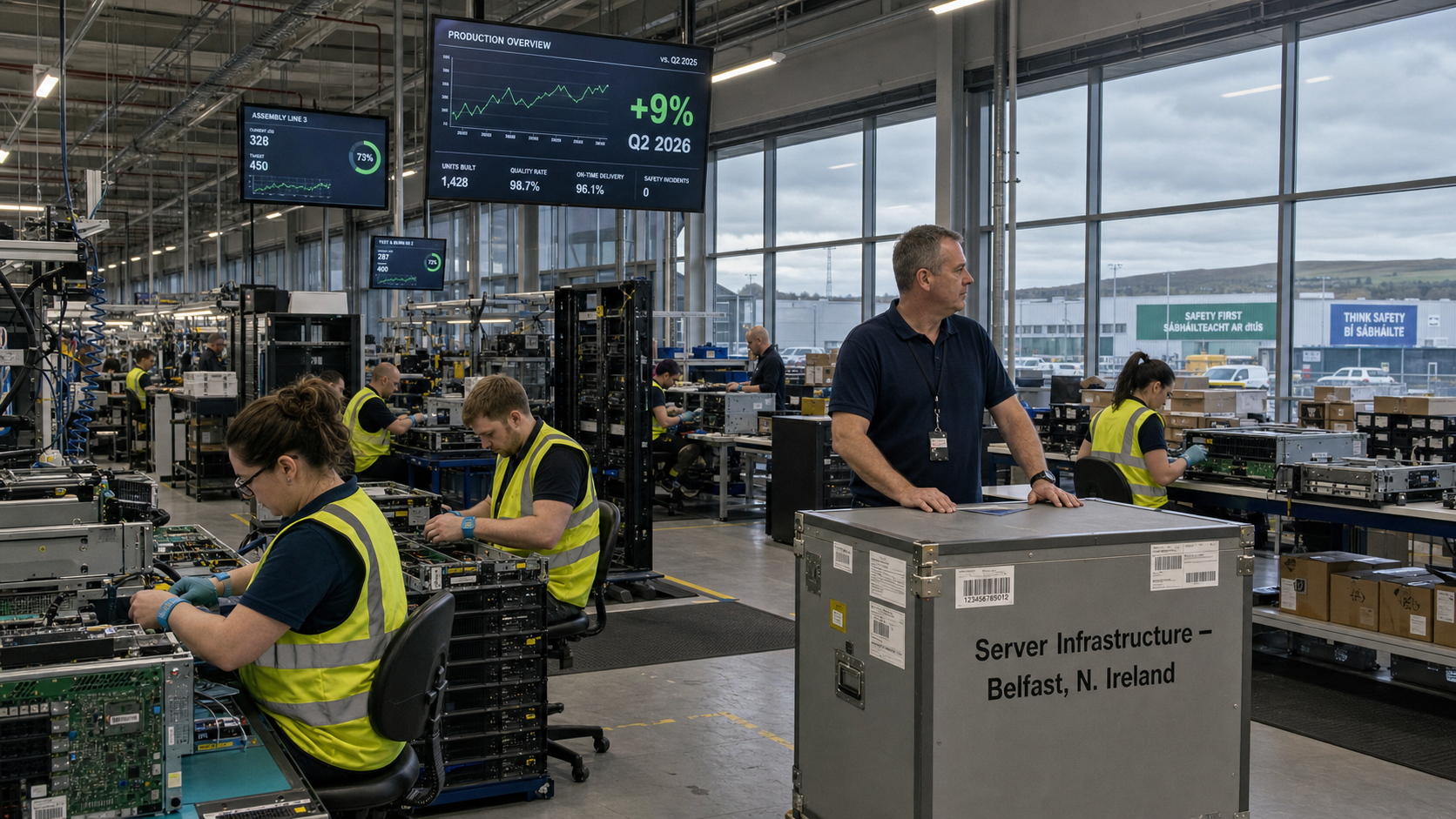
Northern Ireland Manufacturing Surges 9% as Data Centre Boom Drives Electronics Sector to Record Growth
Northern Ireland's manufacturing sector has recorded annual growth of 9% in the second quarter of 2026, dramatically outpacing the UK average of 1.2% and marking one of the strongest performances in the region's industrial history, as the global proliferation of data centres and artificial intelligence infrastructure creates a specialised cluster of high-value businesses across the province.
Background
Northern Ireland's manufacturing base has undergone a significant transformation over the past decade. The decline of traditional industries — linen, shipbuilding, and heavy engineering — that defined the regional economy for much of the twentieth century has been partially offset by the growth of advanced manufacturing, particularly in the electronics, aerospace, and food processing sectors. However, the scale of the current data centre-driven boom represents something qualitatively different: a sustained, structural shift in demand that is reshaping the composition of the manufacturing sector in real time.
The global data centre construction market has been growing at an extraordinary pace since 2023, driven by the computational requirements of large language models, cloud computing infrastructure, and the proliferation of AI-powered services. Data centres require enormous quantities of specialised electrical equipment — power distribution units, cooling systems, uninterruptible power supplies, and high-voltage switchgear — and Northern Ireland has developed a cluster of businesses with the expertise to supply these components at scale.
The Seagate factory in Londonderry has been a significant contributor to the regional growth figures, producing hard disc drives that are critical for storing the vast datasets required by AI companies including Microsoft, Google, and OpenAI. The factory, which employs several hundred people in the city, has expanded its production capacity in response to sustained demand from hyperscale data centre operators.
Key Developments
Official figures from the Northern Ireland Statistics and Research Agency confirm that the manufacturing sector grew by 9% on an annual basis in the second quarter of 2026, compared with a UK average of 1.2%. The computer, electronic, electrical, and optical products subsector — the category that captures most of the data centre supply chain activity — expanded by nearly 28% in the same period, a figure that has surprised even optimistic analysts.
TES in Ballykelly, County Londonderry, has been among the most prominent beneficiaries of the boom. The company, which manufactures power systems and electrical infrastructure for data centres, has reported "astronomical" demand for its products and has significantly expanded its workforce in response. Similar stories are being told by firms across the province, from Antrim to Newry, as the data centre supply chain extends its reach into the regional economy.
The BBC reported that the growth is not isolated to Northern Ireland. The Central Bank of the Republic of Ireland noted that imports of machinery and equipment rose by 56% in the second quarter of 2026, a pattern attributed to sustained investment in AI and data centre hardware across the island. The cross-border dimension of the boom is significant: several Northern Ireland firms are supplying data centres being built in the Republic, and the supply chain increasingly operates on an all-island basis.
Why It Matters
The data centre boom represents a genuine opportunity for Northern Ireland to diversify its economic base and reduce its dependence on public sector employment, which accounts for a higher proportion of the workforce in Northern Ireland than in any other part of the United Kingdom. The manufacturing jobs being created in the electronics and electrical equipment sectors tend to be well-paid, skilled positions that offer career progression and stability — precisely the kind of employment that economic development agencies have been seeking to attract for decades.
However, the boom also carries risks. The data centre sector is highly cyclical, and the extraordinary growth rates of 2025 and 2026 are unlikely to be sustained indefinitely. Firms that have expanded rapidly to meet current demand may face difficult decisions if the pace of data centre construction slows. The concentration of growth in a relatively small number of subsectors also means that the regional economy remains vulnerable to shifts in global technology investment patterns.
Local Impact
The manufacturing boom is having a tangible impact on communities across Northern Ireland. In Ballykelly and the wider Limavady area, the expansion of TES has created employment opportunities that have reduced the need for young people to leave the area in search of work. In Londonderry, the Seagate factory's continued investment has provided stability in a city that has historically struggled with higher-than-average unemployment rates.
Invest Northern Ireland has been active in promoting the region's capabilities to international data centre developers, and several major projects are understood to be at advanced stages of planning. The agency has identified the data centre supply chain as a priority sector for inward investment, and it is working with local universities — including Ulster University and Queen's University Belfast — to develop the skills pipeline that the sector will require over the coming decade.
What's Next
The third quarter 2026 manufacturing figures are expected to be published in November, and analysts will be watching closely to see whether the extraordinary growth rates of the second quarter have been sustained. Invest Northern Ireland is expected to announce a new data centre supply chain development programme before the end of the year, and several planning applications for new data centre facilities in the greater Belfast area are currently under consideration by local councils.