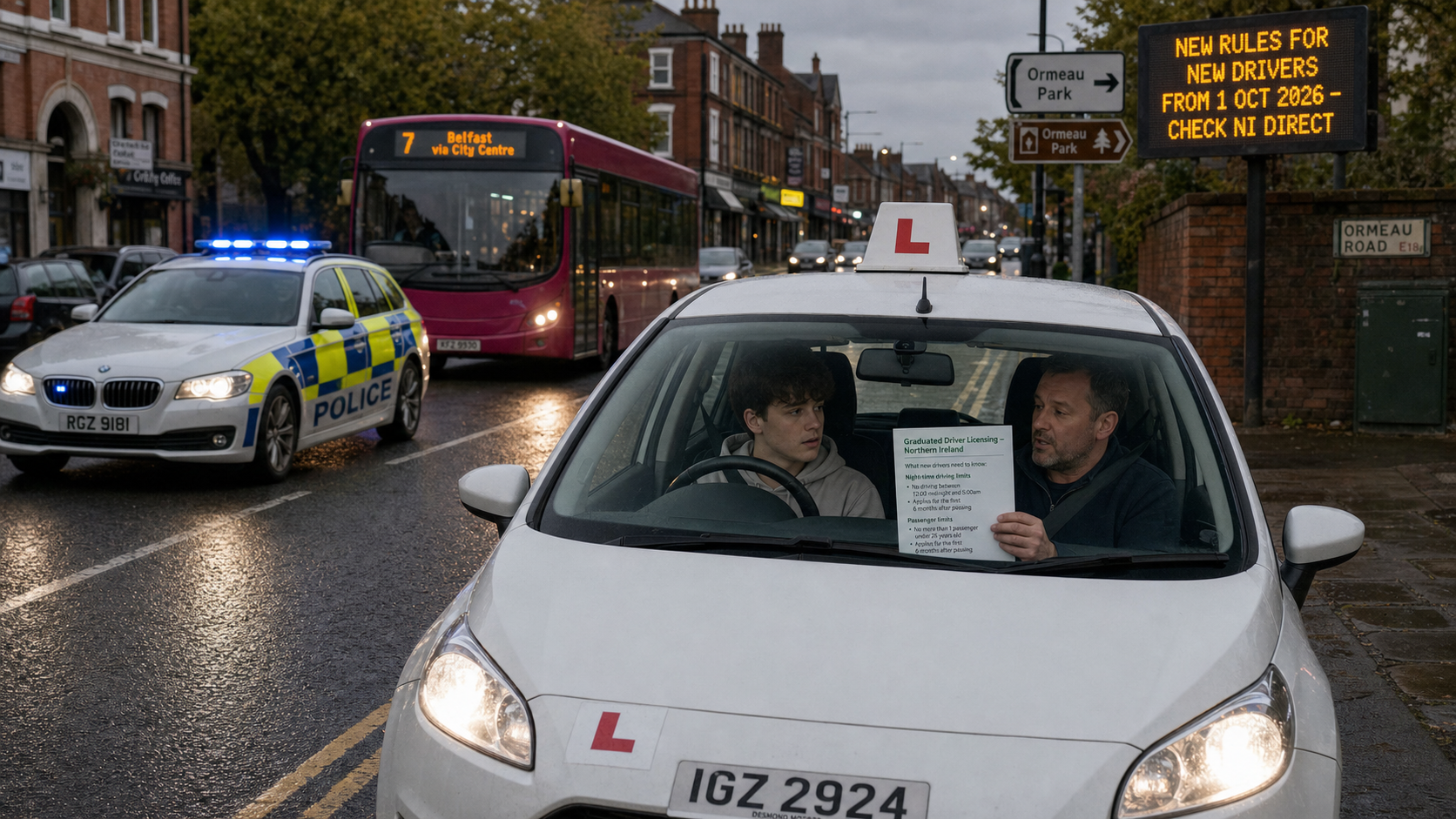
Northern Ireland Introduces Graduated Driver Licensing from October as New Rules Extend Probationary Period to Two Years
Northern Ireland will introduce a Graduated Driver Licensing scheme from 1 October 2026, extending the probationary period for new drivers to two years and introducing new restrictions on night-time driving and passenger numbers for those under 24. The reforms, aimed at reducing the disproportionate number of fatal and serious collisions involving young drivers, will also allow learner drivers to access motorways for the first time when accompanied by an approved instructor.
Background
Young drivers aged 17 to 23 are significantly over-represented in fatal and serious road traffic collisions in Northern Ireland. Despite accounting for a relatively small proportion of all licence holders, this age group is involved in a disproportionate share of the most serious crashes on Northern Ireland's roads. The pattern is not unique to Northern Ireland — it is a consistent finding across road safety research in the United Kingdom, Ireland, and internationally — but the consequences for families and communities across the province have been devastating.
Graduated Driver Licensing is an approach to road safety that has been adopted in various forms in Australia, New Zealand, Canada, and several US states, and has consistently been shown to reduce collision rates among young drivers. The core principle is that new drivers should be introduced to the full range of driving conditions gradually, with restrictions on the highest-risk situations — night-time driving and carrying multiple young passengers — during the early months after passing the test. The evidence base for GDL is robust, and its introduction in Northern Ireland has been recommended by road safety researchers and advocacy groups for many years.
The Department for Infrastructure, led by Minister Liz Kimmins, has been developing the GDL scheme for several years, and the October 2026 implementation date represents the culmination of an extensive consultation and legislative process. The reforms apply to those whose provisional licence entitlement begins on or after 1 October 2026, with a transition period for those already in the learning process.
Key Developments
Under the new scheme, learner drivers must wait at least six months after their provisional licence becomes valid before they can sit a practical driving test — a Mandatory Minimum Learning Period designed to ensure that new drivers have sufficient experience before taking to the roads independently. Learners must also complete a structured Programme of Training and record their progress in a digital logbook, which is a prerequisite for booking a practical test. The logbook app carries a £17 fee.
One of the most significant changes is the extension of the probationary period from 12 to 24 months. The two-year period is divided into two phases, indicated by different "R" plates: a blue plate on a white background for the first six months, during which night-time and passenger restrictions apply, and a white plate on a blue background for the remaining 18 months. During the first six months post-test, drivers under 24 are prohibited from carrying more than one passenger aged 14 to 20 between 11pm and 6am, with exemptions for immediate family members and situations where an experienced driver is in the front passenger seat.
The current 45mph speed restriction for newly qualified drivers will be removed under the new scheme, a change that has been welcomed by motoring organisations who argued that the restriction was creating dangerous situations on higher-speed roads. Learner drivers will, for the first time, be permitted to drive on motorways when accompanied by an Approved Driving Instructor — a change that aligns Northern Ireland with practice in Great Britain and addresses a significant gap in learner driver experience.
Why It Matters
The introduction of GDL in Northern Ireland is a significant road safety reform that has the potential to save lives and prevent serious injuries over the coming years. The evidence from jurisdictions that have implemented similar schemes is compelling: Australia's GDL system, introduced in various states from the 1990s onwards, has been associated with reductions of between 20% and 40% in crash rates among young drivers. New Zealand's scheme, introduced in 1987, is credited with a substantial reduction in young driver fatalities over the following decade.
For context, the Republic of Ireland does not yet have a comparable GDL scheme, though Minister for Transport Seán Canney has recently called for a review of the driving test curriculum to better reflect modern road conditions, including the possibility of incorporating motorway driving. The divergence between the two jurisdictions on this issue is notable, and the evidence from Northern Ireland's experience with GDL may inform future policy discussions in the Republic.
The reforms have been broadly welcomed by road safety organisations, including the Road Safety Authority equivalent in Northern Ireland and the Royal Society for the Prevention of Accidents. Some motoring organisations have raised concerns about the practical implications of the passenger restrictions for young people in rural areas, where car sharing is often essential for accessing work and social activities, and the Department has indicated that it will monitor the impact of the restrictions carefully.
Local Impact
For young people across Northern Ireland — from Belfast's outer suburbs to rural areas in Fermanagh, Tyrone, and Armagh — the new rules will require adjustments to how they plan their driving and social lives in the months after passing their test. The night-time passenger restrictions will be particularly significant in rural areas, where public transport options are limited and car sharing among young people is common. Driving instructors across the province have been preparing their students for the new requirements, and the DVA has been running an information campaign to ensure that learners and their families understand what the changes mean in practice. The extension of the probationary period to two years means that new drivers will need to maintain a clean licence for longer before the restrictions are lifted.
What's Next
The GDL scheme takes effect on 1 October 2026. Those who hold a provisional licence entitlement beginning before that date have until 31 March 2027 to complete their training and pass their practical test under the existing rules. From 1 April 2027, all learners must complete the new Programme of Training and Logbook before booking a practical test. The Department for Infrastructure has committed to reviewing the impact of the scheme after two years, with a particular focus on collision rates among young drivers and the practical implications of the passenger and night-time restrictions.