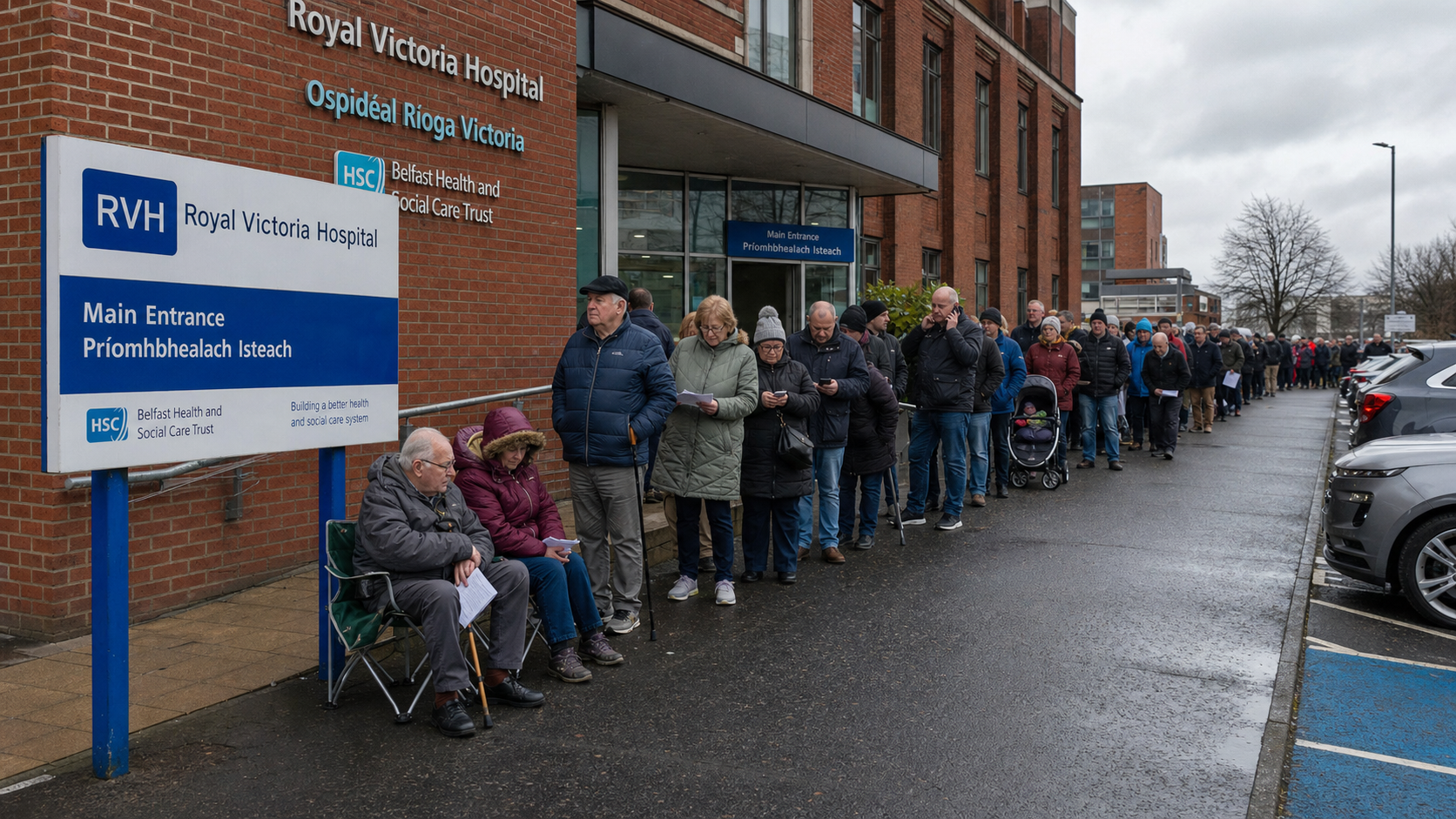
NI Waiting Lists Crisis Deepens as 542,000 Patients Queue for Consultant Appointments Amid Budget Freeze
Northern Ireland's health waiting list crisis has reached a new and deeply troubling milestone, with 542,451 patients waiting for a first consultant-led outpatient appointment as of the most recent official figures, the average wait now exceeding one year, and the longest recorded wait standing at 305 weeks — nearly six years — as the Stormont budget deadlock continues to prevent the investment needed to address the backlog.
Background
Northern Ireland's health service has been in a state of managed crisis for the better part of a decade. The region's five health and social care trusts — Belfast, South Eastern, Southern, Western, and Northern — operate under the oversight of the Department of Health and are funded through the block grant provided to the Stormont Executive. The structural underfunding of that grant, combined with the particular demands of a divided health system that historically developed duplicate services on both sides of the community divide, has left the service chronically short of the resources needed to meet demand.
The waiting list problem predates the COVID-19 pandemic, but the pandemic dramatically accelerated it. The cancellation of routine procedures and the redeployment of staff to urgent care during 2020 and 2021 created a backlog that the system has never recovered from. Unlike England, which has implemented a Referral to Treatment tracking system that follows patients through their entire care journey, Northern Ireland remains the only UK region without a fully operational RTT system, making it difficult to accurately measure the true scale of the problem or compare performance with other regions.
The Encompass electronic patient record system, which is being rolled out across NI's health trusts, is intended to provide a more accurate and comprehensive picture of the waiting list landscape. However, its implementation has been slower than planned, and the full benefits of the system are not expected to be realised for several years.
Key Developments
The latest official statistics, covering the period to September 2025, show that 542,451 patients are waiting for a first outpatient appointment with a hospital consultant. More than 85 per cent of those patients have waited longer than the nine-week target, and 55 per cent have waited longer than 52 weeks. The longest recorded wait stands at 305 weeks — approximately five years and ten months — a figure that represents a profound failure of the system's duty of care to individual patients.
In addition to the outpatient waiting list, more than 225,000 people are waiting for diagnostic tests, including MRI scans, CT scans, and endoscopies. The endoscopy waiting list, which had been reduced by 62 per cent through a targeted intervention programme, has begun to grow again as the funding for that programme has been constrained by the budget deadlock.
The Northern Ireland Audit Office has previously warned that the waiting list crisis cannot be resolved without sustained, multi-year investment in both capacity and workforce. The £73 million that was diverted from the waiting list reduction fund to cover the Department of Health's budget deficit in late 2025 represented a significant setback, effectively undoing months of progress in specific specialties.
Why It Matters
The waiting list figures are not statistics — they are people. Behind each of the 542,451 entries on the outpatient list is an individual living with pain, anxiety, or uncertainty about their health, unable to access the specialist assessment they need. The 305-week wait — nearly six years — is an extreme case, but it is not an isolated one. Thousands of patients have been waiting for more than three years for appointments in specialties including orthopaedics, dermatology, and ophthalmology.
The connection between the waiting list crisis and the Stormont budget deadlock is direct and consequential. Without an agreed multi-year budget, health trusts cannot plan the capital investment in theatre capacity, diagnostic equipment, and workforce expansion that would be needed to make a meaningful dent in the backlog. The £1.5 billion over three years currently on the table from the UK government, if agreed, would provide some relief — but health economists have consistently argued that the scale of investment required to bring NI's waiting lists to a comparable level with England is significantly larger than any package currently under discussion.
Local Impact
The impact of the waiting list crisis is felt differently across Northern Ireland's health trust areas. The Belfast Trust, which covers the city and its immediate hinterland, has the highest absolute numbers of patients waiting, with the Royal Victoria Hospital and Belfast City Hospital both operating under sustained pressure. The Western Trust, covering Derry and the wider west, has some of the longest waits in specific specialties, partly reflecting the historical underinvestment in health infrastructure west of the Bann. The Southern Trust, covering Armagh, Newry, and Banbridge, has been particularly affected in orthopaedics and general surgery. GP practices across all trust areas report that patients are increasingly presenting with conditions that have deteriorated significantly during their wait for specialist assessment.
What's Next
The Department of Health is expected to publish updated waiting list statistics covering the period to August 2026 on 24 September 2026. The figures are expected to show continued deterioration. The Stormont budget negotiations, if successful, could unlock additional funding for waiting list reduction programmes before the end of the financial year. Professor Mark Taylor, appointed in July 2025 to lead the waiting list reduction effort, is due to present an updated action plan to the Health Minister in October.