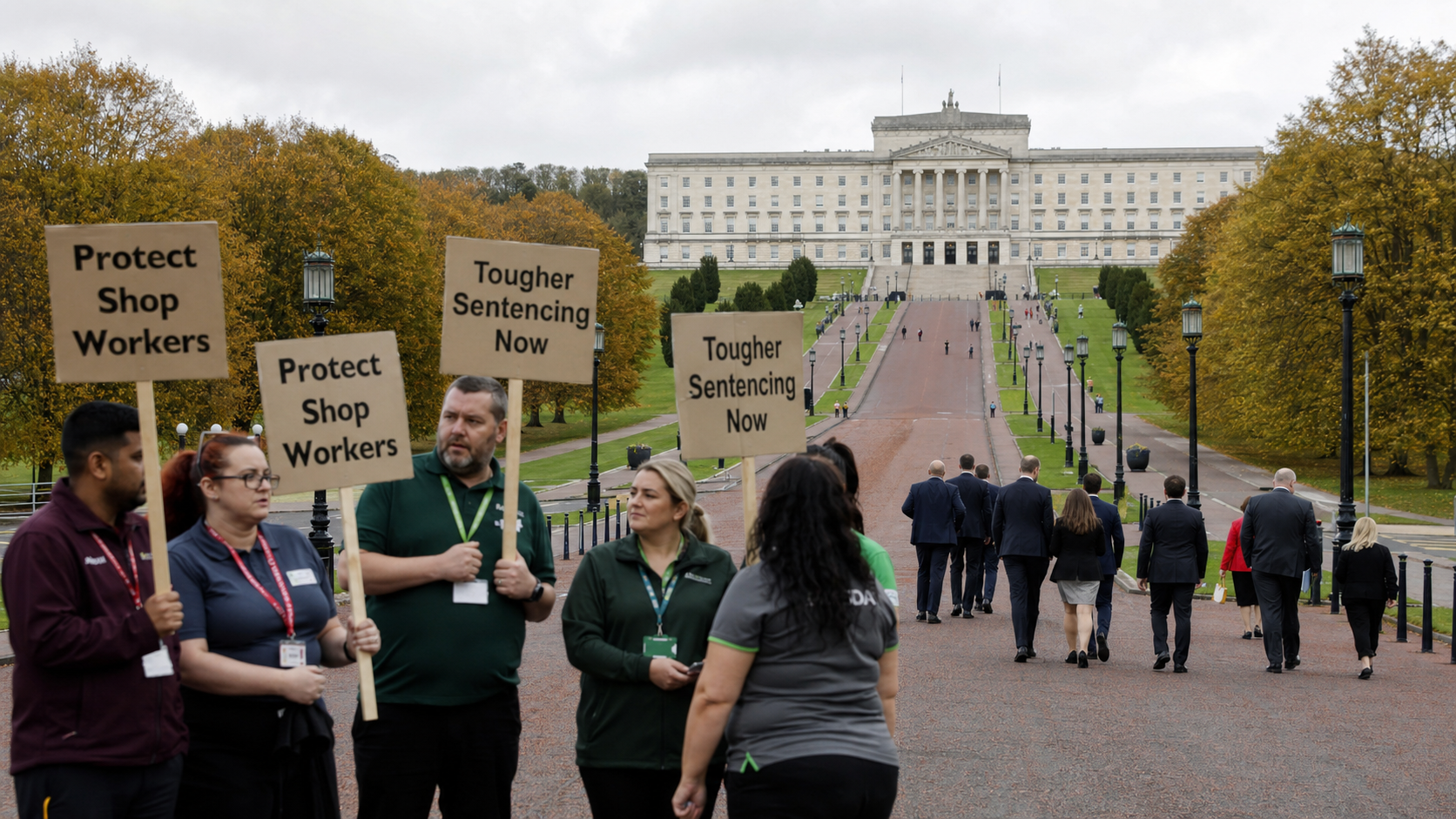
Helen Edwards has worked in retail for years, but lately she dreads the start of each shift. "Like anybody else, I get up in the morning and get ready to go to work — except I have no idea whether I'll be safe when I get there," she told a Stormont committee hearing this week.
Edwards, a representative of the Union of Shop, Distributive and Allied Workers (USDAW), described a working environment where confrontations with shoplifters or aggressive customers occur two to three times a week — sometimes daily. "It seems that constantly we're phoning the police or writing up incident reports," she said. "We're only doing our jobs. We don't deserve to be shouted at like that."
Her testimony came as the Northern Ireland Assembly continues scrutiny of the new Sentencing Bill, introduced by Justice Minister Naomi Long, which would make it a specific criminal offence to assault a public-facing worker. The legislation includes stronger sentencing aggravators for attacks on those delivering public services — from supermarket cashiers to healthcare receptionists and bus drivers.
A Growing Problem on Northern Ireland's High Streets
The bill arrives against a backdrop of sharply rising incidents of retail crime and worker abuse across Northern Ireland. The Northern Ireland Retail Consortium (NIRC) has documented a significant increase in both shoplifting and associated violence in recent years, a trend its director Neil Johnston described as "completely unacceptable."
Johnston welcomed the Sentencing Bill, saying it would give businesses "more clout to act" when staff are targeted. He noted that the current legal framework treats assaults on retail workers the same as any other assault, with no recognition of the particular vulnerability of those who cannot simply walk away from a confrontation.
For Edwards, the psychological toll is as significant as the physical risk. She described being confronted by a perpetrator outside her workplace — an experience that left her shaken. "Inside your work, you're braver because you have your colleagues around to support you," she said. "Outside, it was scary when somebody accosts you." She added that younger colleagues in particular find the environment intimidating, and that staff turnover in the sector has worsened as a result.
What the Legislation Would Do
The Sentencing Bill, currently progressing through the Assembly's Justice Committee, would create a new category of aggravated assault specifically targeting public-facing workers. Under the proposed legislation, courts would be required to treat an assault on a worker in a public-facing role as a more serious offence, with sentencing guidelines reflecting that aggravation.
A spokesperson for the Department of Justice said the legislation aims to address "increasing concerns about assaults on workers serving the public" and to send a clear message that such behaviour will not be tolerated. The bill mirrors similar legislation introduced in Scotland and England and Wales in recent years, where specific offences for assaulting retail workers have been credited with raising awareness and improving reporting rates.
Justice Minister Naomi Long has been a consistent advocate for the measure, arguing that public-facing workers are disproportionately exposed to risk and deserve specific legal protection. "Nobody should go to work fearing for their safety," she said during the bill's second reading. "These workers keep our communities running, and the law should reflect the seriousness with which we view attacks on them."
Businesses Taking Matters Into Their Own Hands
While the legislation works its way through Stormont, many Northern Ireland retailers have not waited for the law to change. A growing number of businesses have joined the Business Crime Reduction Partnership (BCRP) initiative, which uses a shared app to flag incidents and circulate crime alerts across participating retailers.
Damien Corr from the Cathedral Quarter Business Improvement District in Belfast described the app as a practical response to the delays in non-emergency police response times. Adult repeat offenders are flagged through the system, allowing businesses to share intelligence and take preventative action. "It's not a replacement for policing," Corr said, "but it gives us a way to protect ourselves and our staff in real time."
The Police Service of Northern Ireland (PSNI) has acknowledged concerns about non-emergency call waiting times and has emphasised the need for a multi-agency approach to the problem. Superintendent Cunningham, speaking at a recent retail crime forum, said: "This is not just a policing issue. It requires a multi-agency approach to ensure Northern Ireland's retail sector remains safe."
Unions and Retailers United in Support
The bill has drawn unusually broad support from both trade unions and business groups — a coalition that reflects the scale of the problem. USDAW, which represents hundreds of thousands of retail workers across the UK and Ireland, has campaigned for specific legal protections for shop staff for several years, arguing that the current law leaves workers feeling like "second-class citizens" in the eyes of the justice system.
That phrase — second-class citizens — has resonated strongly in the Assembly debate. Several MLAs from across the political spectrum have cited it in their contributions, and it has become something of a rallying cry for those pushing the bill through committee. The Alliance Party, Sinn Féin, the SDLP, and the Ulster Unionist Party have all expressed support for the principle of the legislation, though some amendments are expected at committee stage.
The Democratic Unionist Party has also indicated broad support, with one DUP MLA noting that retail workers in her constituency had raised the issue repeatedly at advice clinics. "These are people who serve their communities every single day," she said. "They deserve to feel safe at work."
A Signal of Intent from Stormont
The Sentencing Bill is one of several pieces of legislation currently progressing through the Assembly that reflect a renewed focus on community safety and public services. Its passage would mark a significant moment for Northern Ireland's retail and public service sectors, and for the tens of thousands of workers who interact with the public every day.
For Helen Edwards, the legislation cannot come soon enough. "We just want to be able to do our jobs without being afraid," she said. "Is that really too much to ask?" If the Assembly passes the bill as expected later this year, the answer, at last, will be no.