NI Leasehold Flat Owners Demand Right to Challenge as Service Charges Triple Without Explanation
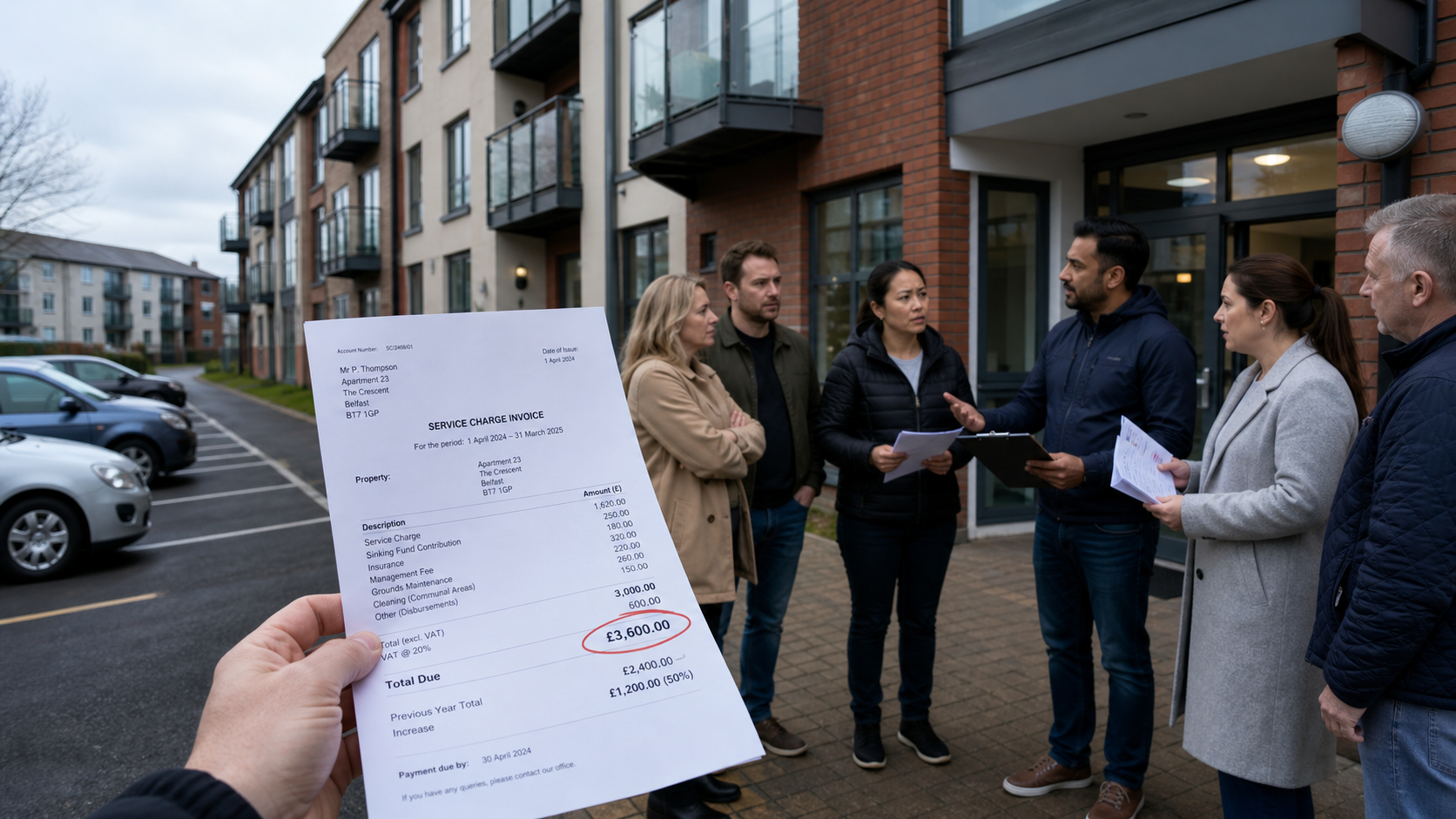
Owners of leasehold flats across Northern Ireland are demanding a statutory right to challenge property service charges after fees for the maintenance and management of shared areas trebled in some developments, leaving residents facing bills they say bear no relation to the services actually provided and with no effective legal mechanism to contest them.
Background
Leasehold property ownership is a form of tenure in which the buyer purchases the right to occupy a property for a fixed term — typically 99 or 125 years — while the freehold, or outright ownership of the land and building, remains with a separate party. Leaseholders are typically required to pay service charges to the freeholder or a management company to cover the costs of maintaining shared areas such as lifts, communal gardens, entrance halls, and building exteriors.
The leasehold system has been the subject of sustained criticism across the United Kingdom for many years, with campaigners arguing that it creates a structural power imbalance between freeholders and leaseholders. Freeholders and management companies can set service charges at levels that leaseholders have limited ability to contest, and the costs of challenging unreasonable charges through the courts or tribunals can be prohibitive for individual flat owners.
In England and Wales, the Leasehold and Freehold Reform Act 2024 introduced new protections for leaseholders, including requirements for greater transparency in service charge demands and stronger rights in disputes. However, property law is a devolved matter, and Northern Ireland has not enacted equivalent legislation. This means that leaseholders in Northern Ireland currently have fewer statutory protections than their counterparts in England and Wales, a disparity that has become increasingly apparent as service charges have risen sharply in recent years.
Key Developments
Leaseholders in a number of Northern Ireland developments have reported that their annual service charges have trebled in recent years, with some facing bills of several thousand pounds per year for services they say are inadequate or poorly documented. In several cases, residents say they have received service charge demands with minimal breakdown of costs, making it impossible to assess whether the charges are reasonable or to identify specific items they wish to contest.
The affected leaseholders are calling for the introduction of legislation in Northern Ireland that would give them a statutory right to challenge service charges before an independent tribunal, similar to the First-tier Tribunal (Property Chamber) that operates in England and Wales. They are also seeking requirements for management companies to provide detailed annual accounts showing how service charge funds have been spent, and protections against being required to pay a freeholder's legal costs in the event of a dispute.
The issue has been raised at Stormont, where several MLAs have called on the Department of Finance to bring forward legislation addressing the leasehold service charge problem. The Department has indicated it is monitoring developments in England and Wales and considering whether equivalent measures are needed in Northern Ireland.
Why It Matters
The leasehold service charge issue affects a significant number of households in Northern Ireland, particularly in Belfast and other urban areas where apartment living has become more common over the past two decades. The growth of the apartment sector in cities like Belfast, driven by planning policies encouraging higher-density development in urban cores, has brought with it a corresponding growth in the number of leaseholders exposed to service charge disputes.
The absence of effective challenge mechanisms means that leaseholders who believe their service charges are unreasonable face a stark choice: pay up or pursue costly and uncertain legal action. For many flat owners, particularly those on modest incomes or with mortgages, the prospect of a legal battle with a well-resourced management company is simply not viable. This power imbalance allows management companies to set charges at levels that may not be justified by the actual costs of maintaining the building, with leaseholders having little practical recourse.
The disparity between Northern Ireland and England and Wales in this area of law is increasingly difficult to justify. Leaseholders in Belfast face the same structural vulnerabilities as those in Manchester or Birmingham, but without the statutory protections that Westminster has introduced for English and Welsh leaseholders.
Local Impact
The issue is particularly acute in Belfast's apartment developments, many of which were built during the property boom of the 2000s and are now reaching the point where major maintenance works — and the associated service charge increases — are becoming unavoidable. Developments in the Cathedral Quarter, the Titanic Quarter, and the Ormeau Road area have all seen service charge disputes in recent years. In Derry, leaseholders in several city centre apartment blocks have reported similar problems. The Northern Ireland Housing Executive has been asked to provide guidance to affected leaseholders, but its remit does not extend to private leasehold disputes. The Consumer Council for Northern Ireland has called for urgent legislative action to address the gap in consumer protection.
What's Next
The Department of Finance is expected to publish a consultation paper on leasehold reform in Northern Ireland before the end of 2026. Campaigners are pushing for legislation to be introduced at Stormont before the May 2027 Assembly election, arguing that the issue affects tens of thousands of households and deserves urgent attention. The Leasehold Reform Group Northern Ireland, a newly formed campaign organisation, has announced plans to hold public meetings in Belfast and Derry in October to build support for legislative change.