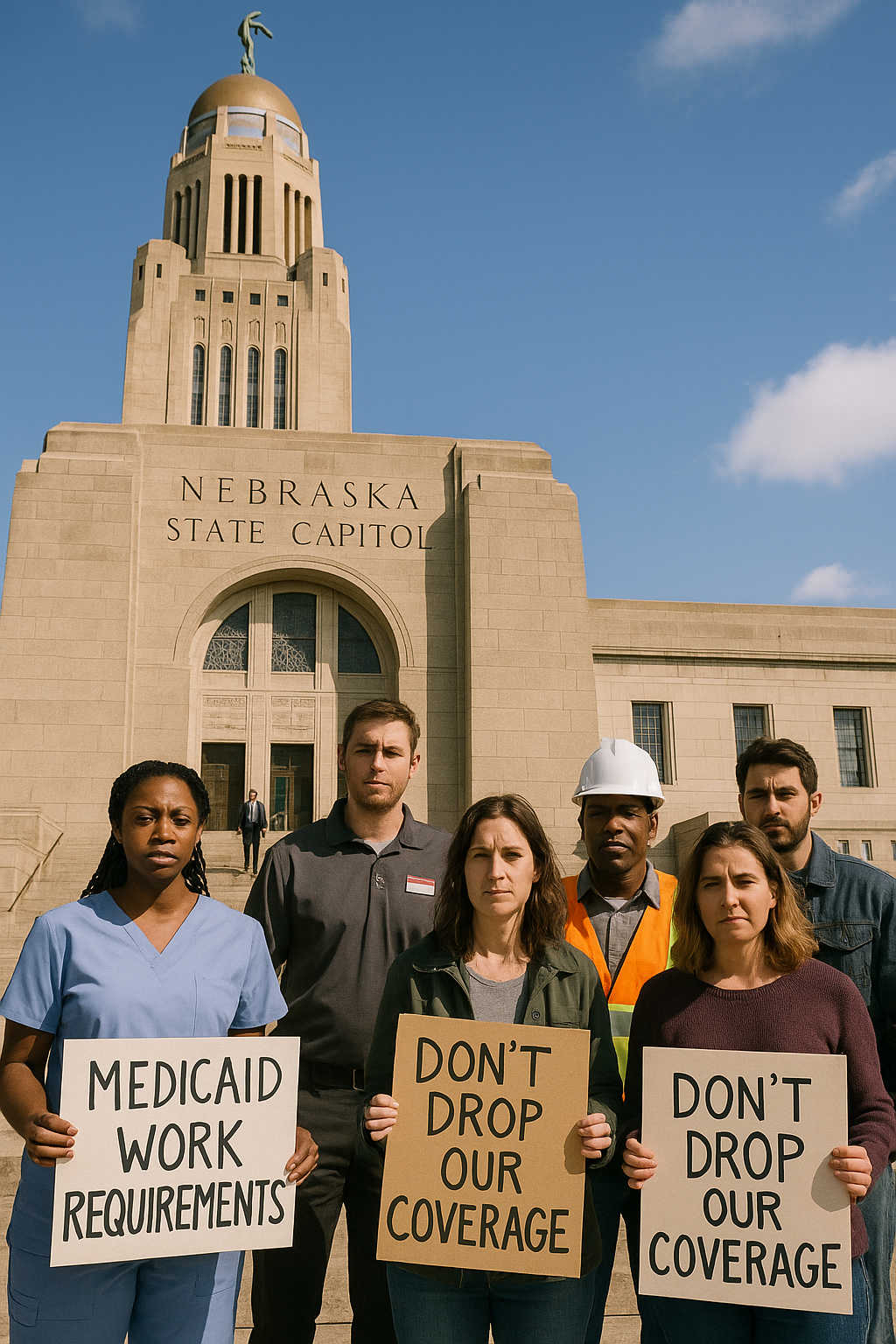
Nebraska Becomes First State to Enforce Medicaid Work Requirements Under Federal Mandate
Nebraska activated Medicaid work requirements on May 1, 2026, making it the first state in the nation to enforce the policy ahead of the federal deadline set by the One Big Beautiful Bill Act. Governor Jim Pillen and Centers for Medicare & Medicaid Services Administrator Dr. Mehmet Oz announced the implementation together, requiring able-bodied adults aged 19 to 64 in the Medicaid expansion population to complete at least 80 hours per month of work, schooling, volunteering, or other approved activities to maintain their health coverage.
Background
Medicaid work requirements have been a long-standing goal of Republican policymakers who argue that attaching conditions to public benefits encourages self-sufficiency and reduces dependency. The One Big Beautiful Bill Act, passed by the Republican-controlled Congress and signed by President Trump, mandated that all states implement work requirements for the Medicaid expansion population by January 1, 2027. Nebraska, under Governor Pillen, moved to implement the policy eight months ahead of that deadline.
The Medicaid expansion population in Nebraska consists of adults with incomes up to 138% of the federal poverty level — approximately $21,610 for a single person or $44,380 for a family of four in 2025. Nebraska expanded Medicaid in 2020 following a voter-approved ballot initiative, adding roughly 90,000 residents to the program. The work requirements apply to that expansion population, not to traditional Medicaid recipients such as children, pregnant women, or the elderly.
Key Developments
Under Nebraska's implementation, eligible adults must document at least 80 hours per month of qualifying activities. Approved activities include employment, enrollment in school at least half-time, participation in an apprenticeship program, volunteering, and community service. The Nebraska Department of Health and Human Services will use existing data to verify compliance where possible; individuals whose compliance cannot be confirmed through data will be required to submit documentation themselves.
Enrollees found non-compliant receive a notice and have 30 days to meet the requirement or claim an exemption before facing denial or disenrollment. Nebraska officials stated they will allow enrollees to self-attest to volunteering, schooling, or qualifying exemptions — such as poor health or caregiving responsibilities — without requiring supporting documentation like medical records.
Exemptions are broad and include people with disabilities, pregnant women, parents or guardians of children under 13, caregivers of individuals with disabilities, foster care alumni through age 25, members of recognized Native American tribes, disabled veterans with total disability status, individuals in substance abuse treatment, and those who are incarcerated or recently released.
Why Americans Should Care
Nebraska's implementation is a direct preview of what 49 other states will face by January 2027. Health policy analysts are watching closely because previous state-level experiments with Medicaid work requirements produced alarming results. Arkansas implemented work requirements in 2018 and lost coverage for more than 18,000 people within months — the vast majority of whom were actually working but failed to navigate the reporting requirements. Georgia's program, launched in 2023, enrolled far fewer people than projected and generated significant administrative costs. In Nebraska, advocates warn that rural residents in counties like Scotts Bluff, Dawson, and Custer — where broadband access is limited and documentation burdens are higher — face the greatest risk of losing coverage through administrative failure rather than genuine non-compliance. The policy's national rollout will affect an estimated 20 million Medicaid expansion enrollees across the country.
Why It Matters
The debate over Medicaid work requirements cuts to the heart of a fundamental disagreement about the purpose of public health insurance. Proponents argue that work requirements align Medicaid with the structure of other means-tested programs like SNAP and TANF, and that employment itself improves health outcomes. Opponents counter that the evidence base for this claim is thin and that the primary effect of work requirements is coverage loss through administrative complexity rather than increased employment.
Research from the Kaiser Family Foundation and the Urban Institute consistently finds that the overwhelming majority of Medicaid expansion enrollees who are not working are either caregivers, students, or individuals with health conditions that prevent employment — categories that should qualify for exemptions but often fail to navigate the paperwork. The international comparison is instructive: no other wealthy democracy conditions health coverage on employment status. Canada, Germany, France, and the United Kingdom provide universal coverage regardless of work status, reflecting a consensus that health care access should not be contingent on labor market participation. Nebraska's rollout will generate data that shapes the national debate — and potentially the legal challenges — over whether work requirements achieve their stated goals or simply reduce enrollment.
What's Next
Nebraska's compliance data will be closely monitored by health policy researchers and advocacy groups. Legal challenges to the federal work requirement mandate are already being prepared by organizations including the National Health Law Program and the Center on Budget and Policy Priorities, who argue the requirements exceed federal Medicaid authority. Other states considering early implementation include Georgia, which already has a limited work requirement program, and Texas, which has signaled interest in moving ahead of the federal deadline. The January 2027 national deadline will trigger the largest simultaneous change to Medicaid eligibility rules in the program's 60-year history.
Sources: NPR; Nebraska Governor's Office; Washington Times