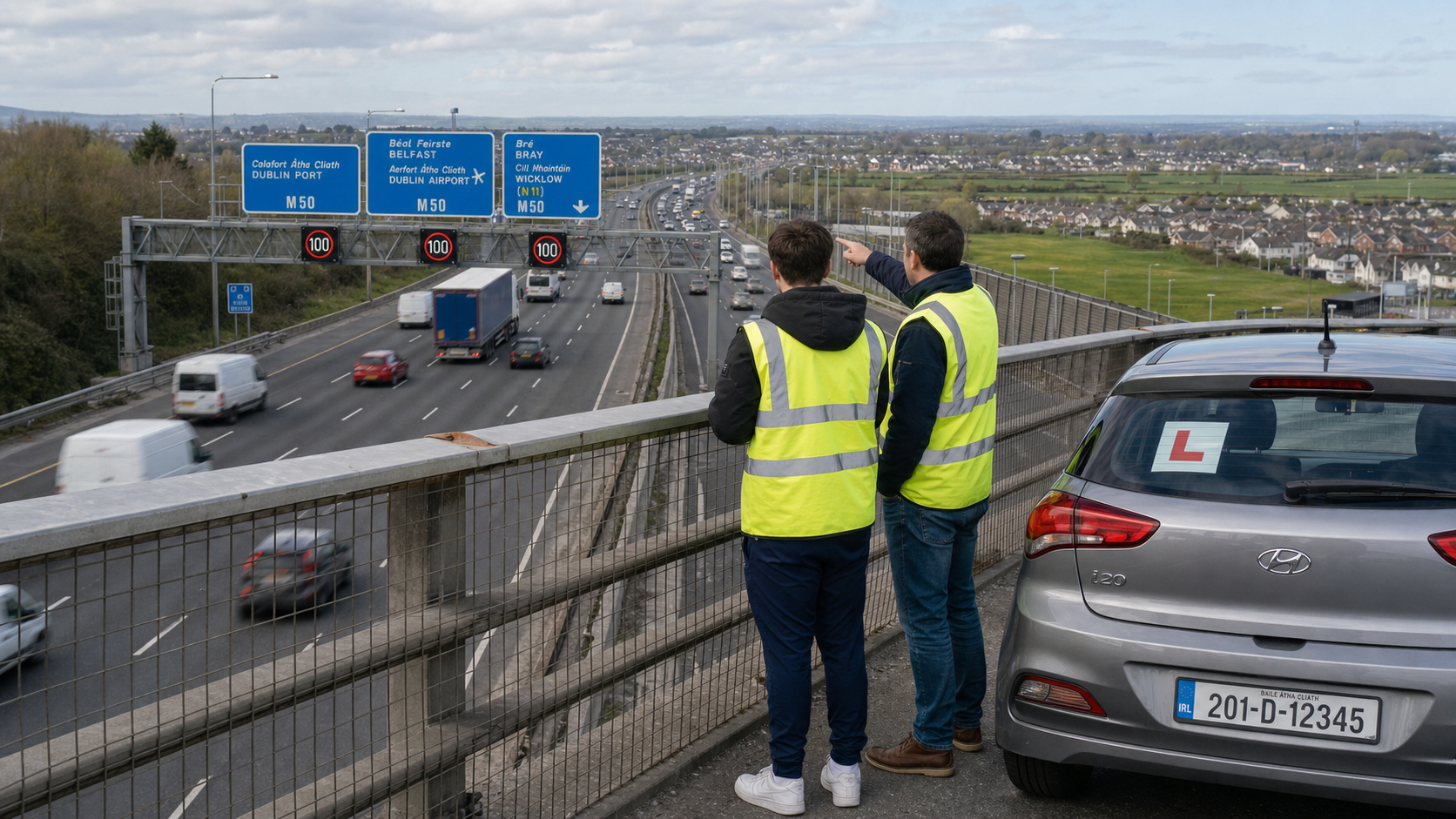
Minister Calls for Motorway Driving in Irish Driving Test as Republic Lags Behind Northern Ireland on Road Safety Reform
Junior Transport Minister Seán Canney has called for a review of the Irish driving test curriculum to include motorway competence, as the Republic of Ireland falls behind Northern Ireland, which is introducing a comprehensive Graduated Driver Licensing scheme from 1 October 2026. Canney has suggested using simulators for areas without motorway access and has asked the Road Safety Authority to examine the issue, but critics have noted that the proposal remains at the discussion stage while Northern Ireland moves ahead with substantive reform.
Background
The Irish driving test has not been substantially reformed in many years, and the exclusion of motorway driving from both the learner driver curriculum and the practical test has long been identified as a significant gap in road safety preparation. Under current rules, learner drivers in the Republic of Ireland are prohibited from driving on motorways even when accompanied by a qualified driver. Once a driver passes the test and obtains a full licence, they are immediately permitted to drive on motorways — a transition that road safety experts have described as abrupt and potentially dangerous.
The contrast with Northern Ireland is stark. From 1 October 2026, Northern Ireland will introduce a Graduated Driver Licensing scheme that includes, for the first time, the right for learner drivers to access motorways when accompanied by an Approved Driving Instructor. The scheme also extends the probationary period for new drivers to two years and introduces restrictions on night-time driving and passenger numbers for those under 24. The evidence base for GDL is robust, with jurisdictions that have implemented similar schemes — including Australia, New Zealand, and Canada — recording significant reductions in young driver collision rates.
The Road Safety Authority in the Republic has been aware of the case for GDL for many years, and various reports and consultations have recommended its introduction. However, the legislative and administrative changes required to implement a full GDL scheme have not been prioritised, and the Republic has fallen behind not only Northern Ireland but also most comparable European countries in the sophistication of its approach to graduated licensing.
Key Developments
Minister Canney's comments, made in an interview with the Irish Examiner published on Tuesday, represent the most senior political endorsement of motorway driving in the Irish test to date. The Minister expressed support for incorporating motorway driving into both training and the test itself, and acknowledged the practical challenge that some regions — including County Donegal, which has no motorway — would face in implementing such a requirement. His proposed solution, the use of simulator training to ensure all learners achieve the necessary competence, is an approach that has been used in other jurisdictions and has some evidence of effectiveness.
The Minister indicated that he would ask the Road Safety Authority to review the current curriculum to bring it up to modern standards. The RSA, which is responsible for the driving test and road safety policy in the Republic, has previously indicated its openness to curriculum reform, but the pace of change has been slow. The RSA's most recent annual report noted that young drivers aged 17 to 24 continue to be over-represented in fatal and serious collisions on Irish roads, a finding that underlines the urgency of reform.
Road safety advocates have welcomed the Minister's comments while noting that a call for a review is not the same as a commitment to action. The Road Safety Authority of Ireland has been asked to examine the issue on previous occasions without substantive change resulting, and there is scepticism in some quarters about whether the current initiative will produce different outcomes.
Why It Matters
The gap between the Republic of Ireland and Northern Ireland on graduated driver licensing is a road safety issue with real consequences. Young drivers in the Republic face the same risks as their counterparts in Northern Ireland — the same over-representation in fatal and serious collisions, the same vulnerability to the specific hazards of night-time driving and peer passenger pressure — but without the structured framework of graduated licensing that Northern Ireland is now introducing. The evidence from jurisdictions that have implemented GDL is clear: the scheme saves lives.
For context, the Republic of Ireland has one of the higher rates of road fatalities per capita among comparable European countries, and young drivers are a disproportionate part of that figure. The introduction of GDL in Northern Ireland from October 2026 will create a situation in which a young driver in Newry faces a more structured and evidence-based licensing regime than a young driver in Dundalk, just across the border. That divergence is difficult to justify on road safety grounds.
The motorway competence issue is a specific and tractable problem within the broader GDL debate. The current situation — in which new drivers are permitted to drive on motorways immediately after passing a test that has never required them to demonstrate motorway competence — is anomalous by international standards and has been identified as a risk factor by road safety researchers. Minister Canney's call for a review is a step in the right direction, but the pace of reform needs to accelerate.
Local Impact
For learner drivers and their families across the Republic, the current situation means that the transition from learner to full licence holder involves an abrupt exposure to motorway driving for which many new drivers are inadequately prepared. Driving instructors across the country have noted that many of their students are anxious about motorway driving precisely because they have had no opportunity to practise it during their learning period. The RSA's proposed review of the curriculum will need to address this gap in a practical way that works for learners in all parts of the country, including those in areas without motorway access. The simulator option proposed by Minister Canney is one possible solution, but it would require significant investment in simulator facilities at driving test centres across the country.
What's Next
The Road Safety Authority is expected to respond to Minister Canney's request for a curriculum review in the coming weeks. Any changes to the driving test curriculum would require a period of public consultation and, potentially, legislative amendment. Road safety advocates have called for the government to commit to a specific timeline for the introduction of GDL in the Republic, rather than allowing the issue to remain at the discussion stage indefinitely. The RSA's annual road safety report, expected in the autumn, will provide updated data on young driver collision rates that will inform the policy debate.