Michelle O'Neill Insists Sinn Féin Will Not Walk Away from Stormont Despite Power-Sharing Tensions
First Minister Michelle O'Neill has moved decisively to contain speculation about the stability of the Stormont Executive, stating in unambiguous terms that Sinn Féin has no intention of withdrawing from the power-sharing institutions, even as the party faces internal pressure over the pace of progress on key issues and the Executive continues to grapple with a deeply contested budget for the current financial year.
Background
The Northern Ireland Executive has operated in a state of managed tension for much of 2026. The restoration of the institutions in early 2024, following the DUP's two-year boycott over the post-Brexit trading arrangements, was welcomed across the political spectrum as a necessary step towards stable governance. But the return to Stormont has not been without friction, and the months since restoration have been marked by persistent disagreements over budget allocations, the pace of public service reform, and the broader question of what power-sharing is actually delivering for citizens.
Sinn Féin senator Conor Murphy raised eyebrows in late July when he described the power-sharing arrangements as "precarious" and warned that the institutions could not function effectively without a genuine commitment from all parties to the principles of partnership government. His remarks were widely interpreted as a signal of frustration within Sinn Féin at the DUP's approach to Executive business, and they prompted immediate speculation about whether the party might be preparing the ground for a withdrawal from the institutions.
That speculation intensified in the context of the ongoing budget impasse. The Executive has yet to agree a budget for the current financial year, with Finance Minister John O'Dowd's draft multi-year budget for 2026-2030 having failed to secure cross-party support. The DUP described the draft as "deeply flawed", while the SDLP called it an "unambitious ghost budget". The result has been a period of financial uncertainty that has hampered departments' ability to plan and deliver services.
Key Developments
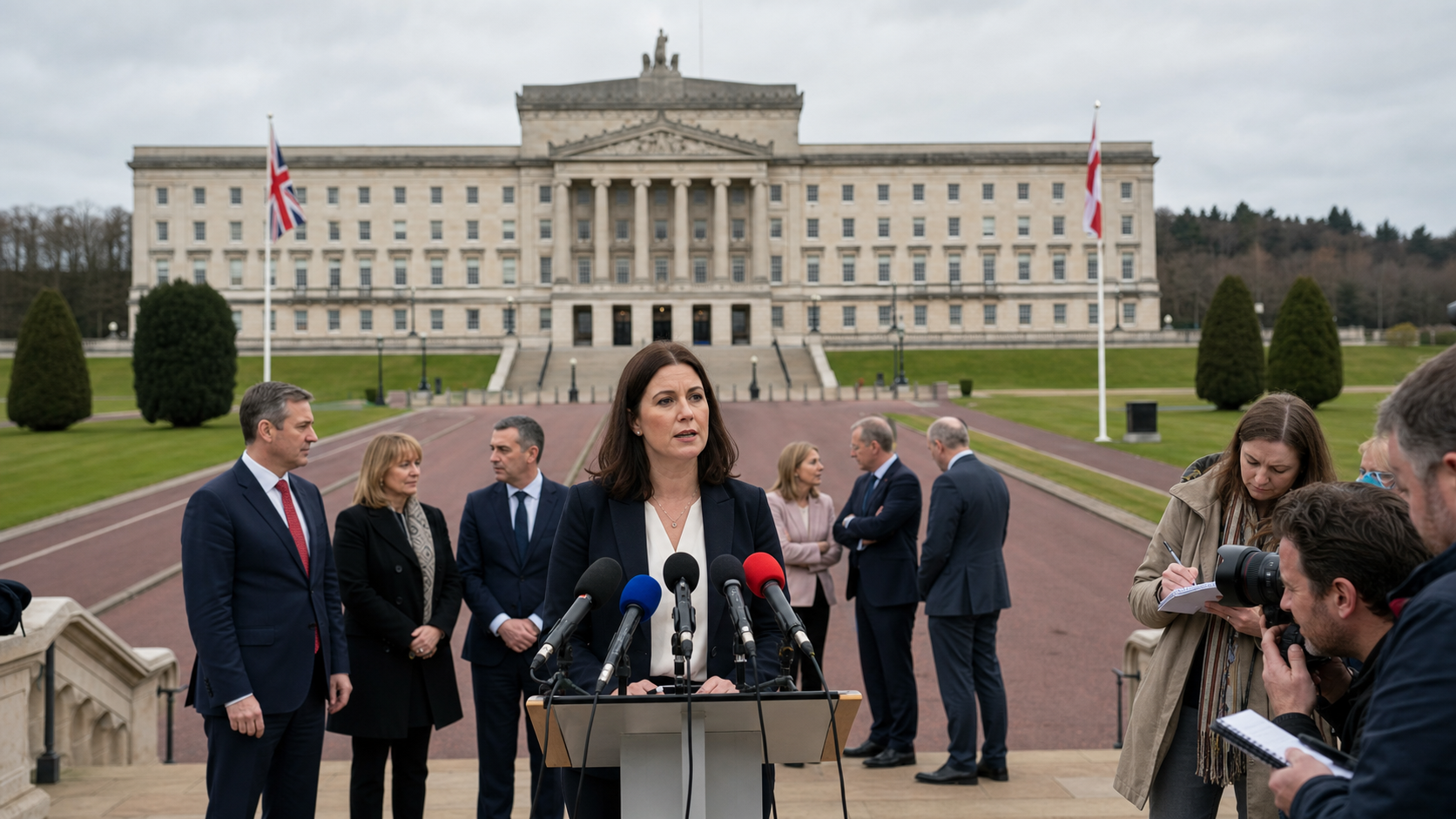
Speaking at a public event on Sunday, O'Neill was direct in her response to the speculation. Sinn Féin, she said, had "no intention of bringing Stormont down" and would not walk away from the institutions, regardless of the challenges involved in making power-sharing work. She acknowledged that the Executive faced difficulties from parties that were, in her assessment, "fundamentally opposed to power-sharing", but argued that abandoning the Assembly would be "disastrous" — handing control of public services to British Government ministers and removing the voice of nationalist and republican communities from the governance of Northern Ireland.
O'Neill also used the occasion to renew her criticism of Prime Minister Andy Burnham's remarks during his recent visit to Belfast, in which he described a border poll as "off the table". She described those comments as "divisive, arrogant, and ill-informed", arguing that the right to a referendum on Irish unity is enshrined in the Good Friday Agreement and is not a concession that any British prime minister has the authority to withdraw.
Why It Matters
The stability of the Stormont Executive matters enormously for the day-to-day lives of people across Northern Ireland. When the institutions collapse — as they have done repeatedly since their establishment in 1998 — the consequences are felt most acutely in public services: health waiting lists grow longer, infrastructure projects stall, and the capacity of the civil service to make long-term decisions is severely constrained. The two-year DUP boycott that ended in early 2024 left a legacy of deferred decisions and accumulated pressures that the Executive is still working through.
O'Neill's public commitment to the institutions is therefore significant, not just as a political statement but as a signal to the civil service, to business, and to the public that the Executive intends to function. Whether that commitment can be sustained in the face of ongoing budget difficulties and political tensions remains to be seen, but the First Minister's clarity on the question of withdrawal is, at minimum, a stabilising factor in an uncertain environment.
Local Impact
The budget impasse has real consequences for services across Northern Ireland. The Department of Health, which is facing a projected overspend of hundreds of millions of pounds, has warned that without a settled budget it cannot make the investment decisions needed to address waiting lists — which remain among the longest in the United Kingdom. The Department of Education, similarly, has flagged the risk of staff redundancies if the budget constraints are not resolved. In Belfast, Derry, Newry, and communities across the six counties, the uncertainty translates into delayed decisions on everything from school building programmes to road maintenance contracts.
What's Next
The Stormont Assembly returns from summer recess in September, at which point the budget impasse will move back to the top of the political agenda. Finance Minister John O'Dowd has indicated that he intends to bring a revised budget proposal to the Executive in the coming weeks, though whether it will secure the cross-party support needed for passage remains unclear. The DUP has signalled that it will not support any budget that it regards as inadequate for the needs of Northern Ireland's public services, while Sinn Féin has argued that the party's approach to budget negotiations has been obstructive. The coming weeks will test whether the Executive can find a way through.