MetroLink Cost More Than Doubles to Up to 17.5 Billion Euro as Government Approves Move to Tender Stage
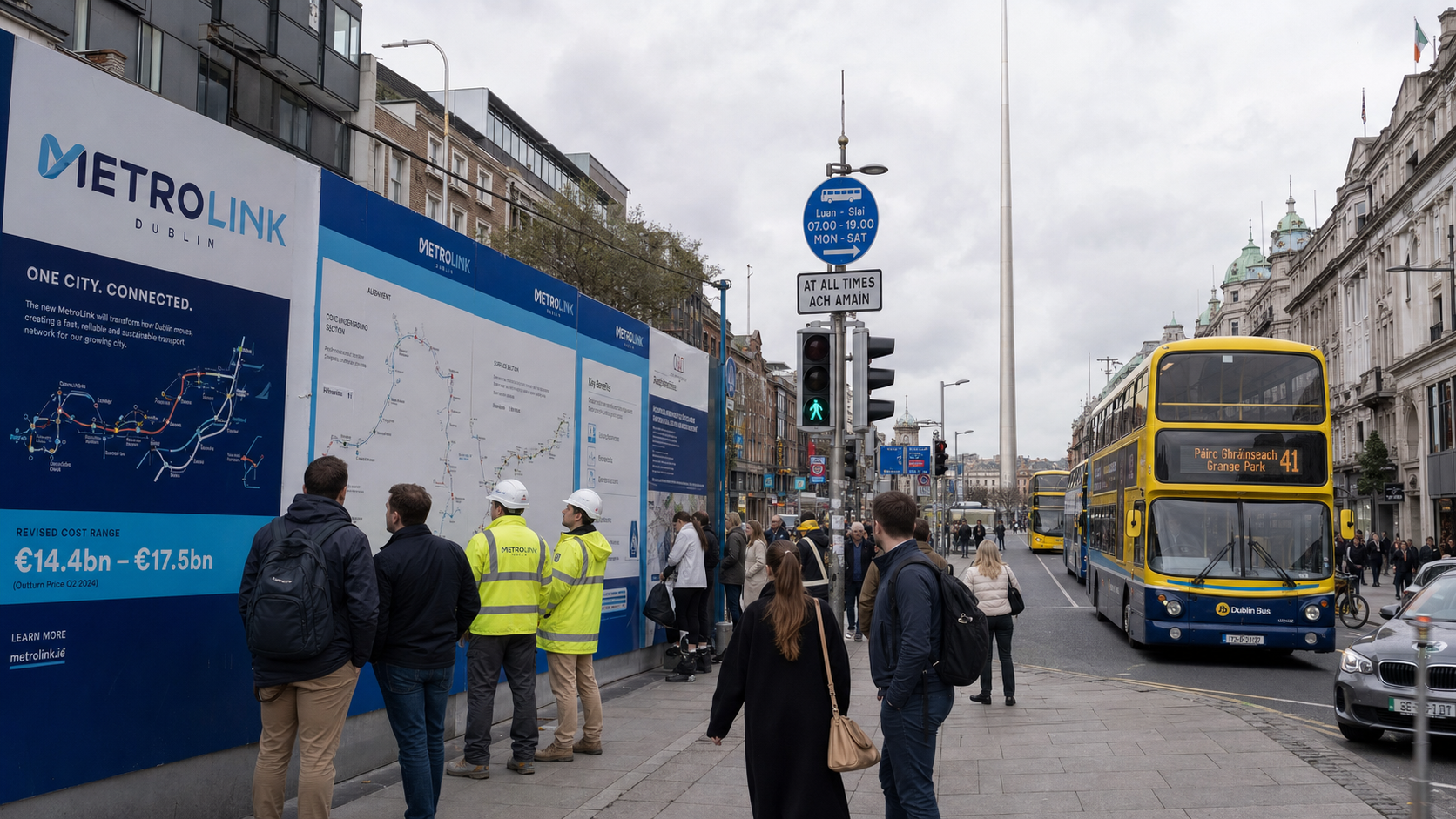
The Irish government has approved a revised cost estimate of between 14.4 billion and 17.5 billion euro for the MetroLink project — more than double the 2022 projection of 7.16 billion to 12.25 billion euro — as the 19.4km Dublin metro corridor advances to the formal procurement and tender stage, with construction expected to begin in 2027 and commercial operations targeted for the 2036-2038 timeframe.
Background
MetroLink has been one of the most discussed and most delayed infrastructure projects in Irish history. The concept of a Dublin metro has been on the drawing board in various forms since the early 2000s, with previous iterations — including Metro North and the Dart Underground — falling victim to the financial crisis of 2008 and subsequent austerity. The current MetroLink proposal, a 19.4km automated underground corridor connecting Swords in north County Dublin to Charlemont Street in the city centre, with 16 stations most of which will be underground, was approved in principle by the government in 2021 and has been progressing through the planning and design phases since then. The project is being developed by Transport Infrastructure Ireland and is designed to be fully automated — running without drivers — with trains capable of operating at frequencies of every three minutes at peak times, carrying up to 20,000 passengers per hour in each direction. The line will integrate with the DART and Luas networks, providing a high-capacity, low-carbon alternative to private car travel on one of the most congested corridors in the country. The cost escalation announced this week is substantial but not entirely surprising. Construction inflation has been running at elevated levels across Europe since 2021, and the more detailed design work carried out since the 2022 estimates has revealed additional complexities — particularly in the underground sections through Dublin city centre.
Key Developments
Transport Infrastructure Ireland chief executive Lorcan O'Connor attributed the cost increases primarily to construction inflation and more detailed design specifications. The new figures place the expected cost between 14.4 billion and 17.5 billion euro, with a median estimate of 15.75 billion euro. Internal briefing papers have noted that under P95 risk models — which account for a 95% certainty of completion within budget — potential outlays could reach as high as 23.39 billion euro. The final, definitive cost will not be confirmed until formal bids are received and evaluated, a process expected to conclude in late 2027. The government's decision to approve the revised cost range and advance the project to tender stage is significant. It signals that the coalition is committed to proceeding with MetroLink despite the cost escalation, and that the project's strategic importance — for housing, connectivity, and climate — outweighs the financial concerns. The project is expected to directly facilitate the development of approximately 77,000 new homes along the route, with potential for up to 200,000 units across the Greater Dublin Area. Work on the ground is anticipated to commence in 2027, with commercial operations currently targeted for the 2036-2038 timeframe. The project will also require the construction of housing for up to 2,000 workers during the construction phase.
Why It Matters
MetroLink is the single largest infrastructure investment in the history of the Irish state, and its approval at this revised cost represents a significant political commitment. The project's advocates argue that the cost, while substantial, must be assessed against the cost of inaction — a Dublin transport network that is already at capacity, a housing crisis that is partly driven by the absence of high-capacity public transport in areas suitable for development, and a climate commitment that requires a fundamental shift away from private car dependency. Dublin is one of the few European capitals of comparable size without a metro system, and the cost of building one now — while high — is lower than the cost of the congestion, pollution, and lost productivity that the absence of such a system imposes on the city every year. The risk, as with any major infrastructure project of this scale, is cost overrun. The P95 estimate of 23.39 billion euro is a sobering figure, and the history of large infrastructure projects in Ireland suggests that initial cost estimates should be treated with caution.
Local Impact
In Dublin, the MetroLink route will pass through some of the city's most densely populated and most congested areas. Stations at O'Connell Street, Parnell Square, Mater Hospital, Glasnevin, and Ballymun will serve communities that currently have limited access to high-capacity public transport. The Swords terminus will serve one of the fastest-growing towns in Ireland, which has been waiting for a rail connection for decades. Along the route, the project is expected to catalyse significant residential and commercial development, with planning authorities in Fingal and Dublin City Council already working on development frameworks for the station catchment areas. Irish Rail and Dublin Bus services will be reconfigured to integrate with the new line.
What's Next
The formal tender process for MetroLink will begin in the coming months, with bids expected to be received and evaluated by late 2027. Construction is targeted to begin in 2027, with commercial operations in the 2036-2038 timeframe. The Oireachtas Transport Committee will scrutinise the revised cost estimates and the project's governance arrangements in the coming weeks. Transport Infrastructure Ireland will publish a detailed project update, including the revised cost breakdown and the procurement timeline, before the end of the year.