Maritime Regulator Investigates Illegal Seaweed Harvesting in Protected Irish Coastal Areas as 51,000-Tonne Commercial Applications Stall
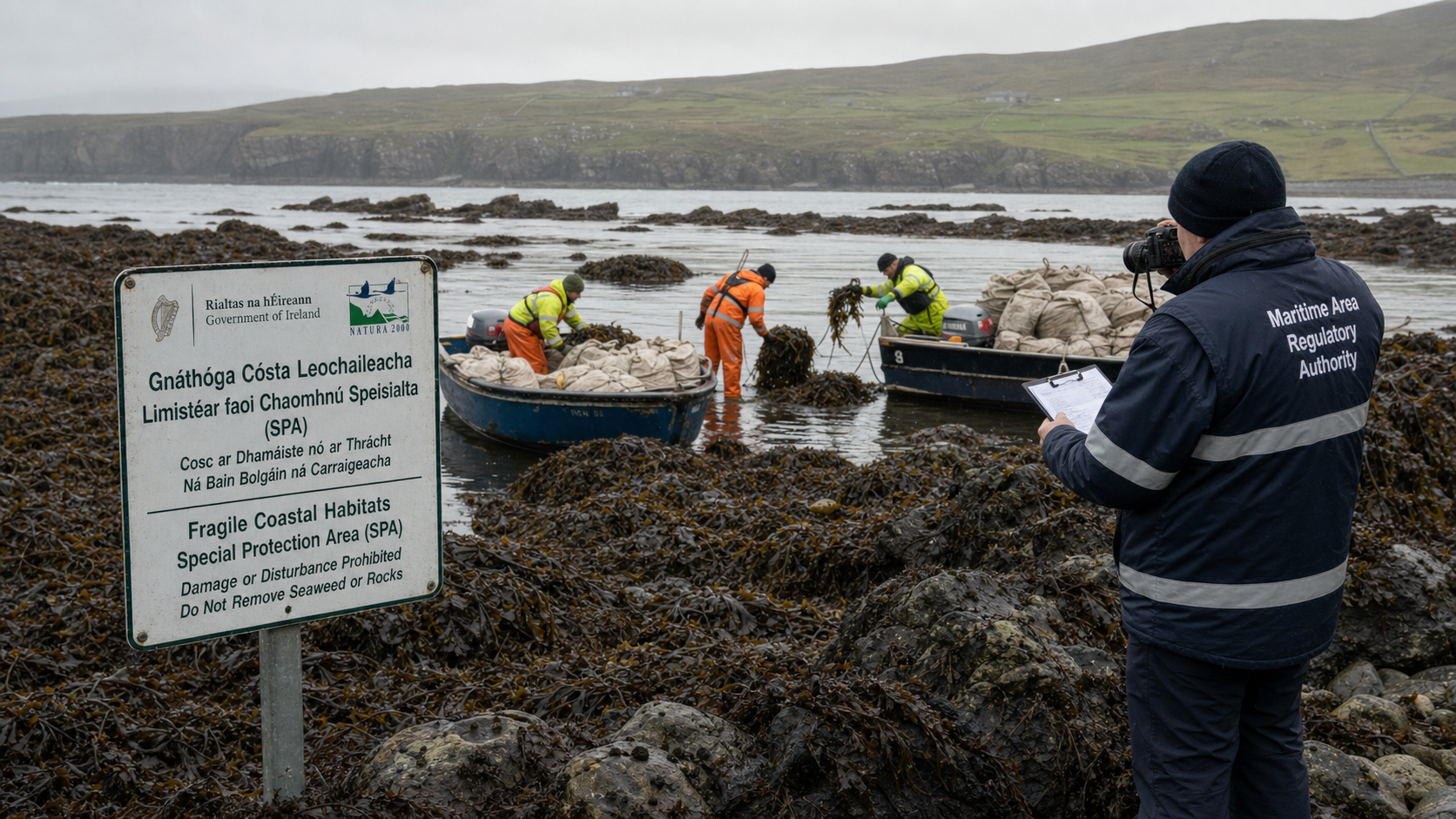
The Maritime Area Regulatory Authority has confirmed that it is actively investigating multiple reports of unauthorised commercial seaweed harvesting in ecologically sensitive zones along Ireland's coastline, including Special Areas of Conservation in the north-west, as twelve licence applications from four private companies seeking to harvest approximately 51,000 wet tonnes of seaweed annually across more than 14,000 hectares of Irish waters remain paused due to internal capacity issues — a situation that has left coastal communities caught between the threat of illegal harvesting and the prospect of large-scale industrial extraction.
Background
Seaweed harvesting has been part of Irish coastal life for centuries. From the kelp beds of Connemara to the carrageen moss of the Aran Islands, coastal communities have harvested seaweed for food, fertiliser, and animal feed in ways that were sustainable precisely because they were small-scale and rooted in local knowledge of the marine environment. The traditional harvester knew which beds to leave fallow, which species to avoid during breeding season, and how much could be taken without depleting the resource.
The global seaweed market has transformed this picture dramatically. Projected to reach €22 billion by 2028, the market is driven by demand from the cosmetics, food, and agricultural sectors, and has attracted significant corporate interest in Ireland's extensive and relatively pristine coastline. Ireland's position on the Atlantic edge of Europe, with its cold, nutrient-rich waters, makes it one of the most productive seaweed environments in the world — a fact that has not escaped the attention of international companies seeking to secure large-scale harvesting rights.
The Maritime Area Regulatory Authority was established in 2023 to manage Ireland's maritime area, including the licensing of commercial seaweed harvesting. The creation of MARA represented a significant step forward in the governance of Ireland's marine resources, but the authority has faced significant challenges in establishing its regulatory capacity and in managing the complex legal landscape surrounding historical harvesting rights.
Key Developments
An investigation by The Journal published this week revealed the scale of the illegal harvesting problem, with MARA acknowledging that it is investigating several reports of unauthorised commercial harvesting in protected areas. The investigation found that enforcement is hampered by the intermittent nature of the activity, the difficulty of catching harvesters in the act, and the complex legal environment created by pre-existing rights that predate MARA's establishment. Harvesters holding such rights have until July 2028 to apply for new licences, creating a period of regulatory uncertainty that some are exploiting.
The investigation also documented confrontational incidents, including reports of threats directed towards National Parks and Wildlife Service staff and local community members who have attempted to challenge illegal harvesting. In some cases, harvesters have claimed to be working for specific companies, only for those companies to deny any association — a pattern that investigators say is common along the coast.
On the commercial licensing front, MARA has confirmed that all twelve pending applications — from companies including BioAtlantis and Arramara Teoranta, which is owned by the Canadian multinational Acadian Seaplants — are paused due to internal capacity issues and the need to prioritise national infrastructure projects. The applications, which collectively seek to harvest 51,000 wet tonnes annually across more than 14,000 hectares, have generated more than 21,000 petition signatures from people opposed to large-scale corporate harvesting.
Why It Matters
The seaweed harvesting controversy encapsulates a tension that runs through much of Ireland's relationship with its natural resources: the conflict between the economic potential of those resources and the ecological and community values that depend on their sustainable management. Ireland's coastline is not merely an economic asset — it is a living ecosystem that supports fish nurseries, carbon sinks, and the biodiversity that underpins the marine food chain. Industrial-scale seaweed harvesting, if poorly managed, could damage these ecosystems in ways that would take decades to recover.
The community dimension is equally important. Coastal communities in the west of Ireland have a deep cultural and economic relationship with the sea that is not captured in any commercial licence application. The traditional harvester who has worked the same beds for generations has a stake in the sustainable management of those resources that goes beyond any financial calculation. The prospect of large corporations harvesting those same beds at industrial scale, with the profits flowing to shareholders in Canada or elsewhere, is experienced by many coastal communities as a form of dispossession.
For context, Ireland's approach to seaweed governance is being watched closely by other Atlantic nations facing similar pressures. The decisions made by MARA in the coming years will set precedents that will shape the management of marine resources across the region.
Local Impact
In the north-west, where the illegal harvesting investigations are most active, communities in Donegal, Mayo, and Galway have been vocal in their opposition to both illegal harvesting and large-scale commercial licensing. Local fishermen and traditional harvesters have reported seeing commercial operators working in areas that have historically been managed by local communities, and have expressed frustration at the slow pace of regulatory enforcement. The National Parks and Wildlife Service, which is responsible for protecting Special Areas of Conservation, has been criticised for its limited capacity to monitor and enforce harvesting restrictions in remote coastal areas.
In Connemara, where seaweed harvesting is deeply embedded in the local economy and culture, community groups have been working with MARA to develop a framework for sustainable commercial harvesting that would allow local operators to benefit from the growing market without the ecological damage associated with industrial-scale extraction. The outcome of this process will be closely watched by coastal communities across the country.
What's Next
MARA is expected to publish updated guidance on seaweed harvesting enforcement in the coming months, and the authority has indicated that it will prioritise the investigation of illegal harvesting in protected areas. The twelve pending commercial licence applications will remain paused until MARA has the capacity to process them, a timeline that the authority has not specified. The Department of Housing, Local Government and Heritage, which has policy responsibility for marine resources, is expected to publish a national seaweed harvesting strategy before the end of 2026, which will set the framework for both commercial licensing and community harvesting rights.