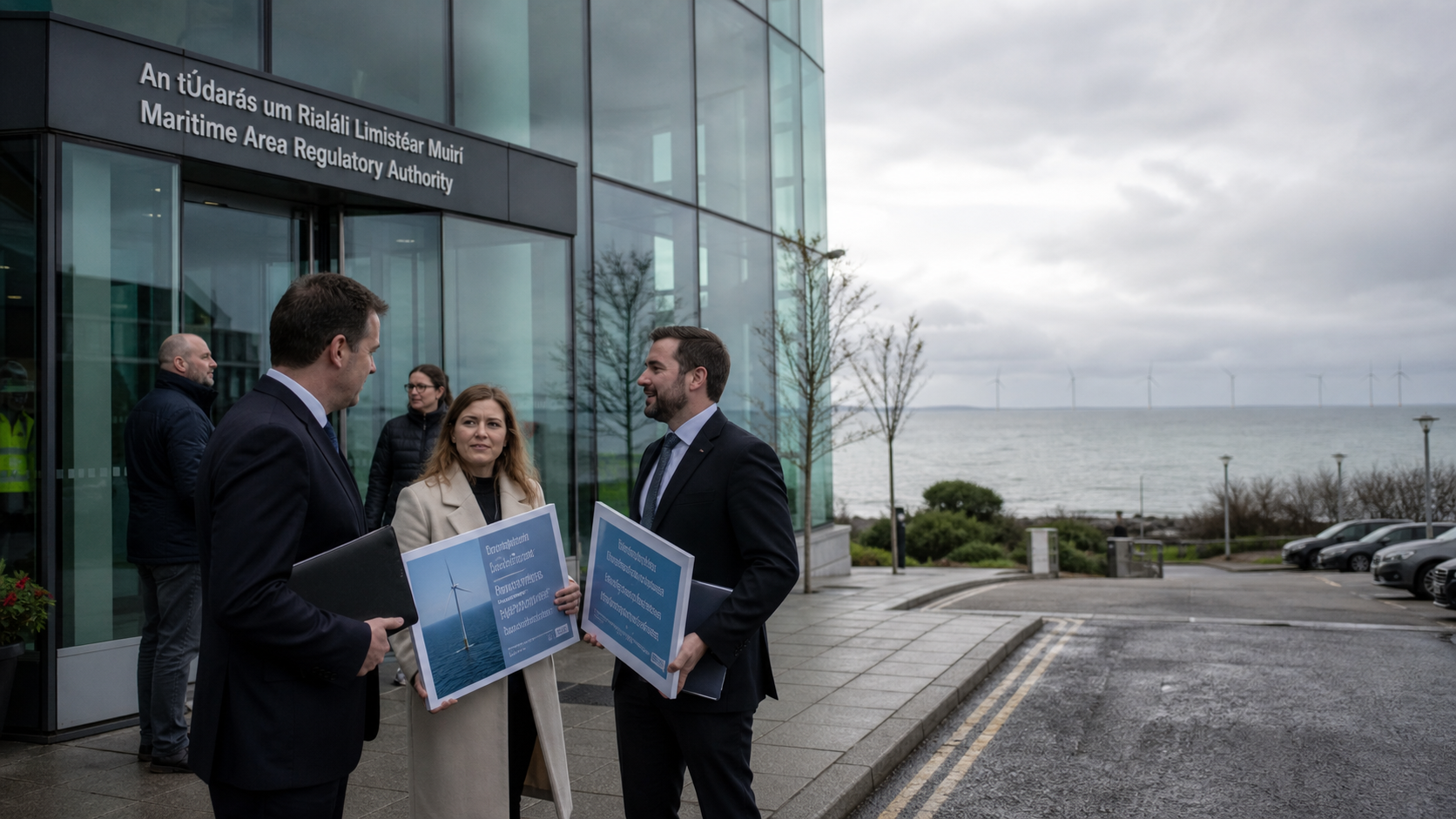
Marine Regulator Accused of 'Performance Failure' as Wind Farm Planning Delays Mount
The Maritime Area Regulatory Authority, the body responsible for offshore energy consents and licensing in Ireland, has been accused of "sustained underperformance" by the government after failing to meet its own statutory decision-making timelines, with the Irish Times reporting on Monday that the regulator's delays are hampering Ireland's ability to develop the offshore wind capacity it needs to meet its 2030 renewable energy targets.
Background
Ireland's offshore wind ambitions are among the most significant in Europe. The government has set a target of 80% renewable electricity by 2030, with offshore wind expected to play a central role in achieving that goal. The country's Atlantic coastline and the shallow waters of the Irish Sea offer exceptional wind resources, and several major offshore wind projects have been in development for years. However, Ireland currently has only one operational offshore wind farm — the Arklow Bank, which dates back to 2004 — leaving the country heavily dependent on imported fossil fuels and onshore wind for its electricity supply.
The Maritime Area Regulatory Authority was established to streamline the consenting process for offshore energy projects, replacing a fragmented system that had been widely criticised for its complexity and unpredictability. MARA was given responsibility for maritime area consents and usage licences, with the expectation that it would process applications more efficiently than its predecessors. The government's offshore wind ambitions depend critically on MARA being able to process applications quickly and predictably.
The planning environment for offshore wind in Ireland has been complicated by a range of factors, including the need for detailed environmental impact assessments, the complexity of the marine environment, and the involvement of multiple state bodies — including EirGrid and Uisce Éireann — in the consenting process. An Coimisiún Pleanála, which handles planning applications for major infrastructure projects, has also faced criticism for the pace of its decision-making on wind farm applications.
Key Developments
The Irish Times reported on Monday that MARA has been accused of "sustained underperformance" by the government, with Minister for the Environment Darragh O'Brien criticising the agency for failing to meet its own commitments and noting that these delays were hindering the delivery of critical infrastructure. The minister's criticism was unusually direct for a government minister addressing a state agency, reflecting the seriousness with which the government views the delays.
A May 2026 report by Wind Energy Ireland found that no new wind farms were approved by An Coimisiún Pleanála in the first quarter of 2026, compared to seven projects in the same period in 2025. As of May 2026, over a dozen wind farm projects were waiting more than a year for a decision, with several projects stuck in the system for over two years. The Codling Wind Park, one of the most significant offshore wind projects in development, faces potential delays into 2027 following a 70-page request for further information from An Coimisiún Pleanála regarding habitat loss and other concerns.
MARA has reported that it has implemented measures to streamline decision-making, including the removal of repetitive processes with state bodies like EirGrid and Uisce Éireann, which it says has reduced wait times for certain consents by over 30%. The agency says it is on track to meet higher annual targets in 2026. However, developers and industry representatives say that the improvements, while welcome, are insufficient to address the scale of the backlog.
Why It Matters
Ireland's failure to develop its offshore wind capacity at the required pace has serious consequences for the country's energy security, its climate commitments, and its economic competitiveness. The country's dependence on imported fossil fuels leaves it exposed to the kind of energy price volatility that caused significant economic damage during the 2021-2022 energy crisis. Developing domestic renewable energy capacity is not merely a climate imperative — it is an energy security imperative.
The delays also have economic consequences. Offshore wind development is a major source of investment and employment, and Ireland's failure to move projects through the planning system quickly is causing some developers to redirect investment to other jurisdictions. Denmark, which has a much more streamlined offshore wind consenting process, has been cited by industry representatives as a model that Ireland should seek to emulate.
Unlike the UK, which has developed a more efficient offshore wind consenting process through its Planning Inspectorate, Ireland's system remains fragmented and slow. The government's decision to establish MARA was intended to address this, but the agency's performance to date suggests that structural reform alone is not sufficient — the agency also needs the resources, expertise, and political backing to make decisions quickly and confidently.
Local Impact
The delays in offshore wind development have direct consequences for communities along Ireland's coastline, many of which stand to benefit significantly from the economic activity associated with offshore wind construction and operation. Counties Wexford, Wicklow, Cork, and Clare have major offshore wind projects in development, and the delays in the planning process are creating uncertainty for local businesses, port operators, and supply chain companies that are positioning themselves to service the sector. The government's target of 80% renewable electricity by 2030 is also directly relevant to Irish households and businesses, which continue to pay some of the highest electricity prices in Europe.
What's Next
The Department of the Environment is expected to publish a review of MARA's performance and a set of recommendations for improving the offshore wind consenting process before the end of 2026. The review is likely to address the resourcing of MARA, the coordination between MARA and An Coimisiún Pleanála, and the procedures for handling requests for further information. The government has also indicated that it is considering legislative changes to streamline the consenting process, though any such changes would need to be carefully designed to avoid creating new legal vulnerabilities. The offshore wind industry has called for a dedicated ministerial task force to drive progress on the consenting backlog.