Mór Fest Brings Ireland to the Heart of Manhattan in New York's First Fully Irish Five-Day Festival
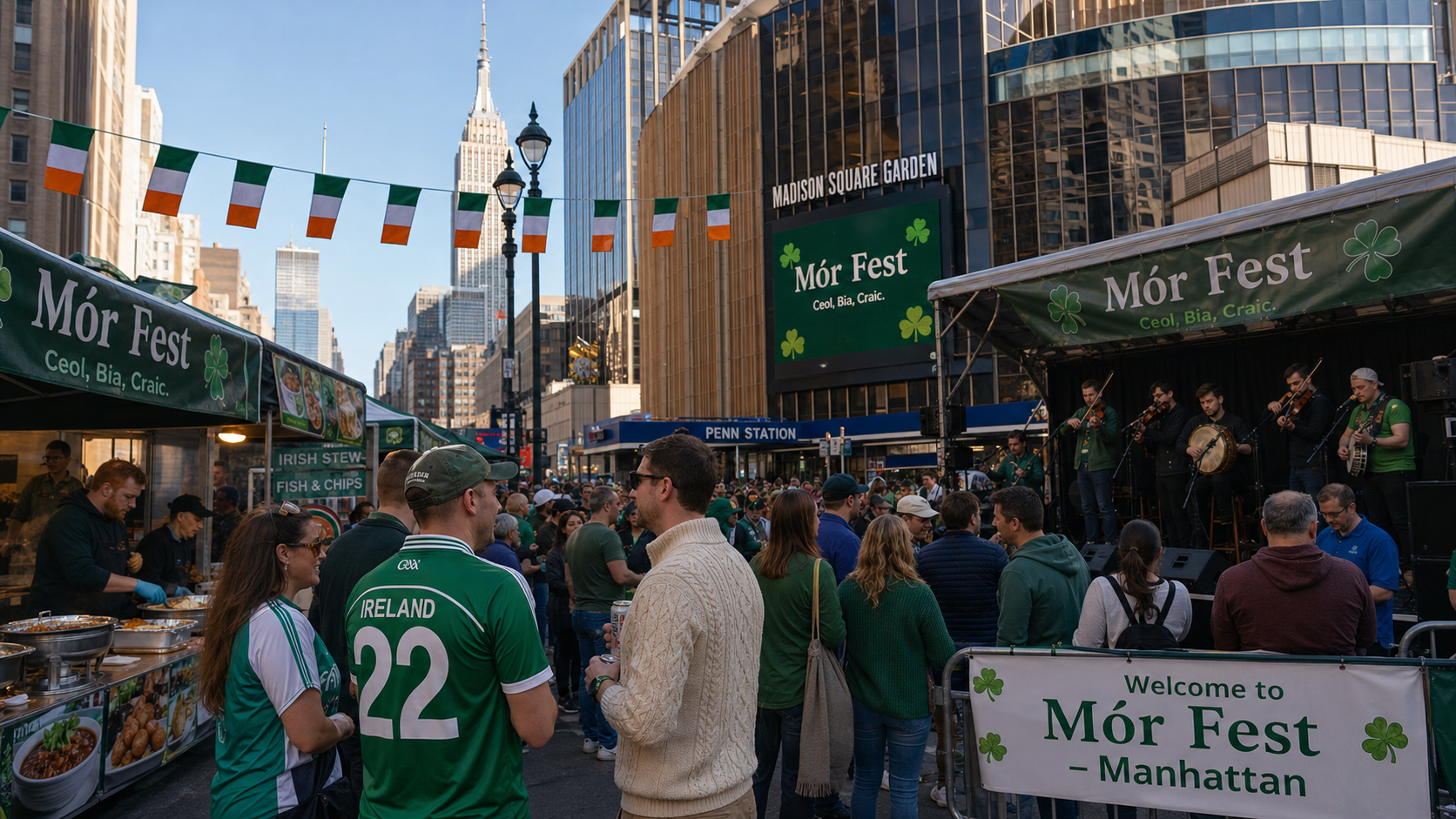
New York City has welcomed its first fully Irish five-day festival, Mór Fest, hosted at Tara Mór near Madison Square Garden in the heart of Manhattan, bringing an extraordinary celebration of Irish music, food, culture, and community to one of the world's most iconic urban settings.
Background
The Irish-American community in New York is one of the oldest and most deeply rooted diaspora communities in the world. From the famine-era arrivals of the 1840s through to the economic emigrants of the 1980s and the skilled professionals who have made New York their home in the twenty-first century, the Irish presence in the city has shaped its culture, politics, and civic life in ways that continue to resonate today. St Patrick's Day remains the most visible expression of that heritage, but the Irish community has long sought ways to celebrate its culture beyond a single annual parade.
Mór Fest represents a new chapter in that story. Conceived as a multi-day immersive celebration of contemporary and traditional Irish culture, the festival was designed to showcase the full breadth of what Ireland has to offer — from traditional music sessions and Irish language workshops to contemporary Irish cuisine, literature, and visual art. The choice of a venue near Madison Square Garden, in the heart of Midtown Manhattan, was deliberate: a statement that Irish culture belongs at the centre of the city's cultural life, not on its margins.
The festival has been supported by Tourism Ireland and a range of Irish cultural organisations, reflecting the Irish government's broader commitment to strengthening diaspora connections through its Diaspora Strategy 2026-2030, which was launched in May of this year with a record budget allocation of €17.5 million.
Key Developments
Mór Fest opened this week to enthusiastic crowds, with queues forming outside the Tara Mór venue well before the doors opened on the first day. The programme has featured live performances from some of Ireland's most celebrated traditional and contemporary musicians, alongside food stalls showcasing the best of modern Irish cuisine — a far cry from the stereotypical pub grub that has historically represented Irish food abroad.
Irish language workshops have attracted particular interest, with organisers reporting that many attendees — including third and fourth-generation Irish-Americans with no previous exposure to the language — have been eager to connect with their heritage through Gaeilge. Literary events featuring Irish authors have drawn strong audiences, and a visual art exhibition showcasing contemporary Irish artists has provided a striking backdrop to the festival's main spaces.
The festival has also served as a gathering point for the broader Irish community in New York, with community organisations, GAA clubs, and diaspora networks using the event to connect with one another and with newly arrived Irish emigrants. Minister of State for International Development and Diaspora Neale Richmond, who has been in New York this week for meetings with community partners, attended the festival and described it as "exactly the kind of initiative that brings the diaspora together and shows the world what modern Ireland looks like."
Why It Matters
Mór Fest matters because it represents a maturing of how the Irish diaspora presents itself to the world. For too long, Irish cultural events in New York have been dominated by a narrow set of symbols — the shamrock, the pint, the céilí — that, while beloved, do not capture the full complexity and creativity of contemporary Irish culture. A five-day festival that encompasses traditional music, contemporary art, Irish language, modern cuisine, and literary discussion is a statement that the diaspora is ready to engage with Ireland as it actually is, not as a nostalgic projection.
It also matters for the Irish government's diaspora strategy. The 2026-2030 strategy explicitly seeks to broaden the definition of the diaspora to include an "affinity diaspora" — people who have lived, studied, or worked in Ireland and maintain a cultural connection without hereditary ties. An event like Mór Fest, held in the heart of Manhattan, is precisely the kind of initiative that can attract this broader audience and deepen Ireland's cultural footprint in one of the world's most influential cities.
Local Impact
For the Irish community in New York — estimated at over 100,000 Irish-born residents, with millions more claiming Irish heritage — Mór Fest has provided a focal point for community pride and connection. The New York Irish Center in Long Island City, the Aisling Irish Community Center in Yonkers, and GAA clubs across the five boroughs have all promoted the festival to their members. For recently arrived Irish emigrants, many of whom are navigating the challenges of building a new life in an expensive and demanding city, the festival has offered a sense of home and belonging. For older generations of Irish-Americans, it has provided an opportunity to reconnect with a contemporary Ireland that may feel quite different from the country their parents or grandparents left behind.
What's Next
Mór Fest runs through the weekend, with the programme concluding on Sunday evening. Organisers have already indicated that they intend to make the festival an annual event, with plans to expand the programme and the venue capacity in future years. Tourism Ireland has expressed strong support for the initiative, and there is interest from other Irish cultural organisations in partnering with the festival for future editions. The success of the inaugural event will be closely watched by the Department of Foreign Affairs and the diaspora community as evidence that large-scale Irish cultural festivals can thrive in major international cities beyond the traditional St Patrick's Day format.