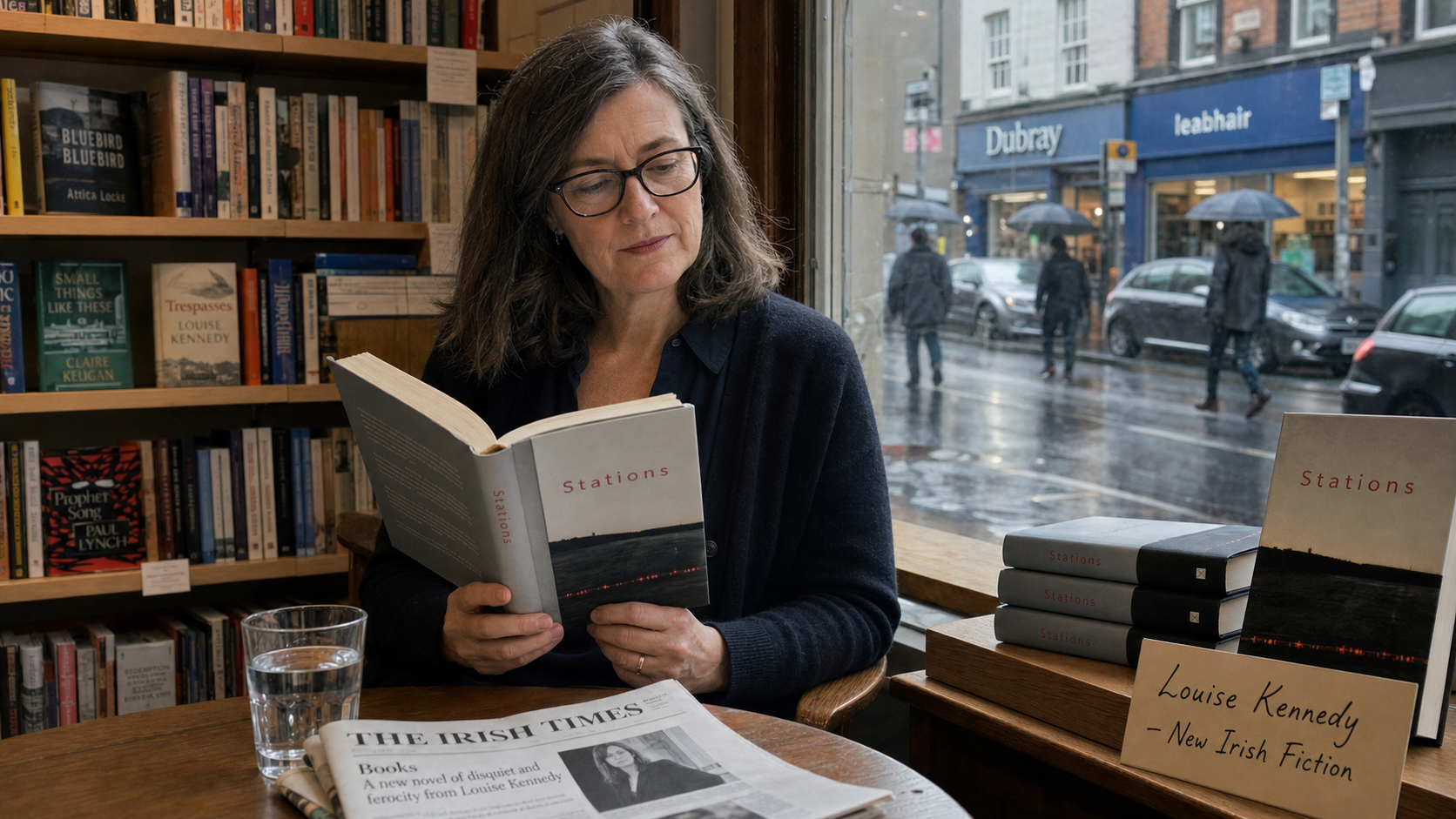
Louise Kennedy's 'Stations' Published Today: A London-Irish Story of Love, Loss, and the Long Reach of the Past
Louise Kennedy's second novel, Stations, is published today by Bloomsbury Circus, following the international success of her debut Trespasses, which established her as one of the most significant voices in contemporary Irish fiction — a novel that follows Roisin and Red across 25 years of Irish and London-Irish life, exploring themes of class, aspiration, addiction, and the enduring power of early connection.
Background
Louise Kennedy's emergence as a major literary figure has been one of the most striking developments in Irish fiction in recent years. Her debut novel, Trespasses, published in 2022, was set against the backdrop of the Troubles in Northern Ireland and received extraordinary critical acclaim, winning multiple awards and being translated into numerous languages. The novel's success placed Kennedy in the company of the finest Irish writers of her generation and created enormous anticipation for her second book.
Kennedy grew up in Northern Ireland and has lived in both Ireland and England, and her fiction draws deeply on those experiences of movement and displacement. Like many Irish writers before her — from Edna O'Brien to Colm Toibin — she has found in the experience of the Irish in Britain a rich vein of material that speaks to universal themes of belonging, identity, and the difficulty of going home.
Stations is described by its publisher as part of the London-Irish literary tradition, drawing thematic parallels to works such as The Grass Arena by John Healy and If I Could Read the Sky by Timothy O'Grady and Steve Pyke. The title refers both to the transport hubs where key scenes occur and to the Stations of the Cross — a symbol of falling and continuing that runs through the novel's structure and themes.
Key Developments
Stations follows two protagonists, Roisin and Red, who meet as teenagers in a town in Ireland in 1982. Despite Red's reputation for trouble, the two form a close, intelligent, and humorous bond. When a legal issue forces Red to leave his family and hometown for a new life in England, the two characters grow up and apart, yet remain connected by a fragile, enduring thread.
The plot progresses as Roisin travels to London to spend Christmas with her estranged father, leading her to become entangled in Red's life once more. As Roisin attempts to reclaim their former closeness, she finds that Red continues to distance himself, leaving her to grapple with the weight of their shared past. The narrative spans 25 years, from 1982 to the mid-2000s, using date-stamped chapters to manage the passage of time without relying on excessive backstory.
Kennedy has spoken in interviews about the autobiographical elements of the novel — like Roisin, she moved from Northern Ireland to the South as a child and later spent time in London — and about her intention to incorporate wit and humour into a narrative that deals with heavy subjects including addiction, abuse, and family dysfunction. The novel is published simultaneously in the UK, Ireland, and the United States.
Why It Matters
The publication of Stations is a significant event in the Irish literary calendar, not just because of Kennedy's reputation but because of what the novel represents. The London-Irish experience — the experience of the hundreds of thousands of Irish people who have made their lives in Britain over the past century — has been a recurring subject of Irish fiction, but it has rarely been treated with the combination of psychological depth and social specificity that Kennedy brings to it. Her ability to render the texture of working-class Irish life in both Ireland and London, and to trace the long-term consequences of early choices and circumstances, places her in the tradition of the great social novelists.
The novel's exploration of class and aspiration is particularly resonant in the current Irish context. The cost-of-living crisis, the housing emergency, and the growing sense that social mobility is becoming more difficult have created a political and social environment in which questions about who gets to succeed and who gets left behind are more urgent than ever. Kennedy's fiction addresses these questions not through polemic but through the lives of specific, fully realised characters — which is, ultimately, the most powerful way to make them felt.
Local Impact
Stations will be launched at a series of events across Ireland and Britain in the coming weeks, with readings and signings planned at bookshops in Dublin, Belfast, Cork, and London. Chapters Bookstore in Dublin, which has been a strong supporter of Kennedy's work since the publication of Trespasses, is hosting a launch event this evening. The novel is expected to be a strong seller in the run-up to Christmas, and booksellers across Ireland have reported significant advance orders. Kennedy is also expected to appear at the Dublin Theatre Festival's literary programme, which runs alongside the main theatre programme, and at the Galway International Arts Festival's autumn events.
What's Next
Stations will be reviewed in the major Irish and British literary publications over the coming weeks, with the Irish Times, Irish Examiner, and Guardian all expected to carry substantial reviews. The novel will be submitted for consideration for the major Irish and British literary prizes, including the Booker Prize and the Irish Book Awards. Kennedy is expected to undertake an extensive tour of literary festivals and bookshops in Ireland, Britain, and the United States in the autumn and winter, building on the international profile she established with Trespasses. Her publisher has confirmed that the novel has already been sold for translation into several European languages, with further deals expected to follow the publication reviews.