Longford Solar Farm to Power 18,000 Homes as Ireland Accelerates Renewable Energy Transition
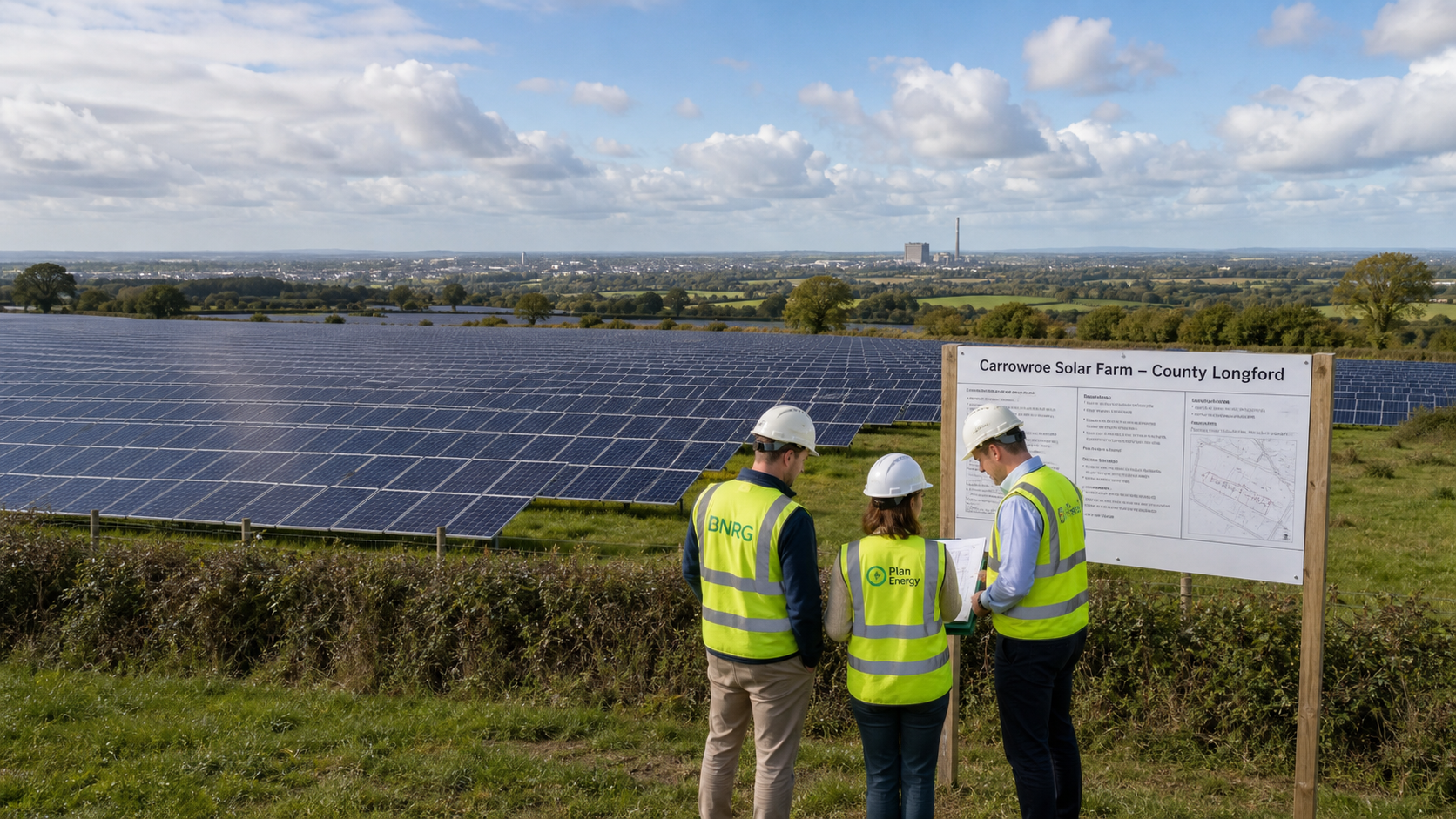
Plans have been announced for the Carrowroe Solar Farm near Lanesborough in County Longford, a 98-hectare development that could power more than 18,400 homes and offset nearly 28,000 tonnes of carbon emissions annually, as the Irish midlands emerges as a key hub for the country's accelerating transition to renewable energy.
Background
County Longford has become an increasingly attractive location for large-scale solar energy development, driven by a combination of factors that make it particularly well-suited to this form of renewable generation. The county's flat peatland terrain provides ideal conditions for solar panel installation, while its proximity to the grid infrastructure of former power stations — including the Lough Ree Power Station at Lanesborough, which closed in 2020 — means that connecting new renewable generation to the national grid is significantly more straightforward and cost-effective than in many other parts of the country.
The closure of the Lough Ree and West Offaly peat-burning power stations as part of Ireland's Just Transition programme created both a challenge and an opportunity for the midlands region. The challenge was the loss of hundreds of jobs in communities that had been economically dependent on the peat industry for generations. The opportunity was the availability of grid connections, land, and a skilled workforce that could be redirected towards the renewable energy sector. The Carrowroe Solar Farm is one of several projects that are beginning to realise that opportunity.
Ireland has committed to generating 80% of its electricity from renewable sources by 2030, a target that requires a dramatic acceleration in the deployment of wind, solar, and other clean energy technologies. Solar energy has historically played a smaller role in Ireland's renewable mix than wind, partly because of the country's relatively low levels of solar irradiance compared to southern Europe. However, advances in solar panel technology have made solar generation increasingly viable in Irish conditions, and the government's Renewable Electricity Support Scheme (RESS) has provided the financial framework needed to attract investment.
Key Developments
Global renewable energy developer BNRG, in partnership with Plan Energy Developments, announced the Carrowroe Solar Farm following a public consultation in July 2026. The project is proposed for a 98-hectare site bordering the River Shannon, located less than one kilometre south of Lanesborough. At full capacity, the facility is estimated to generate enough electricity to power approximately 18,400 households and to offset nearly 28,000 tonnes of carbon dioxide emissions annually — equivalent to taking approximately 6,000 cars off the road.
The project includes a proposed community benefit fund valued at approximately €2.45 million over its operational lifetime, which would be available to local community groups, schools, and organisations in the Lanesborough area. This community benefit element has become a standard feature of large-scale renewable energy projects in Ireland, reflecting both regulatory requirements and the recognition by developers that local community support is essential for the long-term success of such projects.
Developers anticipate that construction could commence in 2028, with the farm becoming operational by 2029, pending planning permission from Longford County Council and, potentially, An Coimisiún Pleanála. The planning process for large-scale solar farms in Ireland has become more streamlined in recent years following legislative changes, but projects of this scale still face a rigorous assessment process that typically takes 18 to 24 months.
Why It Matters
The Carrowroe Solar Farm is one of several large-scale renewable energy projects currently in development in County Longford, and together they represent a significant contribution to Ireland's 2030 renewable energy targets. The Middleton House Solar Farm, currently under construction approximately 6km north of Lanesborough, is expected to power over 15,000 homes when it becomes operational, while the Ballymahon Solar Farm — which has received planning approval but is subject to an appeal to An Coimisiún Pleanála — would add further capacity to the county's renewable energy portfolio.
For the midlands region, the development of a solar energy sector represents an important economic diversification opportunity. The communities around Lanesborough and Ballymahon have faced significant economic challenges since the closure of the peat power stations, and the construction and maintenance of solar farms — while not providing the same number of permanent jobs as the power stations — offers a new source of employment and economic activity. The community benefit funds associated with these projects also provide a direct financial return to local communities.
Local Impact
In Lanesborough and the surrounding areas of north Longford, the announcement of the Carrowroe Solar Farm has been broadly welcomed, though some local residents and environmental groups have raised concerns about the visual impact of large-scale solar installations on the landscape and about the potential effects on wildlife and biodiversity. The River Shannon, which borders the proposed site, is a designated Special Area of Conservation, and the planning process will require a detailed environmental impact assessment to address these concerns. Longford County Council has indicated that it will engage constructively with the planning application when it is formally submitted.
What's Next
BNRG and Plan Energy Developments are expected to submit a formal planning application to Longford County Council in late 2026 or early 2027, following the completion of the required environmental surveys and assessments. The public consultation process will continue in the interim, with further community engagement events planned for the Lanesborough area. If planning permission is granted and not successfully appealed, construction is expected to begin in 2028, with the farm generating electricity by 2029.