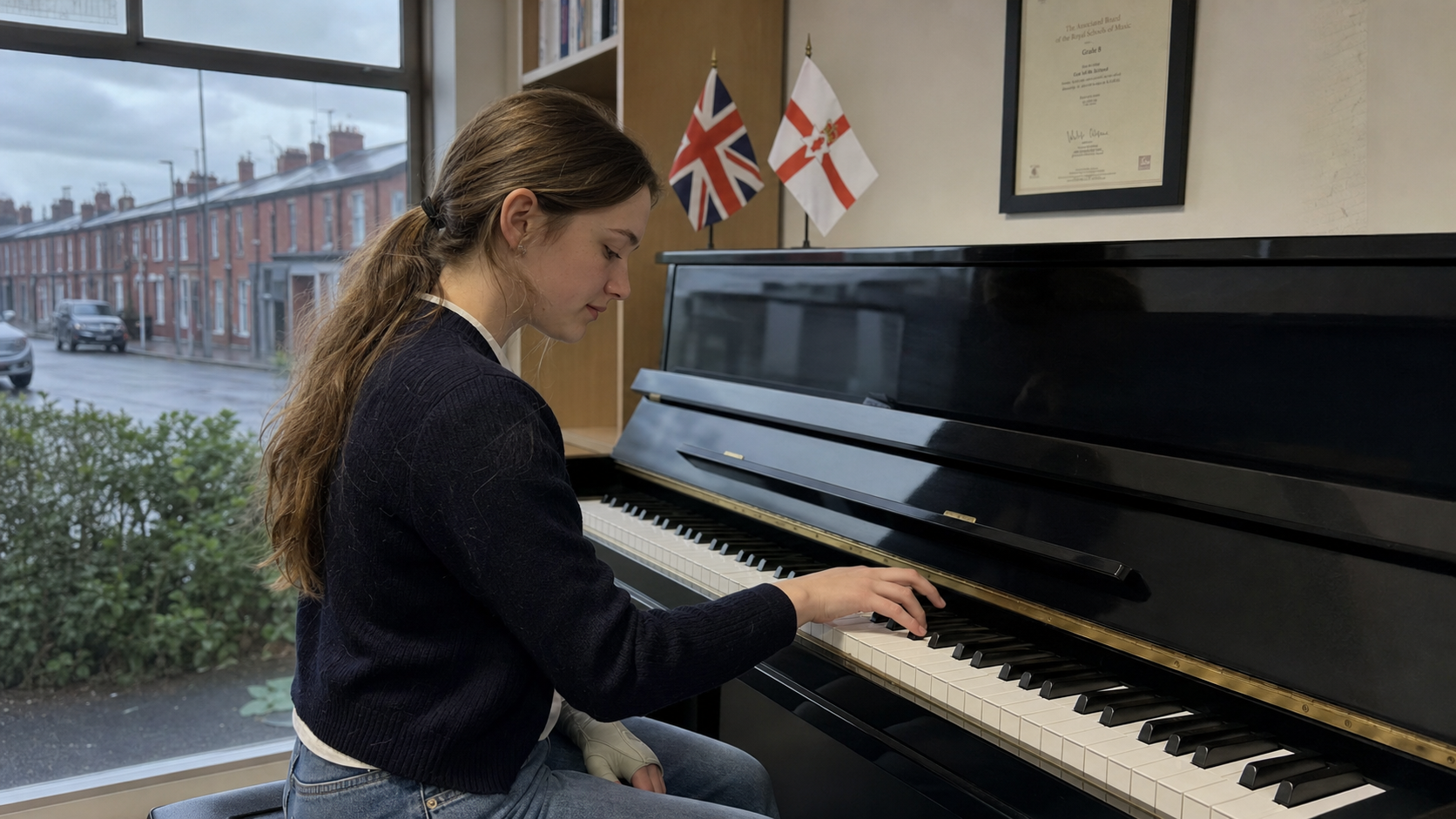
Lisburn Teenager Makes Piano History by Passing Grade 8 Exam with One Hand
A 17-year-old student from Lisburn has etched her name into musical history, becoming the first pianist ever known to the Associated Board of the Royal Schools of Music to pass the Grade 8 piano examination using only one hand — earning a distinction in the process and prompting the world's largest music education body to overhaul its syllabus for the first time in its 137-year history.
Background
Freya Terris, a pupil at Friends' School in Lisburn, County Antrim, had been playing piano since the age of four. A two-time finalist in the prestigious Young Musician competition, she was well on her way to completing the full ABRSM grade ladder when, approximately two years ago, she suffered a severe long-term injury to her right hand that required surgery and left her unable to play with it.
For many young musicians, such a setback would have meant the end of formal examination ambitions. For Terris, it meant a different path. Working closely with her teacher, Rory Dowse, she began exploring the rich but often overlooked repertoire composed specifically for the left hand alone — a body of work that includes pieces by Ravel, Prokofiev, and Britten, written originally for pianists who had lost the use of one hand in the First World War.
When it became clear that a return to two-handed playing was unlikely, Terris contacted the ABRSM directly to ask whether she could sit the Grade 8 examination using a single-handed repertoire. The board responded positively, providing a curated list of left-hand pieces, and the collaboration that followed would change music education policy across 93 countries.
Key Developments
Terris recorded her Grade 8 assessment on 25 January 2026, performing a programme of left-hand repertoire that she had spent two years mastering. When the results came back, she had achieved a distinction — the highest possible grade. The ABRSM informed her that she had earned "a little place in history" as the first candidate at Grade 8 level to pass using a single-handed repertoire.
The impact of her initiative extended far beyond her own certificate. During the collaboration, discussions took place about the absence of formal pathways for one-handed pianists within the ABRSM system. In June 2026, the board published its 2027-28 syllabus, which for the first time includes a dedicated one-hand repertoire list across all grades from 1 to 8. The change means that one-handed pianists in every country where the ABRSM operates — from Ireland and Britain to Singapore, Hong Kong, and Australia — can now work toward a recognised qualification at every level of the grading system.
Terris described the moment she received her results as one of overwhelming relief. "The overwhelming feeling was just relief," she said, adding that she hoped her journey would encourage other pianists facing physical challenges to explore single-handed repertoire as a means of continuing their musical development.
Why It Matters
The ABRSM is the world's largest music education body, with over 650,000 candidates sitting its examinations each year across 93 countries. Until Terris's intervention, the organisation had no formal provision for one-handed pianists at the higher grade levels, meaning that students who lost the use of a hand through injury, illness, or disability faced an effective ceiling on their formal musical progression.
The change to the 2027-28 syllabus is not merely symbolic. It represents a structural shift in how one of the world's most influential music education institutions thinks about disability and inclusion. Unlike the Republic of Ireland's music examination boards, which have historically offered some flexibility for candidates with disabilities, the ABRSM's previous approach had been to assess candidates on a case-by-case basis without a standardised repertoire pathway — a gap that Terris's case has now permanently closed.
For Northern Ireland specifically, where music education has long been a point of civic pride and where schools like Friends' School in Lisburn have produced generations of accomplished musicians, the story carries particular resonance. It is a reminder that the region's young people continue to make contributions to cultural and educational life that extend far beyond its borders.
Local Impact
In Lisburn, the response to Terris's achievement has been one of quiet pride. Friends' School, which has a strong tradition of musical excellence, has celebrated her distinction as a landmark moment for the school community. Her teacher, Rory Dowse, has spoken of the dedication and resilience she demonstrated throughout the two-year process of mastering a new repertoire under difficult circumstances.
For young musicians across County Antrim and the wider Belfast metropolitan area, Terris's story offers a powerful message about perseverance. Music teachers in the region have noted that the ABRSM's syllabus change will have practical benefits for any student who faces a physical barrier to two-handed playing, whether through injury, congenital difference, or progressive illness. The change takes effect from September 2027, meaning that students currently in the early grades will be the first to benefit from a fully inclusive pathway to Grade 8.
What's Next
Freya Terris plans to pursue music at university level following the completion of her studies at Friends' School. She has expressed a desire to continue performing left-hand repertoire and to advocate for greater awareness of the musical possibilities available to one-handed pianists. The ABRSM's new syllabus will be formally launched in autumn 2026, with the one-hand repertoire lists published in full for teachers and students to begin planning their programmes. For Terris, the distinction she earned in January 2026 is already a matter of record — and a record that will not be broken.