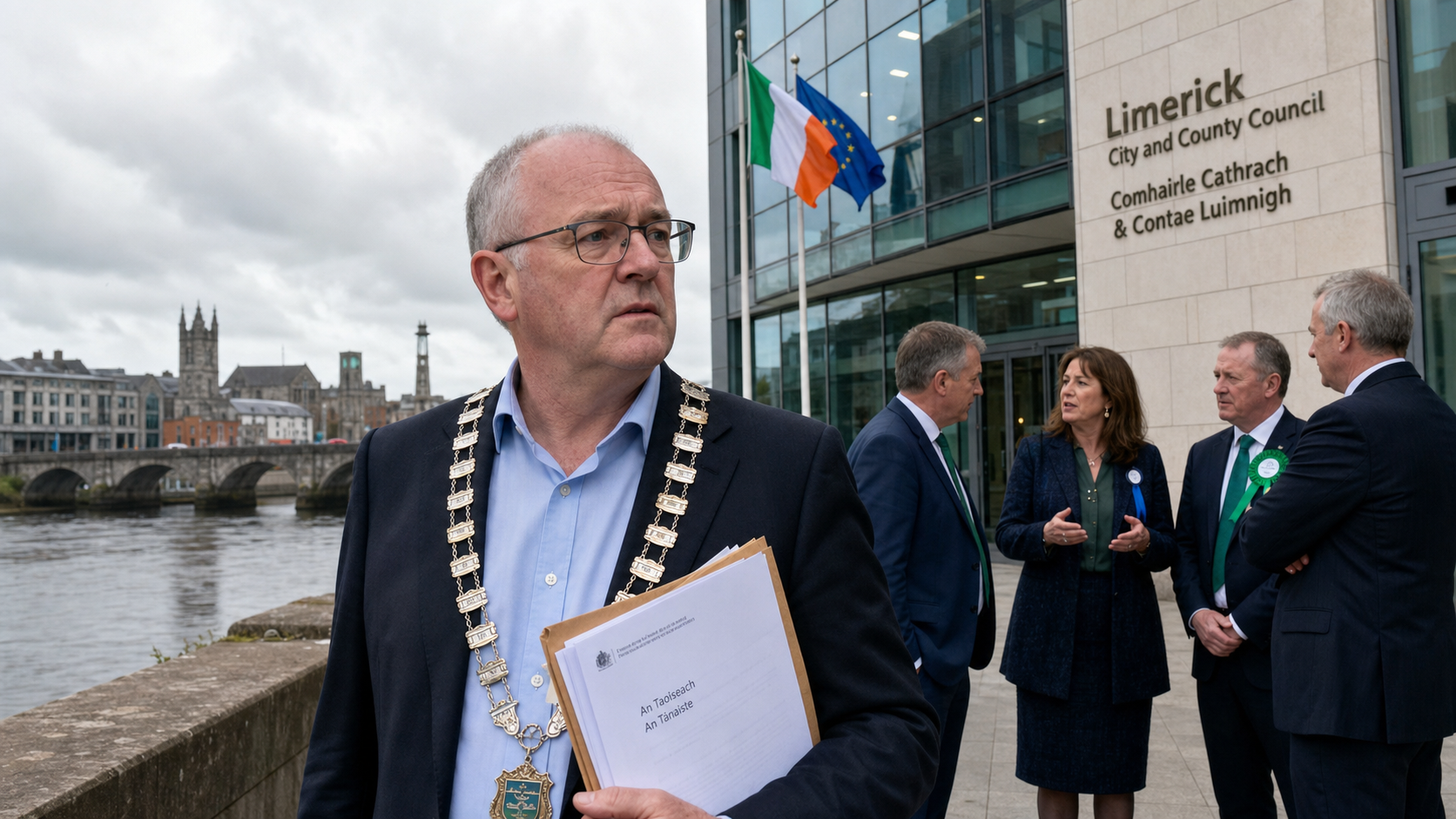
Limerick Mayor Writes to Taoiseach Over Councillors' Conduct at 'Fractious' Seven-Hour Meeting
John Moran, Ireland's first directly elected mayor, has written formally to Taoiseach Micheál Martin and Tánaiste Simon Harris to raise serious concerns about the conduct of Fianna Fáil and Fine Gael councillors who proceeded to pass Limerick City and County Council's corporate plan during his absence from a seven-hour meeting in February — a decision he has characterised as a failure of democratic process and a challenge to the integrity of his office.
Background
John Moran was elected as the first directly elected Mayor of Limerick in 2024, in a pilot programme that gave the city a form of executive leadership that is unique in Ireland. The directly elected mayor model, which was developed following a referendum in Limerick, was intended to provide stronger, more accountable local leadership and to give the city a single identifiable figure who could champion its interests at national and international level.
The relationship between the mayor and the elected councillors has been a source of tension since the outset, reflecting the inherent complexity of a governance model in which executive power is divided between a directly elected individual and a council that retains significant legislative and oversight functions. The February meeting, which concerned the passage of the council's corporate plan for 2025 to 2029, brought those tensions to a head in a particularly public and damaging way.
The corporate plan is a foundational document for any local authority, setting out its strategic priorities and objectives for a multi-year period. Its passage without the mayor's participation — and over his objections — raised fundamental questions about the respective roles of the mayor and the council in Limerick's governance arrangements.
Key Developments
Mayor Moran has stated that he left the seven-hour meeting on February 10 after experiencing symptoms consistent with the cardiac tests he had undergone earlier that day. He informed the meeting that he needed to rest, but the council — led by the Príomh Chomhairleoir and the leaders of the Fianna Fáil and Fine Gael groups — decided to continue and proceed with a vote on the corporate plan in his absence.
Moran characterised the passage of the plan as "questionable" and a failure of democratic process, noting that substantive changes — including 20 pages of amendments — had been introduced late in the process without sufficient opportunity for scrutiny or debate. He argued that the decision to proceed without him raised "serious questions about respect, judgment and fairness" and that he had escalated the matter to the Taoiseach and Tánaiste to protect the integrity of his office.
The Taoiseach responded to Moran's letter by affirming the government's commitment to the office of the directly elected mayor, but advised that the Department of Local Government considers internal council operations to be matters best handled at the local level. Fianna Fáil Cllr Catherine Slattery, who served as Príomh Chomhairleoir during the meeting, dismissed the Mayor's complaints as "pathetic," maintaining that the meeting was conducted professionally and that the decision to proceed was correct.
Why It Matters
The dispute in Limerick is more than a local political squabble — it is a test case for the directly elected mayor model that the government has been considering extending to other cities, including Dublin. If the Limerick experiment is seen to be dysfunctional, with the mayor and the council in open conflict and the governance arrangements producing more heat than light, it will significantly complicate the case for expanding the model elsewhere.
The specific issue of what happens when a mayor is absent from a council meeting — whether through illness, other commitments, or deliberate exclusion — is one that the legislation establishing the Limerick mayoralty does not appear to have addressed with sufficient clarity. The February incident has exposed a gap in the governance framework that will need to be addressed, either through legislative amendment or through the development of clearer protocols for how the council operates in the mayor's absence.
The broader question of the relationship between directly elected mayors and elected councils is one that has been grappled with in other jurisdictions. In London, the relationship between the Mayor and the London Assembly has been a source of ongoing tension, with the Assembly frequently using its scrutiny powers to challenge mayoral decisions. In Limerick, the dynamics are different, but the underlying tension between executive and legislative authority is the same.
Local Impact
For Limerick's residents, the dispute between the mayor and the council is a source of frustration rather than inspiration. The city has significant challenges to address — including housing, economic development, and the regeneration of disadvantaged communities — and the perception that its leadership is consumed by internal conflict rather than focused on those challenges is damaging. Business and community leaders in Limerick have called for the dispute to be resolved quickly and for the mayor and council to find a way of working together that serves the city's interests.
What's Next
The Department of Local Government is expected to review the governance arrangements for the Limerick mayoralty in light of the February incident, with a view to clarifying the respective roles and responsibilities of the mayor and the council. Mayor Moran has indicated that he intends to continue raising the issue until he receives a satisfactory response, and has not ruled out further legal or political action. The corporate plan that was passed in February remains in force, though its legitimacy continues to be disputed by the mayor's office.