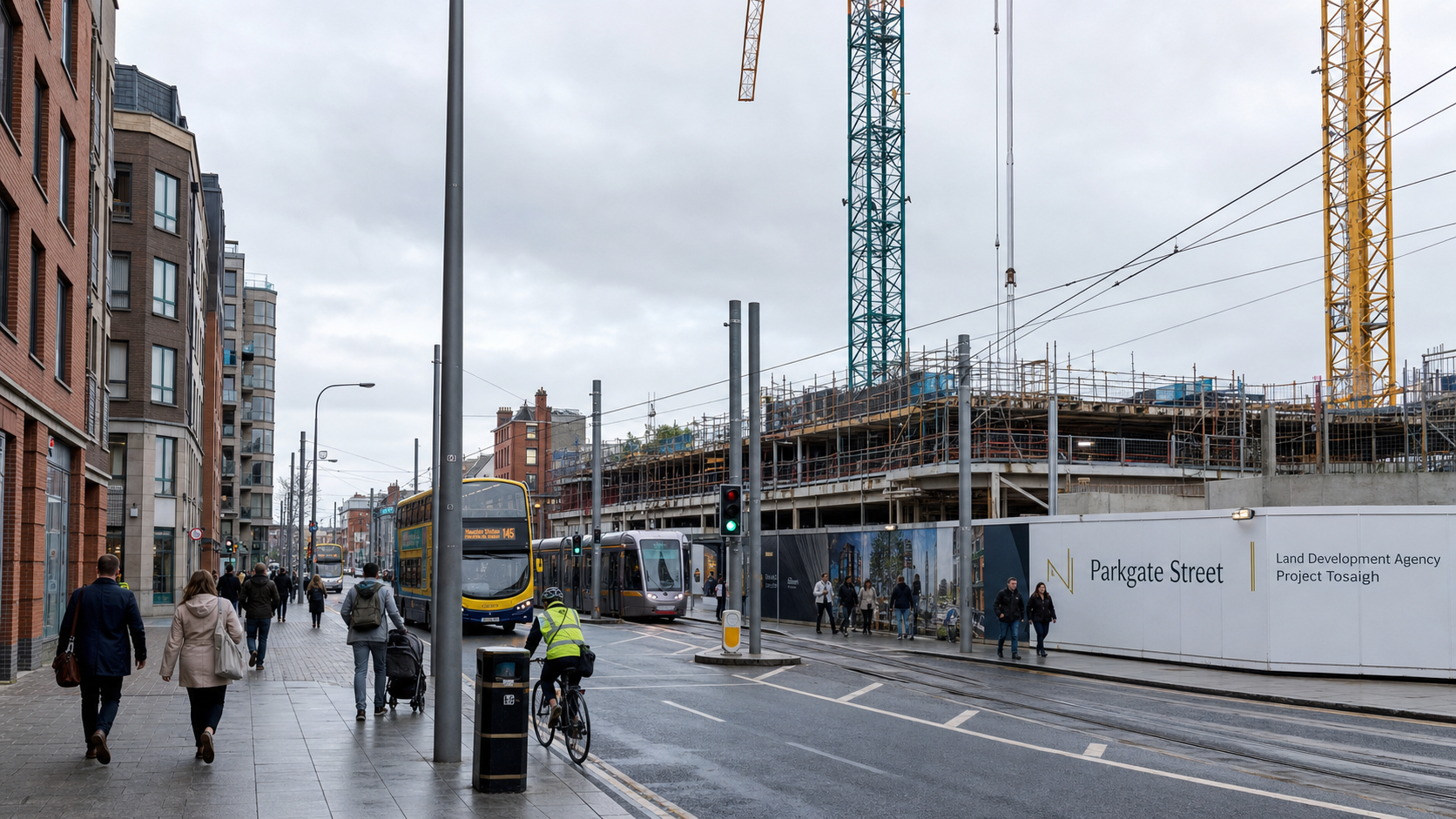
LDA Agrees €220 Million Deal to Buy Ireland's Future Tallest Building on Dublin's Parkgate Street
The Land Development Agency has agreed to purchase 562 homes in a major residential development on Parkgate Street in Dublin, a project that will include a 30-storey, 102-metre tower set to become the tallest building in Ireland when it is completed in 2029. The €220 million deal, struck with developer Castlethorn and funded through the LDA's Project Tosaigh initiative, represents the agency's most ambitious single acquisition since its establishment and is intended to deliver a significant volume of affordable and cost-rental homes in a prime Dublin location.
Background
The Land Development Agency was established by the Irish government to accelerate the delivery of affordable housing on state and state-adjacent land, with a particular focus on large-scale developments that the private market alone would not deliver at the required price points. Project Tosaigh, the LDA's acquisition programme, was designed to allow the agency to purchase large-scale residential developments from private developers at an early stage, securing homes for affordable and cost-rental tenants before they reach the open market.
The Parkgate Street site, located adjacent to Heuston Station in Dublin 8, is one of the most significant development sites in the capital. Its proximity to the city centre, to major public transport connections, and to the Phoenix Park makes it an exceptionally attractive location, and the scale of the development — 562 homes in a mixed-height scheme anchored by a 30-storey tower — reflects the ambition of both the developer and the LDA. John Paul Construction has been appointed as the lead contractor for the site.
The 102-metre tower will surpass the height of the existing tallest buildings in Ireland, including the 85-metre Obel Tower in Belfast and the 85.53-metre Railyard building in Cork, which had been positioned to claim the title of Ireland's tallest residential building before the Parkgate Street project advanced. The completion of the tower in 2029 will mark a significant moment in the evolution of Dublin's skyline and in the broader debate about high-density urban development in the capital.
Key Developments
The LDA confirmed the deal on Friday, September 11, 2026, describing it as a landmark acquisition that will deliver a substantial number of homes in a location that is well-served by public transport and close to major employment centres. The 562 homes will be delivered as a mix of affordable purchase and cost-rental units, with the precise split to be confirmed as the project progresses toward completion. The LDA has indicated that the development will be managed in accordance with its standard approach to affordable housing delivery, with income eligibility criteria applied to ensure that the homes reach those who need them most.
The Project Tosaigh mechanism, through which the deal is funded, allows the LDA to commit to purchasing homes at an agreed price before construction is complete, providing the developer with the financial certainty needed to proceed with a project of this scale and complexity. The approach has been used successfully in a number of previous LDA acquisitions, and the Parkgate Street deal represents its application at a significantly larger scale than any previous transaction.
The announcement was welcomed by housing advocates, who noted that the delivery of 562 affordable homes in a prime Dublin location represents a meaningful contribution to addressing the capital's chronic housing shortage. Critics of the LDA's approach have previously questioned whether the agency's acquisition model delivers sufficient value for public money compared with direct state construction, but the scale and location of the Parkgate Street deal has been broadly welcomed across the political spectrum.
Why It Matters
The Parkgate Street deal is significant on multiple levels. At the most immediate level, it will deliver 562 homes that would otherwise have been sold on the open market at prices beyond the reach of most first-time buyers and renters in Dublin. The cost-rental model, in particular, has been identified as a critical tool for providing long-term housing security for middle-income households who earn too much to qualify for social housing but cannot afford market rents in the capital. The scale of the LDA's commitment — €220 million for a single development — also signals a level of ambition and financial capacity that marks a significant evolution in the agency's role.
The symbolic significance of the tower itself should not be underestimated. Ireland's tallest building being a publicly-acquired affordable housing development, rather than a corporate headquarters or luxury residential tower, sends a powerful message about the direction of housing policy. It also demonstrates that high-density, high-rise development can be delivered in Dublin at a scale that makes a meaningful contribution to housing supply — a point that has been contested in planning debates for many years.
Local Impact
The Parkgate Street development is located in Dublin 8, an area that has seen significant regeneration in recent years but where housing affordability remains a serious challenge. The proximity to Heuston Station, which serves intercity rail connections to Cork, Limerick, Galway, and Waterford, as well as Luas and bus connections to the city centre, makes the location particularly attractive for workers commuting to employment across the capital and beyond. The delivery of 562 affordable homes in this location will have a direct impact on the housing options available to households in the area and will contribute to the broader regeneration of the Heuston Quarter, which has been identified as a priority development zone by Dublin City Council.
What's Next
Construction on the Parkgate Street site is already under way, with John Paul Construction having commenced enabling works. The project is scheduled for completion in 2029, at which point the 30-storey tower will become the tallest building in Ireland. The LDA will publish further details of the affordable purchase and cost-rental allocation process in due course. The agency has indicated that it is continuing to assess further acquisition opportunities under Project Tosaigh, with a pipeline of potential deals at various stages of negotiation.