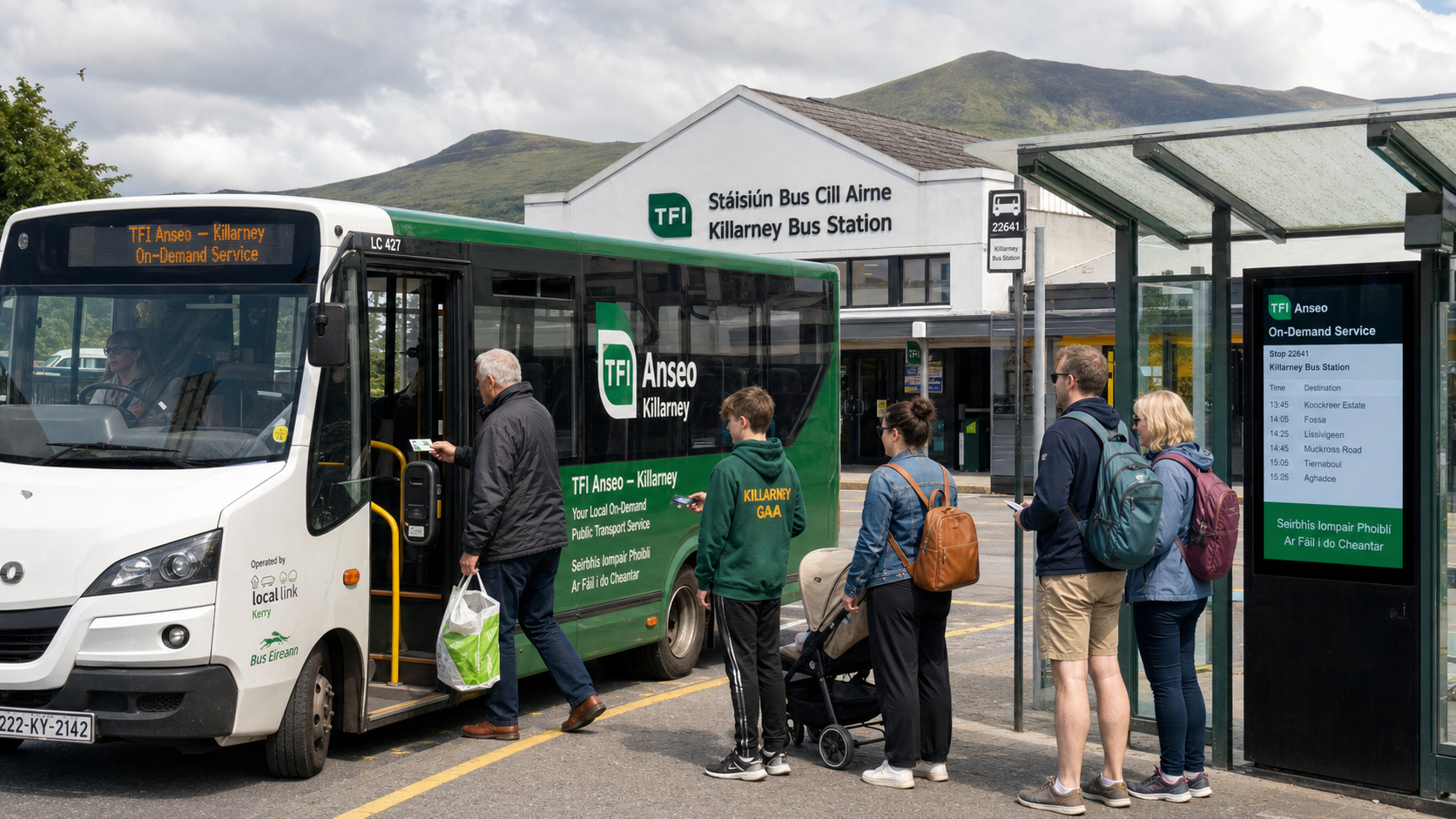
Killarney's On-Demand Bus Pilot Extended After 82,000 Journeys as Kerry Town Proves Rural Transport Can Work
A pioneering demand-responsive bus service in Killarney has been extended for a second year after recording more than 82,000 passenger journeys in its first twelve months, a figure that has surprised even its most optimistic supporters and prompted calls for the model to be rolled out across rural Ireland.
Background
Rural public transport has long been one of the most intractable problems in Irish infrastructure planning. Fixed-route bus services work well in urban areas where passenger density justifies regular timetables, but in towns and villages where demand is dispersed and unpredictable, traditional models have consistently failed to deliver. The result has been a chronic dependence on private cars in rural communities, with particular hardship for older residents, young people without licences, and those on lower incomes.
The TFI Anseo service in Killarney was designed to test a different approach. Launched on August 11, 2025, under the Connecting Ireland Rural Mobility Plan and funded through the Climate Action Fund, the service operates as a demand-responsive transport system within a 10.4 kilometre radius of Killarney town centre. Rather than following a fixed route, the buses travel wherever passengers need to go within that zone, booked through an app or by phone, with the system optimising routes in real time to serve multiple passengers efficiently.
Key Developments
The National Transport Authority confirmed on July 20th that the TFI Anseo pilot would be extended for a second year, with a comprehensive evaluation report scheduled for December 2026. In the first six months of 2026 alone, 53,205 passengers used the service, an average of more than 2,000 per week. The service has recorded as many as 385 passengers in a single day. Customer surveys indicate that 53 per cent of users travel on the service between four and seven days per week.
Perhaps most significantly, approximately 48 per cent of users reported that they would have used a private car if the service were not available. General Manager of TFI Local Link Kerry, Alan O'Connell, has described the results as extraordinary and has advocated for the eventual implementation of a full town bus service with fixed routes to complement the demand-responsive model.
Why It Matters
The Killarney pilot matters because it provides concrete, Irish evidence that demand-responsive transport can work at scale in a rural context. The 48 per cent modal shift figure is particularly striking. For context, most urban public transport interventions struggle to achieve modal shift of this magnitude. The fact that a rural on-demand service is achieving it suggests that the barrier to public transport use in rural Ireland is not primarily one of preference, but of availability.
Local Impact
For Killarney residents, the practical benefits have been immediate and tangible. Older residents who no longer drive have regained independence. Young people without cars have gained access to employment, education, and social activities that were previously difficult to reach. Kerry County Council has expressed strong support for the extension and has indicated it will make representations to the NTA for an expanded service area ahead of the December evaluation.
What's Next
The December 2026 evaluation will determine the long-term future of the TFI Anseo model in Killarney and its potential for replication elsewhere. The NTA is expected to publish findings that will inform the next phase of the Connecting Ireland Rural Mobility Plan. TFI Local Link Kerry is exploring the feasibility of a complementary fixed-route town service that would address the capacity constraints emerging as the on-demand system reaches its operational limits.