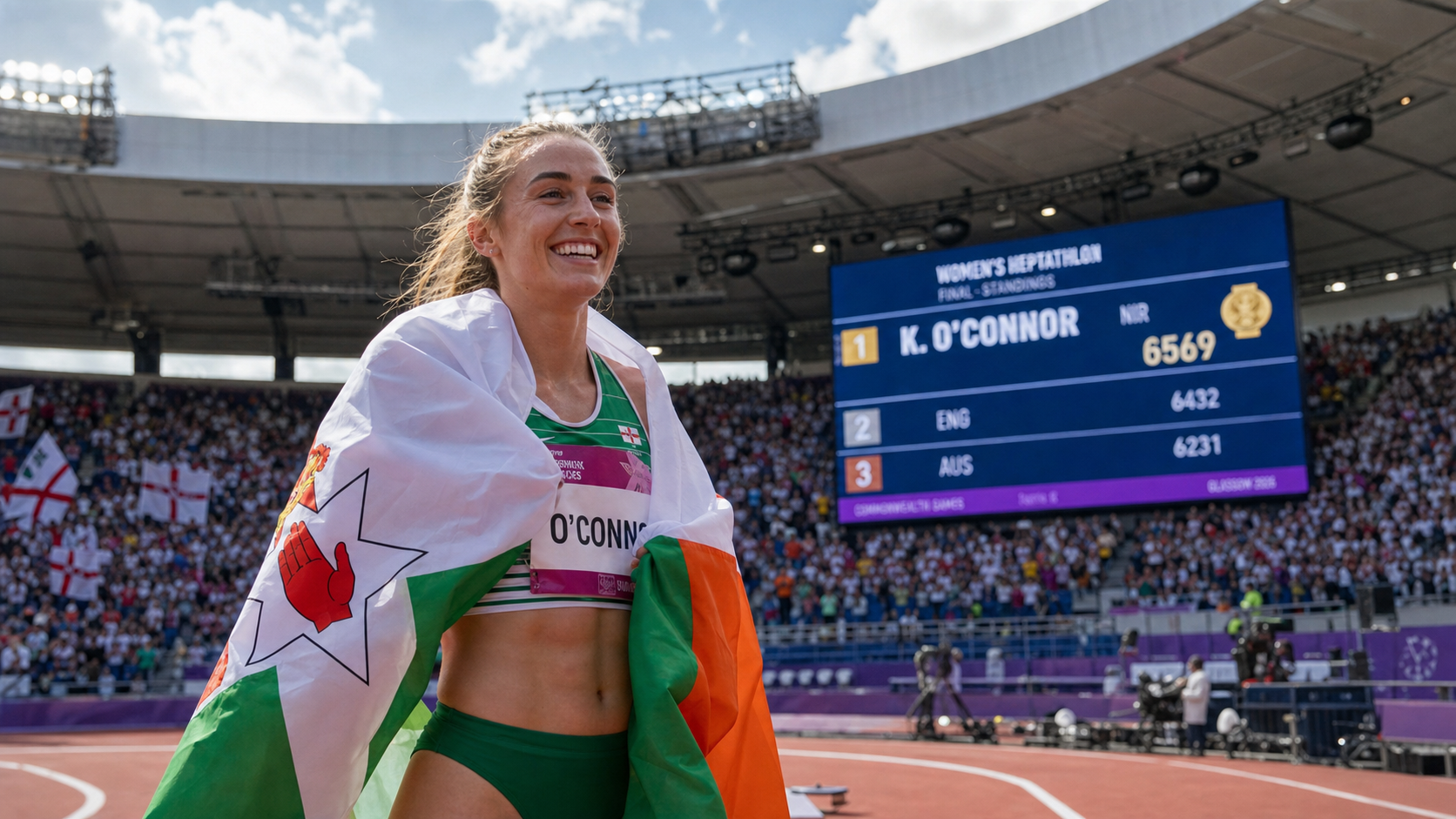
Kate O'Connor Makes History with Northern Ireland's First Commonwealth Athletics Gold in 40 Years
Kate O'Connor has written her name into Northern Ireland sporting history by winning the heptathlon gold medal at the 2026 Commonwealth Games in Glasgow, becoming the first athlete from the six counties to claim Commonwealth gold in athletics since 1986 — a 40-year wait that ended in spectacular fashion at Scotstoun Stadium on Thursday evening.
Background
O'Connor, who is 25 years old and was born in Newry, County Down, has been one of the most consistent multi-event athletes in these islands for the better part of a decade. She finished eighth at the 2018 Commonwealth Games on the Gold Coast and claimed silver in Birmingham four years later, but the gold medal had always remained just out of reach. The 2026 Games in Glasgow represented what many in the athletics community regarded as her best opportunity to finally claim the top prize.
The heptathlon is one of the most demanding disciplines in track and field, requiring competitors to excel across seven events over two days: the 100m hurdles, high jump, shot put, 200m, long jump, javelin, and 800m. It rewards not just physical ability but tactical intelligence, the capacity to manage fatigue, and the mental resilience to recover from a poor performance in one event without allowing it to derail the overall competition.
O'Connor had demonstrated all of those qualities throughout her career, but the 2026 season had been complicated by the withdrawal of England's Katarina Johnson-Thompson — the defending champion and world-class favourite — which both opened the field and raised questions about the quality of the competition. O'Connor was determined to answer those questions emphatically.
Key Developments
The competition began in difficult conditions, with rain-soaked ground making the shot put circle treacherous on the opening day. O'Connor navigated those challenges with composure, setting season-best marks in the high jump, 200m, long jump, and javelin across the two days of competition. Her performance in the 800m — the final event of the heptathlon — was particularly impressive, with a time of 2:10.45 that confirmed her as champion with a total of 6,569 points.
England's Jade O'Dowda took silver, with Australia's Tori West claiming bronze. The margin of victory was comfortable enough to suggest that O'Connor had not merely benefited from Johnson-Thompson's absence but had genuinely delivered a performance worthy of the gold medal on its own terms.
Team Northern Ireland finished the Glasgow Games with 16 medals in total — their second-highest haul in Commonwealth history — with O'Connor's gold joined by Jon McConnell's boxing triumph and significant contributions from the bowls and swimming teams.
Why It Matters
The significance of O'Connor's achievement extends well beyond the medal itself. Northern Ireland athletics has been searching for a landmark moment at the Commonwealth level since 1986, when Mary Peters' legacy still cast a long shadow over the sport in the province. The 40-year gap between Commonwealth athletics golds is a measure of how difficult it is to produce athletes capable of competing at this level, and of how much O'Connor's success means to the sport's development infrastructure.
Athletics Northern Ireland has invested significantly in its talent pathway over the past decade, and O'Connor's gold is the clearest validation yet of that approach. Unlike the Republic's athletics programme, which has benefited from a strong Olympic pipeline and high-profile figures such as Rhasidat Adeleke, Northern Ireland's athletics community has had to work with more limited resources and a smaller talent pool. O'Connor's achievement demonstrates what is possible when that talent is properly supported.
The Commonwealth Games also serve a function that the Olympics cannot fully replicate for Northern Ireland athletes, who compete under the Team NI banner rather than for either Ireland or Great Britain. For many of them, Glasgow 2026 was the pinnacle of their international careers, and O'Connor's gold gives the entire team a moment to celebrate collectively.
Local Impact
In Newry, where O'Connor grew up and first developed her athletics career, the reaction to her gold medal was one of enormous communal pride. The city, which straddles the border between County Down and County Armagh, has a strong sporting tradition, and O'Connor's success adds to a list of achievements that the community can point to with genuine satisfaction. Athletics clubs across the Down and Armagh area reported increased interest from young people in the days following her victory, with coaches noting that a high-profile gold medal is among the most effective recruitment tools available to grassroots sport.
Newry, Mourne and Down District Council is expected to formally recognise O'Connor's achievement in the coming weeks, with a civic reception likely to be arranged for her return from Glasgow. The council has been a consistent supporter of elite sport in the area, and O'Connor's gold provides a compelling case for continued investment in athletics facilities and coaching.
What's Next
O'Connor has confirmed that she intends to compete at the 2026 European Athletics Championships in Birmingham, which begin on August 10. The heptathlon is not on the European Championships programme, but O'Connor has indicated she may compete in individual events. Beyond Birmingham, the focus will shift to the 2028 Los Angeles Olympics, where she will be 27 years old and at the peak of her athletic powers. Her coaching team has already begun planning the four-year cycle that they hope will culminate in an Olympic medal.