Irish Politics Fractures Further as Big Three Parties Hit New Low in September Poll
The combined support for Fine Gael, Fianna Fail, and Sinn Fein has fallen to 58 per cent — a twenty-point decline since October 2022 — according to the latest Irish Times/Ipsos B&A poll, with government satisfaction at a term low of 29 per cent and independents and smaller parties now commanding 35 per cent of the vote, a level equal to the combined share of the two governing parties.
Background
Irish politics has been undergoing a slow but accelerating transformation for more than a decade. The dominance of Fianna Fail and Fine Gael — the two parties that alternated in government for most of the state's history — was first seriously challenged by the rise of Sinn Fein, which became the largest party in the Dail following the 2020 general election. But the September 2026 poll suggests that the fragmentation of the political landscape has moved beyond a simple shift from the traditional duopoly to Sinn Fein, and into something more complex and less predictable.
Six parties now poll below 10 per cent but maintain representation in the Dail: the Social Democrats at 8 per cent, Aontu at 5 per cent, Independent Ireland and Labour at 4 per cent each, and the Green Party and People Before Profit at lower levels. Independent candidates collectively command 14 per cent of the vote. The arithmetic of coalition formation in this environment is formidable, and the prospect of a stable majority government emerging from the next election — expected in 2027 — is far from certain.
The Irish Times/Ipsos B&A poll is one of the most respected in the country, with a methodology that has been consistent over many years, making its trend data particularly valuable. The September 2026 figures represent the most dramatic reading of political fragmentation since the poll began tracking these metrics.
Key Developments
The individual party figures, excluding undecided voters and those unlikely to vote, show Sinn Fein at 23 per cent — still the largest single party but down from its peak — Fianna Fail at 18 per cent, and Fine Gael at 17 per cent. Leader approval ratings have also declined: Taoiseach Micheal Martin is at 34 per cent (down three points), Fine Gael leader Simon Harris at 31 per cent (unchanged), and Sinn Fein leader Mary Lou McDonald at 31 per cent (down four points).
Government satisfaction at 29 per cent is the lowest recorded during the current coalition's term. The poll found that 51 per cent of voters say they find it a lot more difficult to manage financially, with a further 38 per cent saying it is a little more difficult. On Budget 2027 priorities, energy and heating bill support topped the list at 23 per cent, followed by housing support at 21 per cent, public services spending at 17 per cent, and tax reductions at 13 per cent.
Why It Matters
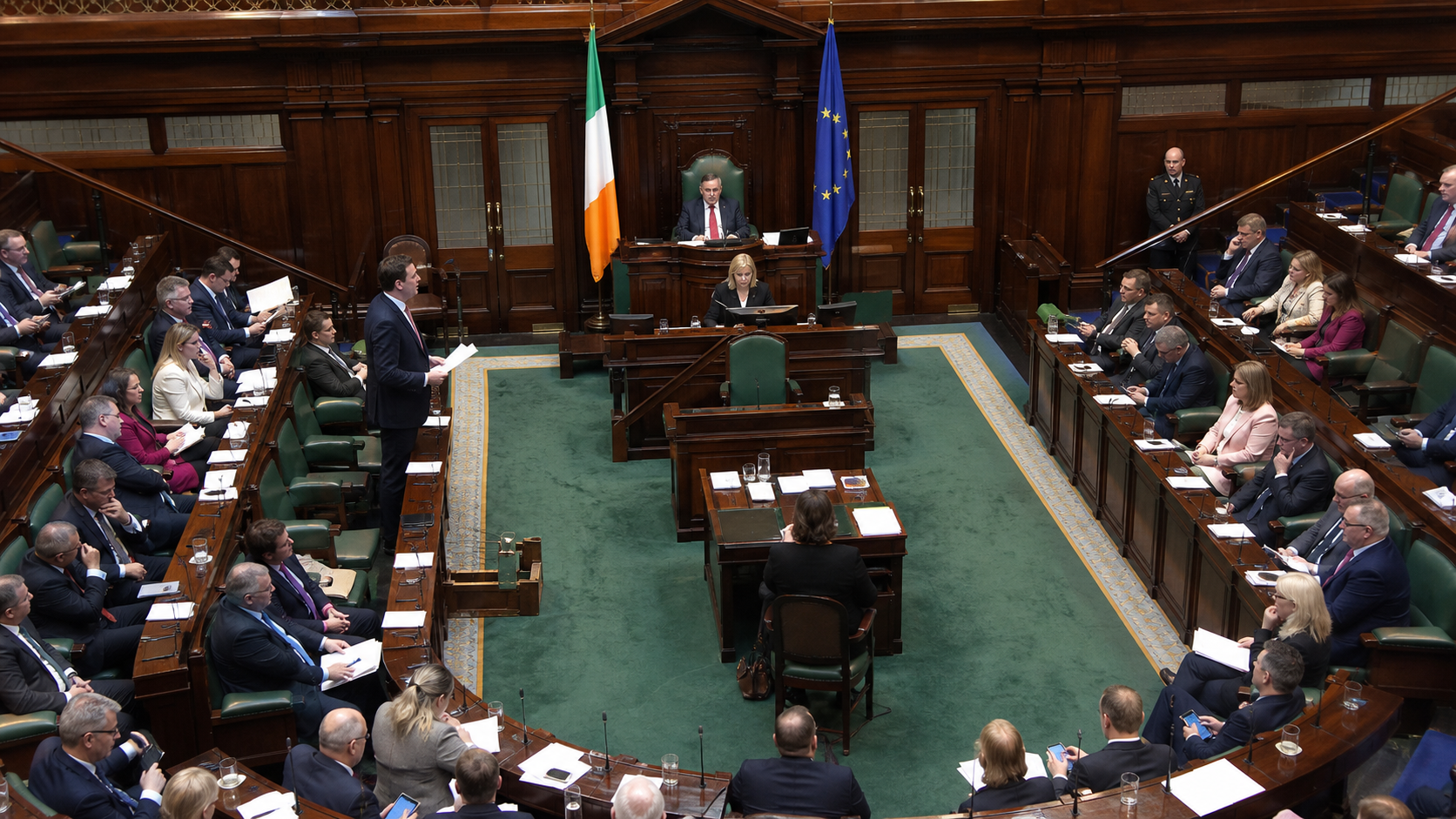
The fragmentation of Irish politics has profound implications for governance. A Dail in which no combination of two or three parties can command a majority is a Dail in which government formation becomes a protracted and uncertain process, and in which the resulting coalition is likely to be unstable and constrained in its ambitions. The experience of the current government — a three-party coalition of Fianna Fail, Fine Gael, and the Green Party — has demonstrated both the possibilities and the limitations of such arrangements.
The rise of Aontu, which is polling at 5 per cent and showing particular strength in the Connacht-Ulster region, is a development that deserves attention. The party, which combines a socially conservative platform with a commitment to Irish unity, is drawing support from voters who feel that neither Sinn Fein nor the traditional nationalist parties adequately represent their values. Its growth, alongside that of the Social Democrats in Dublin, suggests that the Irish electorate is becoming more ideologically diverse and less tribal in its voting patterns — a development that makes the formation of stable governments more difficult but may ultimately produce a more representative Dail.
Local Impact
The poll's findings on financial hardship resonate particularly strongly in Dublin, where the cost of living — driven primarily by housing costs — has been rising faster than in the rest of the country. In constituencies such as Dublin Bay North, Dublin West, and Dublin South-Central, the combination of high rents, rising energy bills, and stagnant wages has created a political environment in which the governing parties are deeply vulnerable. In rural constituencies, particularly in the west and north-west, the emphasis on energy and heating costs reflects the particular vulnerability of households dependent on home heating oil, which has seen significant price increases over the past year. The HSE's projected year-end deficit, which is expected to be confirmed before the Public Accounts Committee on Thursday, adds further pressure on a government already struggling to manage public expectations ahead of Budget 2027.
What's Next
Budget 2027 is expected to be presented to the Dail in mid-October 2026. The poll's findings on voter priorities — particularly the emphasis on energy and heating costs — will inform the government's final decisions on the package of measures to be announced. The Taoiseach, who is currently in New York for the UN General Assembly, is expected to return to Dublin at the weekend for the final stages of budget preparation. The next Irish Times/Ipsos B&A poll is expected in November, and will provide the first reading of public opinion following the budget announcement.