Irish Housing Market Cools Sharply as Asking Price Growth Halves and Transaction Prices Hit Six-Year Low
The Irish housing market has undergone a significant cooling in the third quarter of 2026, with the latest Daft.ie sales report showing national asking price inflation slowing to 3% annually — approximately half the rate recorded a year earlier — while transaction price growth has fallen to just 0.8%, the lowest rate since 2020. The slowdown is driven primarily by weakening demand rather than an increase in supply, with buyers becoming more cautious and properties spending longer on the market.
Background
Ireland's housing market has been one of the most persistently overheated in Europe for the better part of a decade. The combination of chronic undersupply, strong population growth, and historically low interest rates drove prices to levels that placed homeownership beyond the reach of many ordinary workers, particularly in Dublin and the other major cities. The market's trajectory has been a source of intense political controversy, with successive governments accused of failing to build enough homes to meet demand.
The current slowdown represents a departure from that pattern, though economists are careful to note that it does not yet constitute a correction. National asking prices remain 44% above pre-Covid levels and are still 7.5% below the peak recorded during the Celtic Tiger era. The average national list price for a residential property in the third quarter of 2026 was just under €445,000 — a figure that remains far beyond the reach of many first-time buyers on average incomes.
The Daft.ie report, which tracks both asking prices and transaction prices across the country, is one of the most closely watched indicators of housing market health in Ireland. Its quarterly publication is invariably accompanied by intense media and political scrutiny, and the latest edition is no exception.
Key Developments
The most striking finding in the Q3 2026 report is the narrowing of the gap between asking prices and final transaction prices. This gap — a key indicator of market heat — has fallen to 2.6% nationally, down sharply from 6.8% a year earlier and the smallest margin since 2023. The narrowing suggests that buyers are no longer willing to bid significantly above the asking price, a behaviour that was commonplace during the peak of the market.
Regional variations remain significant. Dublin asking prices for three-bedroom semi-detached homes stand at €635,000, up 2.7% year-on-year. Galway City has seen stronger growth at 5.8%, with prices at €618,000. Cork City prices stand at €431,000, also up 5.7%. Limerick City at €376,000 and Waterford City at €313,000 — the latter up 11% year-on-year — reflect the continued migration of demand away from the capital.
Supply remains constrained. While there were approximately 13,800 second-hand homes listed for sale in early September — a 12.5% increase on the previous year — this remains only about half of the pre-pandemic norm. The flow of second-hand homes coming onto the market has been stagnant for three years, suggesting that many homeowners are reluctant to sell in an uncertain environment.
Why It Matters
The cooling of the Irish housing market is significant for several reasons. For prospective buyers — particularly first-time buyers who have been priced out of the market for years — the slowdown offers a degree of hope that prices may become more accessible. The narrowing of the gap between asking and transaction prices means that buyers are no longer required to engage in the kind of frenzied bidding wars that characterised the market at its peak.
For the government, the slowdown presents a political challenge. Budget 2027, due on 6 October, is expected to include measures aimed at stimulating housing supply and supporting first-time buyers. The cooling market complicates the political calculus: measures designed to boost demand could reignite price growth, while measures focused on supply take years to have an effect. Housing Minister James Browne has ordered a review of online bidding portals amid concerns about "gamification" — a sign that the government is aware of the behavioural dimensions of the market as well as the structural ones.
Local Impact
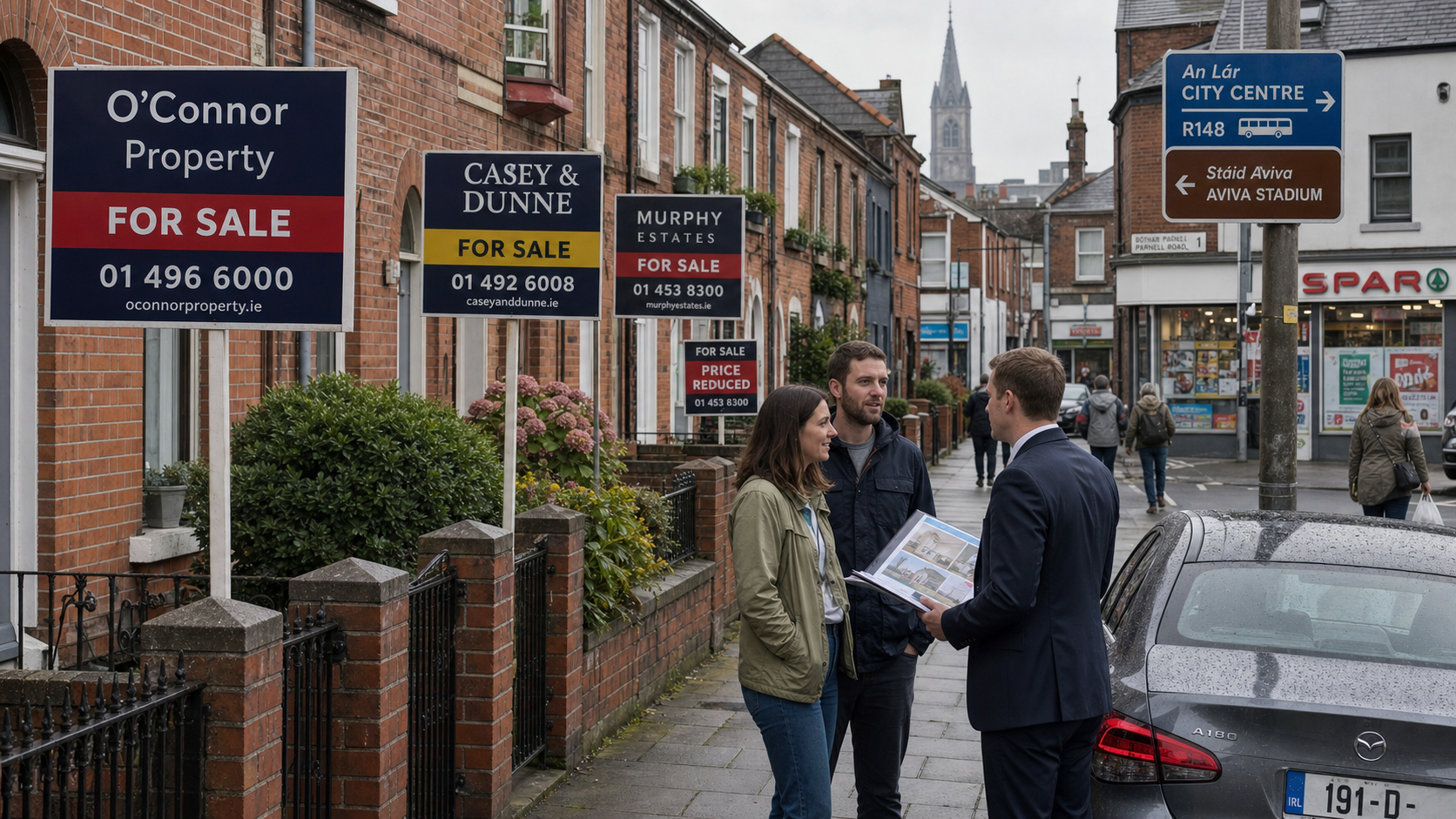
In Dublin, the slowdown is most visible in areas that were previously among the hottest in the market — Ranelagh, Rathmines, and Rathgar in the south inner city, and Clontarf and Raheny on the northside. Estate agents in these areas report that properties are spending longer on the market and that the volume of competing bids has fallen significantly. In Cork city, the Ballincollig and Douglas areas have seen similar trends. For renters in these areas, the cooling of the sales market offers little immediate relief — rental prices remain at record levels, and the supply of rental accommodation continues to fall.
What's Next
Budget 2027 on 6 October is expected to include a range of housing measures, including potential changes to the Help to Buy scheme, increased funding for social and affordable housing, and measures to encourage the release of vacant properties onto the market. The Daft.ie report will be closely watched by government officials as they finalise the budget package. The next quarterly report, covering Q4 2026, will be published in December and will provide the first indication of whether the current slowdown is a temporary correction or the beginning of a more sustained period of price moderation.