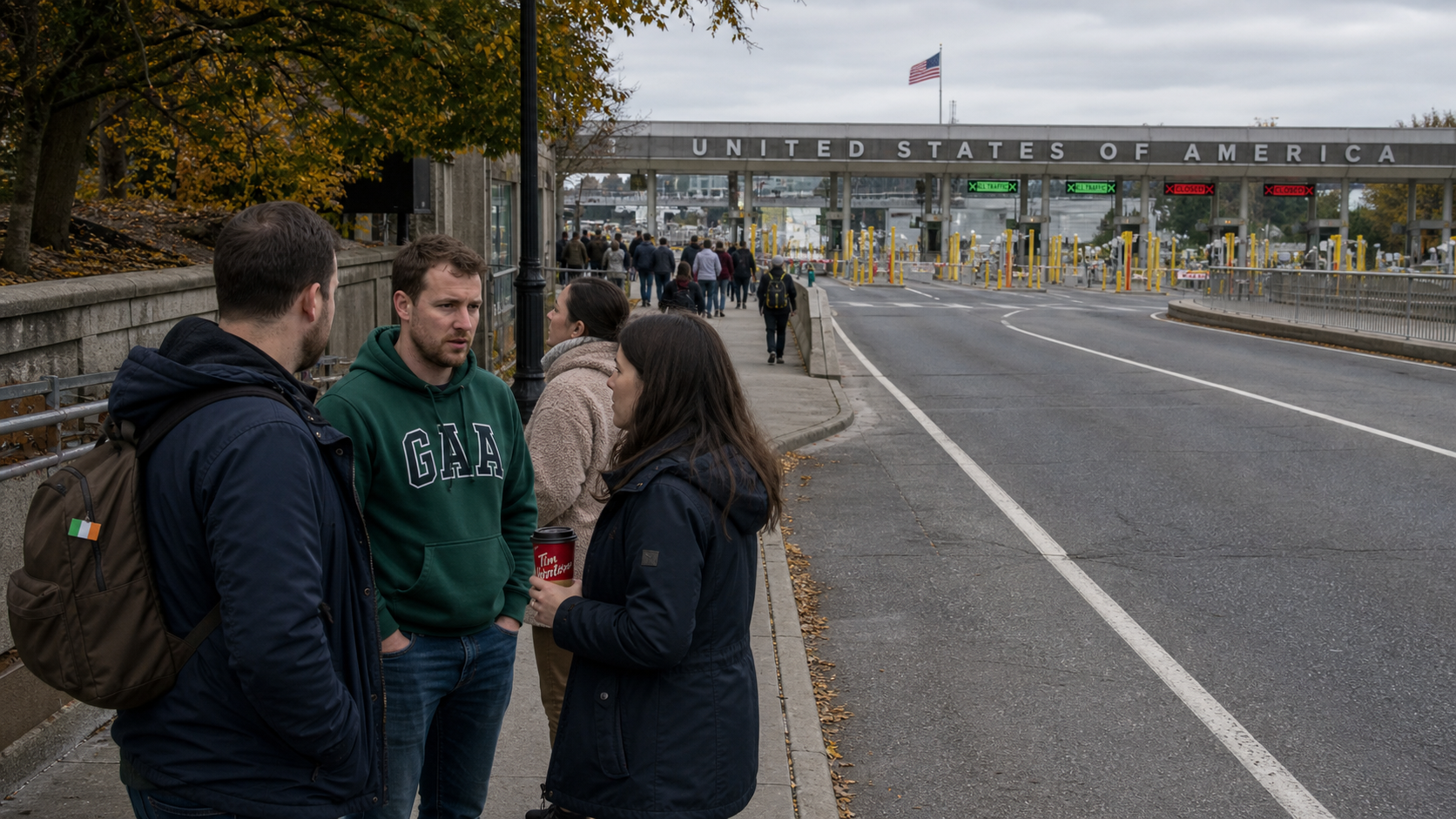
Irish Emigrants in Canada Shun US Border Crossings as Trump Tariffs Reshape Daily Life
Irish emigrants living in Canada have described how the Trump administration's tariffs and increasingly assertive border policies have fundamentally altered their daily lives, with many who previously crossed into the United States for shopping, dining, and leisure activities now choosing to stay on the Canadian side of the border — a shift that reflects a broader recalibration of the Irish-Canadian community's relationship with its American neighbour and that has significant implications for the cross-border economy that has long characterised life in border communities.
Background
The Irish community in Canada is one of the most significant components of the global Irish diaspora, with an estimated 4.5 million Canadians claiming Irish heritage and a substantial number of recent Irish emigrants — particularly from the post-2008 generation and the more recent wave driven by housing costs and cost-of-living pressures — living and working in cities from Toronto and Ottawa to Vancouver and Calgary.
For Irish emigrants living in border communities — particularly in Ontario, Quebec, and British Columbia — crossing into the United States for shopping, entertainment, and leisure has historically been a routine part of life. The proximity of American cities, the lower prices on many goods, and the ease of crossing the border made it a natural extension of daily life for many Canadian residents, including the Irish community.
The Trump administration's imposition of tariffs on Canadian goods, combined with a more assertive approach to border enforcement and a rhetorical posture toward Canada that has ranged from dismissive to openly hostile, has changed that calculation for many people. The tariffs have pushed up prices on American goods imported into Canada, reducing the price advantage that once made cross-border shopping attractive. The border enforcement changes have made the crossing itself more uncertain and time-consuming.
Key Developments
Irish emigrants in Canada have been speaking to Irish media about the changes they have experienced. One Irish woman living in a community near the Ontario-Michigan border described how she and her family had previously crossed into Michigan regularly for grocery shopping, where prices on many items were significantly lower than in Canada. "We don't do that anymore," she said. "Between the tariffs pushing prices up on the American side and the uncertainty at the border, it's just not worth it. We shop locally now."
The shift is not merely economic. Several Irish emigrants described a change in the cultural atmosphere around the border, with a sense that the easy, informal relationship between Canada and the United States that had characterised life in border communities for generations had been replaced by something more guarded and uncertain. "It feels different now," said one Irish man who has lived in Canada for eight years. "The border used to feel like nothing. Now it feels like something."
The Irish-Canadian community has also been following the broader political tensions between Canada and the United States with concern, particularly the Trump administration's comments about Canada's sovereignty and its suggestions that Canada might become the 51st state of the United States — remarks that have been received with a mixture of anger and incredulity in Canada.
Why It Matters
The experience of Irish emigrants in Canada is a microcosm of the broader impact of the Trump administration's trade and border policies on the relationship between the United States and its closest neighbour and trading partner. Canada and the United States share the world's longest undefended border, and the economic and cultural integration of the two countries is profound. The disruption of that integration — even at the margins — has real consequences for the millions of people who live and work in border communities.
For the Irish diaspora in Canada, the changes also have a specific resonance. Many Irish emigrants chose Canada precisely because of its values — its openness, its multiculturalism, its commitment to international cooperation — and the contrast with the direction of American politics under Trump has reinforced their sense that they made the right choice. The Irish government's Diaspora Strategy 2026-2030, which recognises Australia and Canada as increasingly important destinations for Irish emigrants, will need to take account of the changing dynamics of life in these communities.
Local Impact
In Irish community organisations across Canada — from the Irish Canadian Immigration Centre in Toronto to the Irish associations in Vancouver and Calgary — the impact of the US-Canada tensions has been a recurring topic of conversation. Community leaders report that Irish emigrants are increasingly engaged with Canadian politics and civic life, seeing Canada as their home rather than a temporary stopping point on the way to somewhere else. The Irish Embassy in Ottawa has been active in supporting the community and in monitoring the impact of the trade tensions on Irish-Canadian businesses and individuals.
What's Next
The US-Canada trade dispute shows no sign of early resolution, with the Trump administration maintaining its tariff regime and Canada pursuing a combination of retaliatory measures and diplomatic engagement. For Irish emigrants in Canada, the immediate future is likely to involve continued adaptation to the new reality of a more complicated relationship with the United States. The Irish government's Emigrant Support Programme, which provides funding to Irish community organisations abroad, has been asked to consider whether additional support is needed for Irish communities in Canada given the specific challenges they are facing.