Irish Activist Faces Five Years in German Prison Over Weapons Company Attack as Dublin Urged to Act
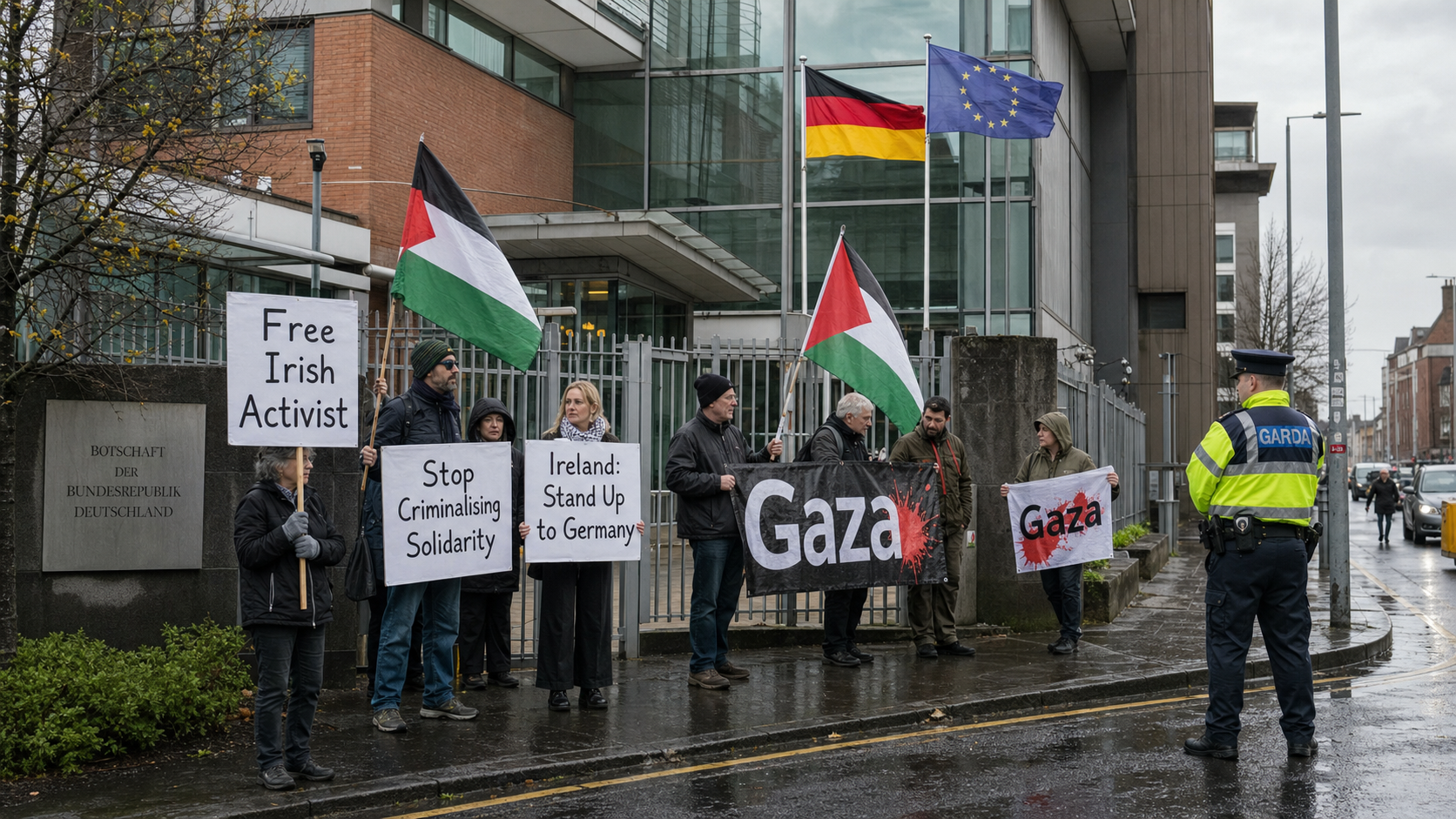
An Irish activist is facing up to five years in a German prison after being charged with attacking a weapons company, with Irish politicians and human rights groups calling on the government in Dublin to put diplomatic pressure on Germany over the case — with supporters of the activist arguing that the charges are politically motivated and connected to pro-Palestinian activism at a time when the conflict in Gaza continues to generate intense debate across Europe.
Background
The case of the Irish activist in Germany has attracted significant attention in Ireland, where the conflict in Gaza has generated a level of public engagement and political debate that is unusual even by the standards of a country with a strong tradition of solidarity with Palestinian rights. Ireland's historical experience of colonialism and partition has long made it a country with particular empathy for the Palestinian cause, and the scale of civilian casualties in Gaza since October 2023 has intensified that empathy across the political spectrum.
Germany, by contrast, has maintained a strong commitment to Israel's right to self-defence, rooted in the country's historical responsibility for the Holocaust and its post-war commitment to the security of the Jewish state. This has led to a significant divergence between German and Irish approaches to the conflict, and to tensions within the European Union over the appropriate response to the humanitarian crisis in Gaza. Germany has also taken a harder line than many other European countries on pro-Palestinian activism, with a number of demonstrations and events being restricted or banned on the grounds of public order or incitement.
The Irish activist, whose identity has been reported in the Irish media, was arrested in Germany in connection with an attack on a weapons company that the activist's supporters describe as a protest against arms exports to Israel. The charges, which carry a maximum sentence of five years, have been characterised by the activist's legal team as disproportionate and politically motivated.
Key Developments
The case has been raised in the Dáil and in the Seanad, with opposition politicians calling on the Minister for Foreign Affairs to make representations to the German government on behalf of the Irish citizen. The Irish Council for Civil Liberties has also expressed concern about the case, arguing that the charges raise questions about the proportionality of the German legal response to political protest and about the protection of the right to freedom of expression and assembly under European human rights law.
The Department of Foreign Affairs has confirmed that it is providing consular assistance to the Irish citizen and is monitoring the case closely. However, the government has been cautious about making public representations to Germany, mindful of the diplomatic sensitivities involved and of the principle that the Irish government does not intervene in the judicial processes of other sovereign states. This caution has frustrated the activist's supporters, who argue that the Irish government has a duty to advocate more forcefully for the rights of its citizens abroad.
The case has also drawn attention to the broader question of how European states are responding to pro-Palestinian activism in the context of the ongoing conflict in Gaza. A number of European countries, including Germany, France, and the United Kingdom, have taken measures to restrict or criminalise certain forms of pro-Palestinian protest, measures that have been criticised by human rights organisations as disproportionate and inconsistent with the right to freedom of expression.
Why It Matters
The case of the Irish activist in Germany matters for several reasons. It raises fundamental questions about the rights of Irish citizens abroad and the obligations of the Irish government to advocate for those rights in the face of what supporters characterise as politically motivated prosecution. It also raises questions about the consistency of European approaches to political protest and about the extent to which the right to freedom of expression is being protected across the EU in the context of the Gaza conflict.
For the Irish diaspora in Germany — a significant community, particularly in cities like Berlin, Munich, and Frankfurt — the case is a source of concern and debate. The Irish community in Germany has generally maintained good relations with German society and institutions, and the case creates a degree of tension that many in the community find uncomfortable. The outcome of the case will be watched closely by Irish citizens living in Germany and by the broader Irish diaspora across Europe.
Local Impact
In Ireland, the case has become part of the broader political debate about the conflict in Gaza and Ireland's response to it. The government has faced sustained pressure from opposition parties and civil society groups to take a stronger stance on the humanitarian crisis in Gaza, and the case of the Irish activist in Germany has added a personal dimension to that debate. For the activist's family and friends in Ireland, the situation is a source of profound anxiety, and their calls for government action have resonated with a public that is deeply engaged with the Gaza conflict.
What's Next
The trial of the Irish activist in Germany is expected to take place in the coming months. The activist's legal team is preparing a defence that challenges both the factual basis of the charges and their proportionality under European human rights law. The Irish government has indicated that it will continue to provide consular assistance and to monitor the case, but has stopped short of making formal diplomatic representations to Germany. The outcome of the trial will determine whether the activist faces a custodial sentence, and the Irish government's response to that outcome will be closely watched by human rights groups and by the Irish diaspora across Europe.