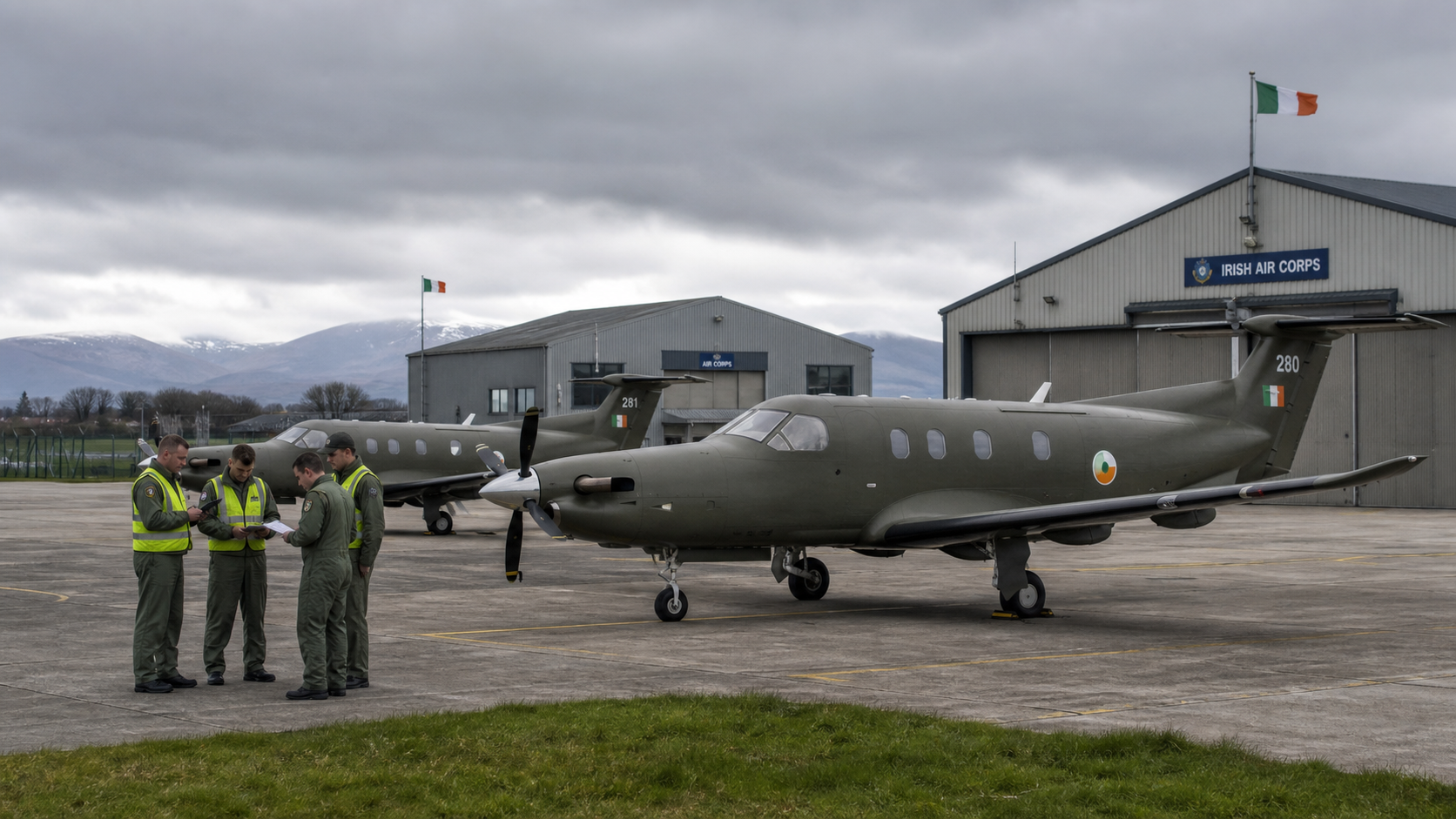
Irish Air Corps Grounds PC-12 Fleet Over Missed Maintenance Deadlines in Second Such Incident in a Year
The Irish Air Corps has grounded its fleet of four Pilatus PC-12 aircraft after a manual audit revealed that a number of scheduled maintenance items had been missed, in the second such grounding of the fleet within twelve months. The aircraft, which play a critical role in medical evacuations, surveillance operations, and transport, were acquired in 2020 at a cost of approximately €50 million and are now the subject of renewed questions about the adequacy of the Air Corps' maintenance management systems.
Background
The Pilatus PC-12 is a single-engine turboprop aircraft widely used by military and civilian operators around the world for a variety of roles. The Irish Air Corps acquired four of the aircraft in April 2020, replacing an older fleet and significantly enhancing the service's capability for medical evacuation missions — a role that is particularly important given Ireland's island geography and the need to transport critically ill patients from offshore islands and remote areas to mainland hospitals.
The PC-12s are based at Casement Aerodrome in Baldonnel, County Dublin, and operate under the command of the Air Corps' Fixed Wing Squadron. In addition to medical evacuations, they are used for maritime patrol, fisheries protection, and the transport of government officials and military personnel. Their grounding therefore has implications not only for the Air Corps' operational capability but for the broader range of state functions that depend on air support.
This is not the first time the PC-12 fleet has been grounded due to maintenance concerns. In September 2025, an audit at Casement Aerodrome identified maintenance shortcomings that forced the grounding of the fleet, necessitating the cancellation of an air ambulance mission. That incident prompted questions in the Dáil about the management of the fleet and the adequacy of the Air Corps' maintenance tracking systems.
Key Developments
The current grounding was triggered by a manual audit that revealed a misalignment between the Air Corps' computer-based Maintenance Information System and the actual maintenance schedules prescribed by the aircraft's manufacturer, Pilatus. A small number of scheduled maintenance items were found to have been missed — not because the work had been overlooked by maintenance personnel, but because the software system had failed to accurately track the required service intervals.
The Defence Forces characterised the situation as a maintenance scheduling "anomaly" and emphasised that the grounding was a precautionary measure rather than an indication that the aircraft were unsafe to fly. The PC-12s held valid Military Airworthiness Review Certificates at the time of the grounding, and the Defence Forces maintained that the aircraft's airworthiness had not been compromised. Nevertheless, the decision to ground the fleet pending resolution of the maintenance discrepancies was taken as a matter of prudence.
The grounding has raised questions about the reliability of the Air Corps' maintenance management software and the adequacy of the manual oversight procedures that are supposed to catch errors of this kind. The fact that a similar issue arose just twelve months ago suggests that the corrective measures put in place after the 2025 grounding were insufficient.
Why It Matters
The grounding of the PC-12 fleet matters because these aircraft perform functions that cannot easily be substituted. Medical evacuations from the Aran Islands, Rathlin Island, and other offshore communities depend on the availability of fixed-wing aircraft capable of operating in the conditions that prevail on Ireland's western and northern coasts. When the PC-12s are grounded, the Air Corps must rely on helicopters or commercial air ambulance services to cover these missions — options that are more expensive, less reliable in poor weather, and not always available at short notice. The broader question raised by this second grounding in twelve months is whether the Air Corps has the resources, personnel, and systems management capability to maintain a modern aircraft fleet to the standards required for safe and reliable operations.
Local Impact
The practical impact of the grounding is felt most acutely in communities that depend on air ambulance services for access to emergency medical care. The Aran Islands, with a combined population of approximately 1,200 people, rely on air transport for medical emergencies that cannot be handled by the island's limited medical facilities. Similar dependencies exist in communities along the west coast of Ireland and on offshore islands including Tory Island, Clare Island, and the Blaskets. During the grounding period, the HSE's National Ambulance Service has been working with the Air Corps to ensure that alternative arrangements are in place for medical evacuations, but the disruption to normal operations is a source of anxiety for island communities and their healthcare providers.
What's Next
The Air Corps has indicated that it is working to resolve the maintenance discrepancies identified in the audit as quickly as possible, with the aim of returning the PC-12 fleet to operational status. The Defence Forces have not specified a timeline for the return to service, but have indicated that the aircraft will not fly until all outstanding maintenance items have been completed and verified. The Department of Defence is expected to face questions in the Dáil about the grounding when the Oireachtas returns from recess, with opposition TDs likely to press for a full review of the Air Corps' maintenance management systems and the adequacy of the oversight arrangements for the PC-12 fleet.