Ireland's New Diaspora Strategy Targets 70 Million People of Irish Heritage as Australia Overtakes US as Top Destination
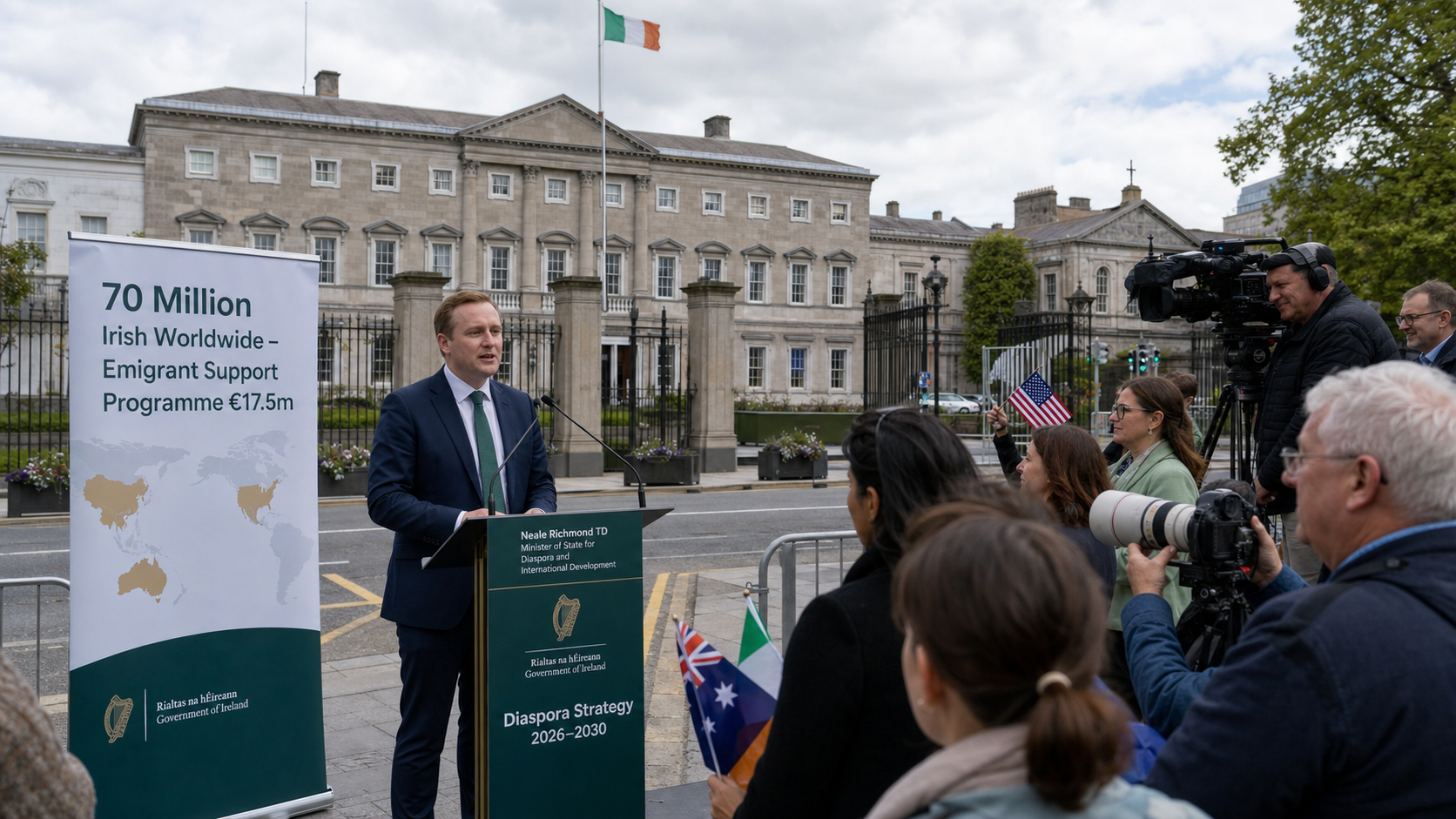
Ireland's Diaspora Strategy 2026-2030, launched in New York in May by Minister of State Neale Richmond, is targeting deeper engagement with the estimated 70 million people of Irish heritage worldwide, backed by a record €17.5 million allocation to the Emigrant Support Programme. The strategy, the product of the most extensive consultation process in Irish history, recognises that Australia has overtaken the United States as the primary destination for Irish emigrants and that the pattern of Irish emigration has shifted fundamentally — with more than half of those who leave Ireland now returning within a decade.
Background
Ireland's relationship with emigration is one of the defining features of its national identity. The Great Famine of the 1840s, which killed approximately one million people and drove another million to emigrate in a single decade, established a pattern of population loss that continued for more than a century and created Irish communities in every corner of the English-speaking world. The Irish diaspora — estimated at 70 million people worldwide, compared to a population of approximately 7 million on the island of Ireland — is one of the largest in proportion to the home country's population of any nation on earth.
The nature of Irish emigration has changed dramatically over the past three decades. The economic migrants of the 1980s — who left Ireland in large numbers during a period of high unemployment and limited opportunity — have been followed by a more diverse and more mobile generation of emigrants who move between countries for career development, lifestyle reasons, and personal relationships. The proportion of emigrants who return to Ireland has increased significantly, and the concept of the "returned emigrant" — bringing international experience, diverse skills, and global networks back to Ireland — has become an important part of the country's economic and cultural narrative.
The government's diaspora engagement strategy has evolved in response to these changes. The Emigrant Support Programme, which funds Irish community organisations and support services in countries with significant Irish populations, has been expanded and reformed to reflect the changing profile of the diaspora. The new strategy, covering the period 2026-2030, represents the most ambitious and comprehensive approach to diaspora engagement that any Irish government has undertaken.
Key Developments
The strategy was developed through a consultation process that involved more than 27 in-person meetings across 17 countries — including locations as diverse as Nairobi, Lagos, and Warsaw — and the first-ever online Global Irish Survey, conducted in the summer of 2025. The breadth of the consultation reflects the government's recognition that the Irish diaspora is no longer concentrated primarily in the United States, the United Kingdom, and Australia but is now spread across a much wider range of countries.
The shift in emigration patterns is one of the most significant findings of the strategy's research phase. Australia has overtaken the United States as the primary destination for Irish emigrants — a development that reflects the relative strength of the Australian economy, the ease of obtaining working visas, and the large and well-established Irish community that already exists in cities like Sydney, Melbourne, and Brisbane. The strategy includes specific commitments to strengthen engagement with the Irish community in Australia, including increased funding for Irish cultural organisations and enhanced consular services.
The strategy also introduces the concept of the "affinity diaspora" — individuals who have lived, worked, or studied in Ireland and maintain a deep cultural connection despite having no hereditary Irish links. This category, which includes many of the international students and workers who have come to Ireland in recent decades, is recognised as an important part of Ireland's global network and is included in the strategy's engagement framework for the first time.
The €17.5 million allocated to the Emigrant Support Programme for 2026 represents a record level of funding and reflects the government's commitment to supporting Irish communities overseas, particularly the most vulnerable — including elderly emigrants who may be isolated, and those who are experiencing poverty or homelessness in their adopted countries.
Why It Matters
Ireland's diaspora strategy matters because the Irish diaspora is one of the country's most significant assets — a global network of people with emotional, cultural, and often economic connections to Ireland that can be leveraged for trade, diplomacy, investment, and cultural exchange. The strategy's framing of the diaspora as "diplomatic capital" reflects a sophisticated understanding of how soft power works in the contemporary world and of the role that diaspora communities can play in advancing Ireland's interests internationally.
The recognition that more than half of Irish emigrants now return within a decade is also significant. Returned emigrants bring with them international experience, diverse skills, and global networks that are increasingly valued by Irish employers and that contribute to the country's economic and cultural dynamism. The strategy's commitment to reducing the administrative barriers facing those who wish to return — including the challenges of re-entering the housing market and of having overseas qualifications recognised — reflects a practical understanding of what is needed to make return a realistic option for more people.
Local Impact
The diaspora strategy has implications for communities across Ireland, not just for those with direct connections to emigration. The returned emigrants who are settling in Irish cities and towns are contributing to the social and economic fabric of those communities, bringing new perspectives and skills that enrich the local environment. In Dublin, Cork, Galway, and Limerick — the cities that attract the largest numbers of returned emigrants — the impact is most visible, but it is felt in smaller towns and rural areas as well, as people return to the communities where they grew up.
What's Next
The strategy will be implemented over the period 2026-2030, with annual progress reports to be published by the Department of Foreign Affairs. The first annual review is expected in early 2027. Minister of State Neale Richmond has indicated that he will undertake a series of visits to Irish communities overseas in the coming months to assess the implementation of the strategy and to engage directly with diaspora organisations. A dedicated diaspora engagement portal, providing information and resources for Irish people living abroad and for those considering returning to Ireland, is expected to launch before the end of 2026.