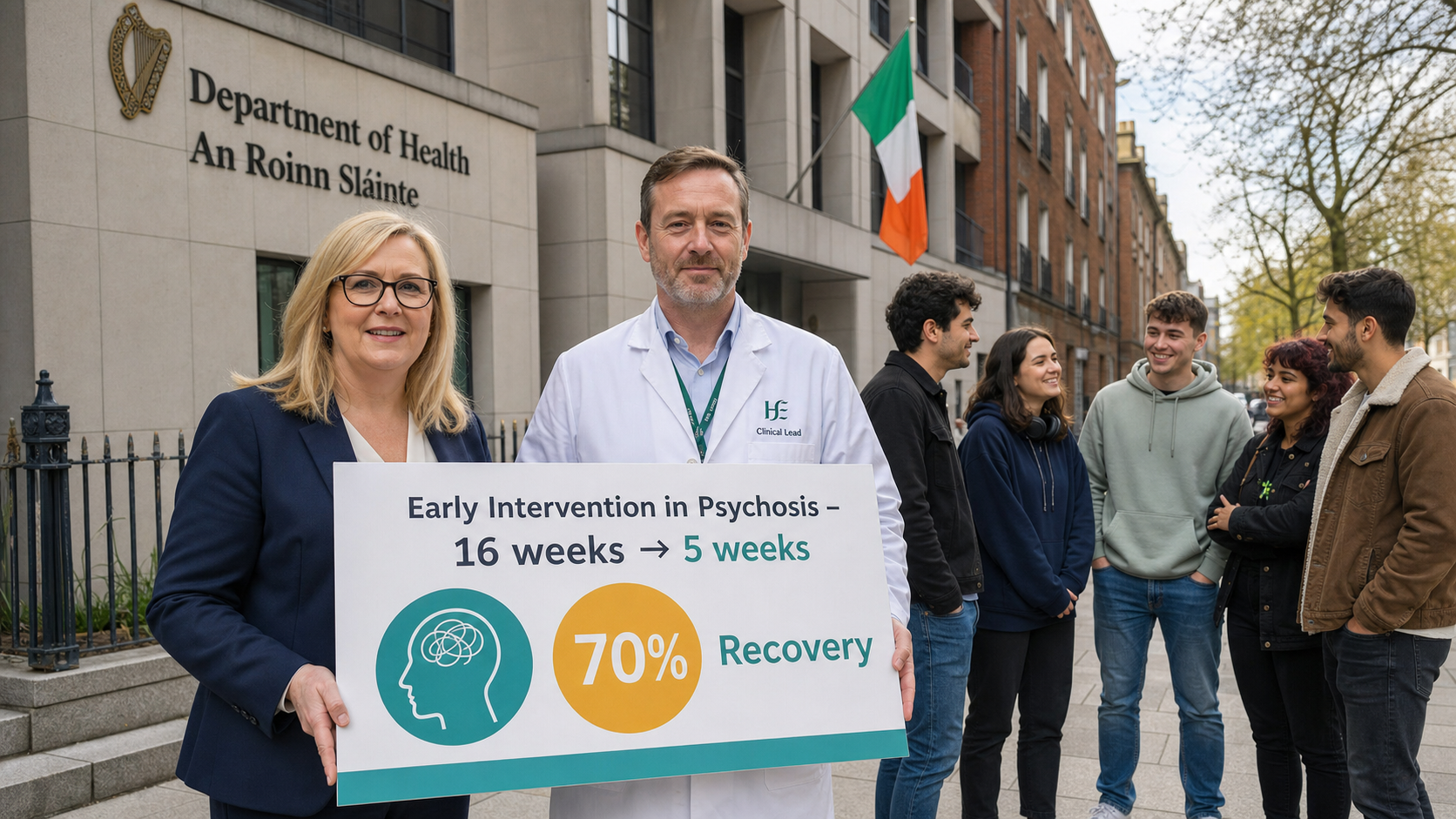
Ireland's Early Intervention Psychosis Programme Cuts Untreated Duration from 16 Weeks to Five as Recovery Rates Hit 70%
Ireland's national Early Intervention in Psychosis programme has achieved a dramatic reduction in the average duration of untreated psychosis — from 16 weeks to just five weeks — with 70% of participants achieving functional or personal recovery, according to new data published by Minister for Mental Health Mary Butler that represents one of the most significant advances in Irish mental health care in recent years.
Background
Psychosis — a condition characterised by a loss of contact with reality, including hallucinations, delusions, and disorganised thinking — is one of the most serious and disabling mental health conditions. In Ireland, psychosis accounts for approximately 26% of all psychiatric inpatient admissions, with males representing 58% of cases. The condition typically first presents in late adolescence or early adulthood, and the speed with which it is identified and treated has a profound impact on long-term outcomes.
The principle underlying early intervention in psychosis is straightforward: the longer a person experiences untreated psychosis, the greater the damage to their social functioning, employment prospects, and long-term mental health. Research consistently shows that rapid, specialist intervention — within weeks rather than months of the first episode — significantly improves recovery rates and reduces the likelihood of relapse and hospitalisation. Ireland's national Early Intervention in Psychosis programme, which has been in development since the HSE identified it as a priority in 2010, is built on this evidence base.
The programme uses two primary service configurations: a Hub and Spoke model for rural and smaller urban areas, and a Stand-Alone model for large metropolitan areas. Six multidisciplinary EIP teams are currently operational nationwide, with four additional teams in recruitment. The government has committed €7.8 million in recurring annual funding to support the programme's expansion.
Key Developments
The new data, published by Minister Butler this week, covers the programme's performance in 2025. The headline figures are striking: the average duration of untreated psychosis has been reduced from 16 weeks to five weeks — a 69% reduction that reflects the programme's success in identifying and engaging with people experiencing a first episode of psychosis before their condition becomes entrenched.
The programme supported 478 individuals and 509 family members in 2025, with 60% of service users being under the age of 35. More than 31,200 specialist appointments were delivered during the year. The recovery data is particularly encouraging: 70% of participants achieved functional or personal recovery, and day-to-day functioning improved by an average of 50% during engagement with EIP teams.
The employment outcomes are also noteworthy. Through Individual Placement and Support programmes embedded within the EIP teams, 179 people secured employment over the past three years. Critically, 80% of individuals who were not in education, employment, or training at the time of referral gained employment after engagement with an EIP team that included an IPS worker — a figure that underlines the programme's potential to prevent the long-term social exclusion that often accompanies untreated psychosis.
Why It Matters
The EIP programme's results matter because they demonstrate that investment in early mental health intervention produces measurable, significant returns — not just in clinical outcomes, but in social and economic terms. A person who recovers from a first episode of psychosis and returns to employment or education within months is a fundamentally different outcome from a person who spends years cycling through acute psychiatric admissions, losing their job, their relationships, and their sense of self in the process.
The programme's success also challenges the persistent narrative that mental health services in Ireland are uniformly inadequate. While significant challenges remain — including long waiting times for CAMHS services, inadequate community mental health infrastructure, and the ongoing crisis in acute psychiatric bed capacity — the EIP programme demonstrates that when the right model is properly resourced and implemented, Irish mental health services can achieve outcomes that compare favourably with the best in Europe.
Local Impact
The EIP programme's six operational teams are distributed across the country, with coverage in Dublin, Cork, Galway, Limerick, and other major urban centres. The four teams currently in recruitment will extend coverage to areas that are currently underserved, including parts of the midlands and the north-west. For families in these areas — who have historically faced the prospect of long waits for specialist mental health assessment — the expansion of the programme represents a significant improvement in access to care. The HSE's community mental health teams, which provide the referral pathway into the EIP programme, have been working to raise awareness among GPs and other primary care providers of the programme's availability and the importance of early referral.
What's Next
The four EIP teams currently in recruitment are expected to be operational by early 2027, extending the programme's reach to areas not currently covered. Minister Butler has indicated that she will seek additional funding in the Budget to accelerate the expansion, with the goal of having a full national network of EIP teams in place by 2028. The programme's 2026 performance data will be published next year, providing an opportunity to assess whether the improvements seen in 2025 have been sustained and extended. The HSE is also developing a national awareness campaign to help people and their families recognise the early signs of psychosis and seek help quickly — a critical component of reducing the duration of untreated psychosis further.