A dramatic 12.1% contraction in Irish GDP during the first quarter of 2026 has pushed the entire 21-country eurozone economy into an unexpected decline, with revised Eurostat data revealing that the bloc shrank by 0.2% in the period — a stark reversal from initial estimates of 0.1% growth that has sent shockwaves through European economic circles.
The extraordinary volatility in Ireland's national accounts has been attributed primarily to a 27.1% contraction in the pharmaceutical sector, which had dramatically front-loaded production and exports throughout 2025 in anticipation of potential US trade tariffs. As those trends unwound in the first quarter of this year, the resulting collapse in export data skewed Ireland's GDP figures in a manner that economists described as "staggering" but ultimately misleading about the true state of the domestic economy.
The Central Statistics Office was quick to contextualise the headline figure, pointing to Modified Domestic Demand — a metric specifically designed to strip away the volatile effects of multinational activity — which grew by a healthy 0.6% during the same period. Non-multinational sectors expanded by 0.4%, and personal consumer spending increased by 0.6%, suggesting that the underlying Irish economy remains in reasonable health despite the dramatic headline contraction.
"These figures are a stark reminder of the unique challenges that Ireland faces in measuring its economic performance," said the CSO's chief economist. "The activities of a small number of very large multinational corporations can have an outsized impact on our national accounts that bears little relationship to the lived experience of Irish households and businesses."
The European Commission and the European Central Bank both moved quickly to reassure markets that the eurozone's apparent contraction was primarily a statistical artefact of Ireland's unusual economic structure rather than a genuine signal of weakness across the bloc. Oxford Economics noted that when Ireland's volatile data is excluded, the broader eurozone economy appears "remarkably steady."
However, the episode has reignited debate about the appropriateness of Ireland's current approach to measuring economic activity and whether the country's GDP figures provide a meaningful guide to policymakers and investors. Several economists have called for greater prominence to be given to alternative metrics that better capture the performance of the domestic economy.
For the Irish government, the figures present a communications challenge. While ministers have been at pains to emphasise the resilience of the domestic economy, the headline GDP contraction has attracted significant international media attention and raised questions about Ireland's economic model and its heavy dependence on a small number of large multinational corporations.
The pharmaceutical sector's role in the contraction has also focused attention on the risks associated with Ireland's concentration of high-value manufacturing activity in a single industry. The sector accounts for a disproportionately large share of Irish exports and GDP, meaning that fluctuations in its output can have dramatic effects on the country's headline economic figures.
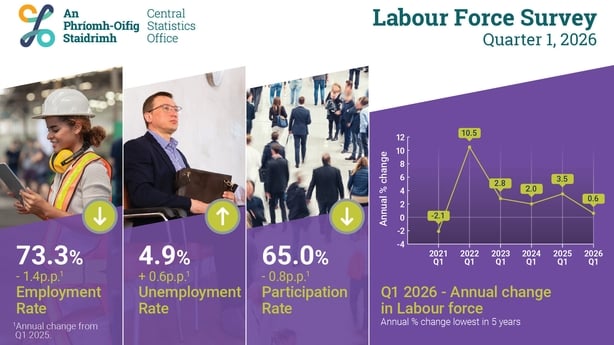
Finance Minister Paschal Donohoe sought to reassure businesses and investors, pointing to strong employment figures and a continued budget surplus as evidence of the underlying strength of the Irish economy. "The fundamentals of our economy remain sound," he said. "Employment is growing, consumer spending is robust, and our public finances are in good order. We should not allow a statistical quirk to obscure that reality."
The Central Bank of Ireland had previously projected 3% growth for the Irish economy in 2026, a forecast that analysts said remained broadly achievable given the strength of domestic demand, though the pharma sector's performance would be a key variable to watch in the coming quarters.
The episode has also drawn attention to the broader question of Ireland's economic model and its long-term sustainability. Critics have argued for years that the country's heavy dependence on a small number of large multinational corporations creates significant vulnerabilities, and the first-quarter GDP figures have given fresh ammunition to those who believe that Ireland needs to diversify its economic base.
Supporters of the current model counter that the presence of multinational corporations has brought enormous benefits to Ireland in terms of employment, tax revenues, and technology transfer, and that the volatility in GDP figures is a statistical issue rather than a reflection of genuine economic weakness. They point to the strong performance of the domestic economy and the continued growth in employment as evidence that the fundamentals remain sound.
The debate is likely to intensify in the coming months as the government prepares its autumn budget and considers how to respond to the challenges posed by global trade tensions, rising energy costs, and the ongoing uncertainty surrounding US tariff policy. For Finance Minister Donohoe, the task of communicating Ireland's economic story to domestic and international audiences has rarely been more challenging.
%20(6)-Nov-26-2025-02-12-55-8074-PM.png)