Irish Labour Market Cools as AI Skills Surge: Unemployment at 4.9% but Hiring Sentiment Turns Cautious
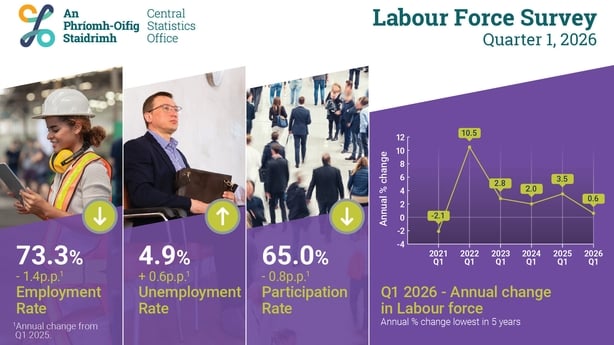
Ireland's labour market is showing clear signs of moderation after a period of exceptional post-pandemic growth, with unemployment settling at 4.9% in May 2026 and employers adopting a more cautious approach to hiring — but the most significant structural shift is the dramatic surge in demand for skills related to artificial intelligence, now mentioned in roughly 11% of all Irish job postings and transitioning from a niche technical requirement to a horizontal competency expected across a wide range of professions.
Background
Ireland's labour market has been one of the most dynamic in Europe over the past decade, driven by the growth of the technology sector, the expansion of financial services, and the continued strength of the pharmaceutical and medical devices industries. Employment reached a record high of approximately 2.83 million people in early 2026, a remarkable achievement for a country that experienced devastating unemployment during the financial crisis of 2008-12. The unemployment rate, which peaked at over 15% during the crisis, has fallen steadily and now stands at 4.9% — a level that economists consider to be close to full employment.
The moderation in hiring sentiment that is now evident reflects a combination of factors. Higher interest rates, which have increased the cost of borrowing for businesses, have made employers more cautious about expanding their workforces. Global trade uncertainty, driven by the ongoing tensions between the United States and its major trading partners, has created a more uncertain environment for the export-oriented sectors that are central to Ireland's economy. And the tech sector, which was a major driver of employment growth in the years following the pandemic, has been going through a period of adjustment, with several major companies including Meta reducing their Irish headcounts.
Despite these headwinds, the labour market remains fundamentally strong. Wage growth of approximately 4.1% year-on-year is above inflation, meaning that workers are seeing real increases in their purchasing power. The employment rate — the proportion of the working-age population in employment — remains at historically high levels. And the pipeline of investment from multinational companies, while more selective than in previous years, continues to generate new job announcements.
Key Developments
The most striking development in the Irish labour market in 2026 is the surge in demand for skills related to artificial intelligence. According to data from Indeed and Morgan McKinley, AI-related skills are now mentioned in approximately 11% of all Irish job postings — a figure that has more than doubled in the past two years and that reflects the rapid integration of AI tools and capabilities into a wide range of business functions. The demand is not confined to technology companies; it is evident across professional services, financial services, healthcare, and even traditional industries like manufacturing and agriculture.
The shift towards contractor roles is another notable trend. Employers who are uncertain about the medium-term economic outlook are increasingly using contractors rather than permanent employees to manage their workforce flexibility, a pattern that has implications for workers' job security and for the tax and social insurance system. The growth of the gig economy and the increasing prevalence of remote and hybrid working arrangements are adding further complexity to the labour market picture.
The tech sector's adjustment has been the most visible element of the labour market moderation. Meta's decision to cut approximately 350 Irish roles, following similar reductions at other major tech companies, has generated significant media coverage and political concern. However, the broader tech sector remains a major employer in Ireland, and new investment announcements — including OpenText's commitment to create 400 jobs over three years and Version 1's opening of a new Dublin AI studio — provide some counterbalance to the job losses.
Why It Matters
The state of the Irish labour market matters because employment is the foundation of individual and family wellbeing, and because the tax revenues generated by a strong labour market fund the public services that the entire population depends on. The moderation in hiring sentiment is not a crisis — the labour market remains fundamentally healthy — but it is a signal that the exceptional growth of recent years is not sustainable indefinitely, and that the economy needs to adapt to a new phase of more moderate but more sustainable growth. The surge in demand for AI skills is particularly significant: it suggests that the Irish economy is adapting to the technological revolution rather than being left behind by it, but it also raises important questions about the workers and communities that may be left behind if the transition is not managed carefully.
Local Impact
The labour market trends are felt differently in different parts of Ireland. In Dublin, where the technology and financial services sectors are concentrated, the moderation in hiring is most visible — the frenetic pace of recruitment that characterised the post-pandemic years has given way to a more selective and deliberate approach. In regional cities like Cork, Galway, and Limerick, the labour market remains relatively strong, supported by the pharmaceutical and medical devices industries that are less exposed to the tech sector's adjustment. In rural areas, the labour market challenges are different — the shortage of workers in agriculture, hospitality, and construction remains acute, and the availability of remote working has not fully compensated for the structural disadvantages of rural locations.
What's Next
The Central Bank of Ireland has projected 3% economic growth for 2026, a more optimistic outlook than earlier fears of a technical recession following the sharp GDP contraction in Q1. The labour market is expected to remain broadly stable through the rest of the year, with unemployment staying close to its current level. The summer transfer window in the tech sector — the period when companies typically make their major hiring decisions for the second half of the year — will be closely watched as an indicator of whether the moderation in hiring sentiment is temporary or more persistent. The government's response to the labour market challenges, including its investment in skills development and its approach to the regulation of AI in the workplace, will be a major focus of policy debate in the coming months.
%20(6)-Nov-26-2025-02-12-55-8074-PM.png)