Ireland's 'Staggering' 12% GDP Slump Is a Statistical Illusion — But the Underlying Risks Are Real
Ireland's economy recorded a headline GDP contraction of 12.1% in the first quarter of 2026, a figure so dramatic that it pushed the entire eurozone into a technical recession and generated alarmed headlines across the international financial press. But economists, government officials, and business leaders are united in insisting that the figure is a statistical mirage — a product of the extraordinary and distorting influence of a small number of multinational pharmaceutical and technology companies on Ireland's national accounts. The real story is more nuanced, and in some respects more concerning.
Background
Ireland's GDP figures have been notoriously unreliable as a measure of the actual performance of the domestic economy for more than a decade. The problem stems from the concentration of a small number of very large multinational companies — primarily in the pharmaceutical and technology sectors — whose activities can cause enormous swings in the headline GDP figure that bear no relationship to the lived experience of Irish businesses and households.
The phenomenon became so pronounced that the Central Statistics Office developed an alternative measure — Modified Domestic Demand (MDD) — specifically to provide a more accurate picture of the domestic economy's performance. MDD strips out the distorting effects of multinational activity and provides a measure that economists and policymakers regard as far more meaningful than the headline GDP figure.
The first quarter of 2026 saw a particularly dramatic example of this distortion. A small number of pharmaceutical companies engaged in significant on-shoring and off-shoring of intellectual property and other assets, generating a massive statistical effect on the GDP figure that had nothing to do with the actual performance of the Irish economy. The result was a 12.1% GDP contraction that, taken at face value, would suggest an economic catastrophe — but which, in reality, reflects the accounting decisions of a handful of multinational boardrooms.
Key Developments
The Irish Times and RTÉ both reported extensively on the GDP figures this week, with economists from the Bank of Ireland, the ESRI, and the Department of Finance all providing context that placed the headline figure in its proper perspective. The key point, repeated consistently across all commentary, was that Modified Domestic Demand — the government's preferred measure — actually grew by 0.6% in the first quarter, suggesting that the domestic economy is performing reasonably well despite the challenging global environment.
Exchequer returns published separately by RTÉ showed that corporation tax receipts were up 9.1% year-on-year, further underscoring the disconnect between the GDP figure and the actual financial performance of the companies operating in Ireland. The tax receipts, which are a more direct measure of corporate profitability, suggest that the multinational sector remains highly profitable even as its accounting activities generate statistical distortions in the national accounts.
The GDP figures have, however, given fresh impetus to a debate about the structural risks of Ireland's economic model. A report commissioned by the Collison brothers — Patrick and John, the Irish-born founders of Stripe — and authored by Professor Alan Ahearne of the University of Galway, warned this week that Ireland's heavy reliance on a small number of foreign firms represents a "structural vulnerability" that requires urgent government action to address.
Why It Matters
The GDP paradox matters because it illustrates, in the starkest possible terms, the fundamental tension at the heart of Ireland's economic model. The country has been extraordinarily successful at attracting foreign direct investment, and the tax revenues generated by multinational companies have funded significant improvements in public services and infrastructure. But that success has come at a cost: an economy that is deeply dependent on the decisions of a small number of foreign boardrooms, and that is therefore exposed to risks that are largely outside the government's control.
The Ahearne report's warning about structural vulnerability is not new — economists have been making similar arguments for years. But the dramatic GDP figure has given the argument a new urgency and a new audience. The question of how Ireland can reduce its dependence on a small number of large foreign companies while maintaining the investment environment that has made it so attractive to those companies is one of the most important strategic challenges facing the country.
The eurozone dimension is also significant. Ireland's GDP contraction pushed the eurozone into a technical recession — a fact that generated significant political and economic commentary across Europe. While the distorting effect of Irish multinational activity is well understood by European economists, the headline figure still has real effects on market sentiment and on the ECB's assessment of the eurozone's economic health.
Local Impact
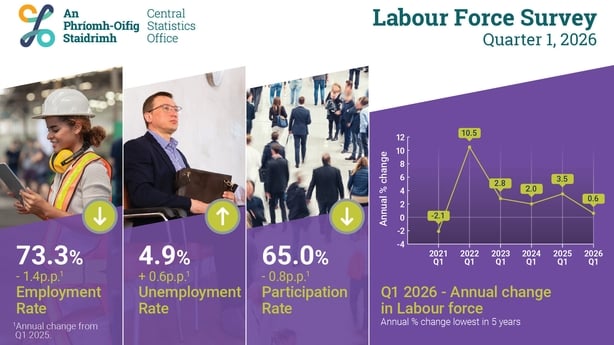
For Irish businesses and households, the GDP figure is largely irrelevant to their daily experience. The domestic economy — as measured by Modified Domestic Demand — is growing modestly, employment remains high, and consumer spending is holding up despite the cost of living pressures of recent years. The housing crisis remains the most significant constraint on economic wellbeing, with high rents and limited housing supply affecting the ability of workers to access the labour market and of businesses to attract and retain staff.
What's Next
The Central Statistics Office will publish revised GDP figures for the first quarter in the coming weeks, which may provide additional clarity on the specific factors driving the contraction. The Department of Finance is expected to publish its mid-year economic review in July, which will include an updated assessment of the economic outlook for 2026 and 2027. The Ahearne report's recommendations — which include significant investment in indigenous enterprise and a reform of the tax system to reduce dependence on corporation tax from a small number of companies — are expected to be discussed at Cabinet level in the autumn.
%20(6)-Nov-26-2025-02-12-55-8074-PM.png)