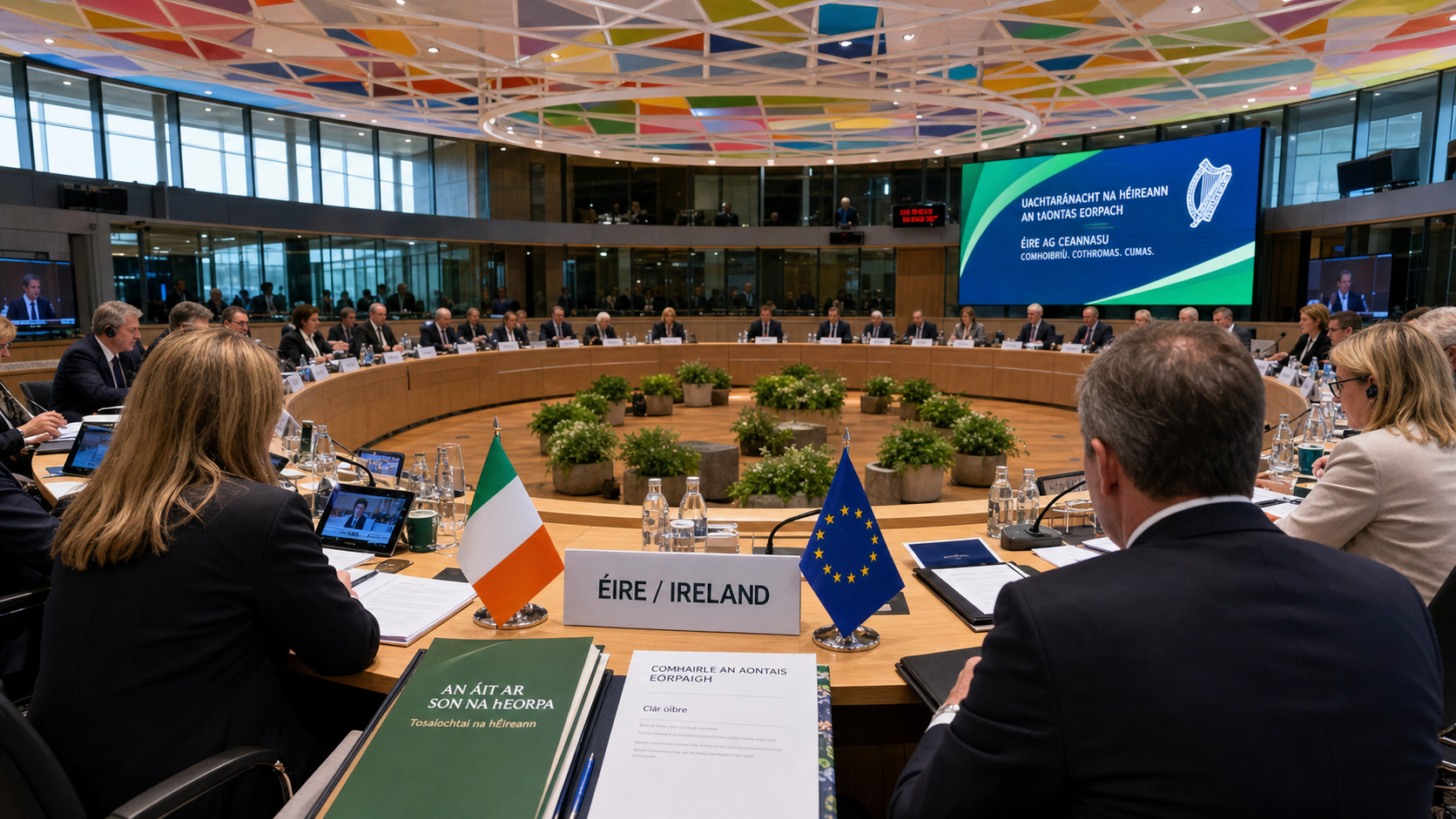
Ireland Takes the Helm of the EU Council Presidency with Ambition, Urgency, and a Historic Irish Language Milestone
Ireland assumed the Presidency of the Council of the European Union on 1 July, taking on the rotating chairmanship of the bloc's legislative body for the eighth time in its history and for the first time since Irish became a fully operational working language of the EU in 2022. The six-month term, running until 31 December 2026, is built around three interlocking priorities — competitiveness, values, and security — and has already seen a high-level College of Commissioners visit to Cork and a packed schedule of Council meetings and ministerial gatherings across Dublin, Cork, Limerick, Galway, and beyond.
Background
The Presidency of the Council of the European Union rotates among member states on a six-monthly basis, with each country taking the chair of Council meetings, setting the agenda for legislative negotiations, and brokering agreements between the 27 member states. It is one of the most demanding diplomatic assignments a small country can undertake, requiring the deployment of experienced civil servants and diplomats across dozens of Council configurations simultaneously, from the General Affairs Council to the Economic and Financial Affairs Council, from the Foreign Affairs Council to the Agriculture and Fisheries Council.
Ireland has held the Presidency seven times previously, most recently in 2013, when it played a significant role in managing the EU's response to the eurozone debt crisis. The country has a strong reputation as an effective and constructive Presidency holder — small enough to be seen as an honest broker between larger member states, experienced enough to navigate the complex procedural and political dynamics of EU legislative negotiations, and deeply committed to the European project in a way that gives it credibility across the political spectrum of the Union.
The 2026 Presidency carries a particular historic significance. Since Irish became a fully operational working language of the EU in 2022 — a status it had been granted in principle since 2007 but which had been subject to a derogation for 15 years — this is the first Irish Presidency in which the language can be used in all Council business, official communications, and cultural programming. The government has committed to integrating Irish into the Presidency's work in a meaningful way, and the launch ceremony at Dublin Castle on 1 July featured speeches in both Irish and English.
Key Developments
The Presidency officially launched with a ceremony at Dublin Castle on 1 July, attended by Taoiseach Micheál Martin, senior ministers, and representatives of the European institutions. The following day, the College of Commissioners — the EU's executive body — visited Cork for a two-day programme of strategic discussions with the Irish government, a visit that underlined the significance of the Presidency and provided an opportunity to advance key legislative priorities at the highest level.
The three pillars of the Irish Presidency programme — competitiveness, values, and security — reflect the priorities that Ireland has identified as most urgent for the EU at this moment. On competitiveness, the Presidency is focused on implementing the "One Europe, One Market" roadmap, which aims to deepen the single market and enhance European productivity in the face of competition from the United States and China. On values, the focus is on the rule of law, democracy, and fundamental rights — areas where the EU has faced significant internal tensions in recent years. On security, the Presidency is prioritising European defence capabilities, cyber security, and resilience against hybrid threats, reflecting the changed security environment following Russia's invasion of Ukraine.
A key overarching objective is securing agreement on the EU's next Multiannual Financial Framework — the seven-year budget that will govern EU spending from 2028 to 2034. Negotiations on the MFF are among the most complex and politically sensitive in the EU's legislative calendar, and Ireland's role as Presidency holder will require it to broker agreement between member states with very different views on the appropriate level and distribution of EU spending.
Why It Matters
For Ireland, the Presidency is both a diplomatic responsibility and a significant opportunity. As Presidency holder, Ireland chairs all Council meetings and sets the agenda for legislative negotiations, giving it an influence over EU policy that far exceeds what a country of its size would normally exercise. The six months of the Presidency are an opportunity to advance priorities that matter to Ireland — from the single market to the Common Agricultural Policy to the EU's relationship with the United Kingdom — in a context where Ireland's voice carries particular weight.
The Presidency also has a domestic dimension. The programme of events across Irish cities — conferences, ministerial meetings, cultural events — brings European institutions and their representatives to communities across the country, raising awareness of the EU and its work in a way that goes beyond the usual Brussels-centric coverage. For a country that has benefited enormously from EU membership, the Presidency is a reminder of the responsibilities as well as the advantages that come with being part of the Union.
Local Impact
The Presidency is generating significant economic activity across Ireland. Dublin, as the primary host city, is seeing increased demand for hotel accommodation, conference facilities, and hospitality services, with the government estimating that the Presidency will generate tens of millions of euros in economic activity over the six-month period. Cork, which hosted the College of Commissioners visit, has also benefited from the associated media attention and visitor numbers. Galway, Limerick, and other cities hosting ministerial meetings and conferences are similarly seeing a boost. The government has advised travellers to allow extra time at Dublin, Shannon, Cork, and Knock airports throughout the Presidency period, as increased diplomatic traffic is expected to cause periodic delays.
What's Next
The coming weeks will see a series of major Council meetings in Dublin, including the General Affairs Council and the Economic and Financial Affairs Council. The Presidency's first major legislative test will come in September, when negotiations on the Multiannual Financial Framework are expected to intensify. Ireland will also host an informal meeting of EU foreign ministers — the Gymnich — in the autumn, which will provide an opportunity to advance the Presidency's security agenda. The full programme of Presidency events, spanning all 26 counties, runs through to December 2026.