Ireland Net Migration Falls 19% as Ukraine War Peak Recedes and Emigration Rises
New figures from the Central Statistics Office show that net migration to Ireland has fallen by 19% compared to the previous year, continuing a steady decline from the peak driven by the arrival of Ukrainian refugees following Russia's full-scale invasion in 2022 — with analysts noting that the country's population growth is moderating after a period of exceptional demographic expansion.
Background
Ireland's migration story over the past four years has been shaped, more than any other single factor, by the war in Ukraine. Following Russia's full-scale invasion in February 2022, Ireland received one of the largest per-capita influxes of Ukrainian refugees of any country in the European Union. At the peak of arrivals in 2022 and 2023, Ireland was receiving thousands of Ukrainian nationals per month, many of them women and children who had fled the conflict while male relatives remained in Ukraine to fight or support the war effort.
The scale of Ukrainian arrivals transformed Ireland's demographic picture in a remarkably short period. Net migration — the difference between the number of people arriving in Ireland and the number leaving — reached record levels in 2022 and 2023, driving population growth that placed significant pressure on housing, schools, healthcare, and public services. The government's response to the Ukrainian crisis, while broadly praised for its humanitarian generosity, also exposed structural weaknesses in Ireland's capacity to absorb large numbers of new arrivals in a short timeframe.
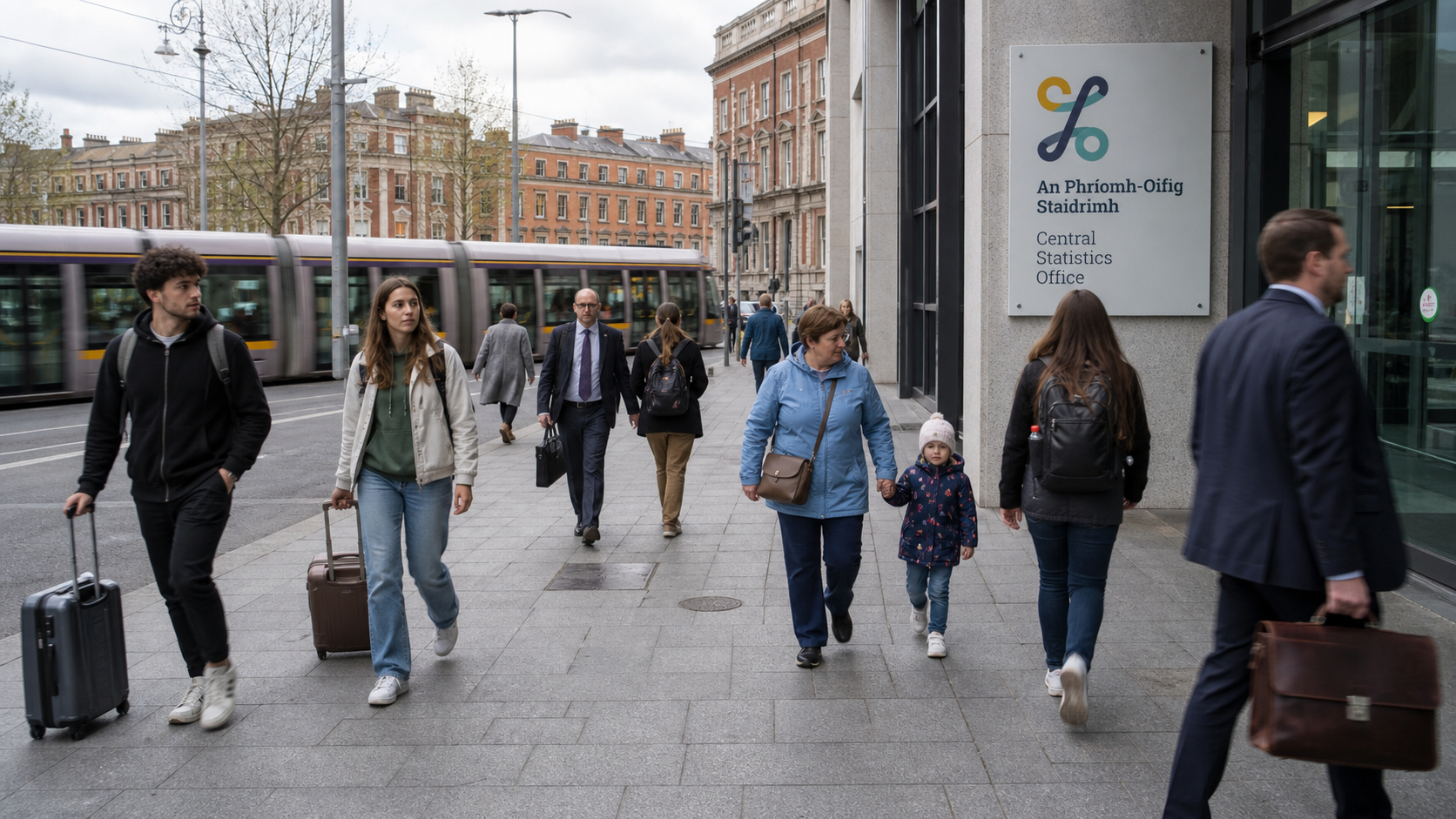
The Central Statistics Office publishes annual Population and Migration Estimates that provide the most comprehensive picture of Ireland's demographic trends. These figures, which draw on a range of administrative data sources, are the primary basis for government planning in areas including housing, education, and healthcare. The 2026 estimates, published this week, confirm that the migration peak has passed and that Ireland's population growth is returning to a more sustainable trajectory.
Key Developments
The CSO figures show that net migration to Ireland fell by 19% in the most recent 12-month period compared to the previous year. While the country continues to record positive net migration — more people are arriving than leaving — the rate of growth has slowed significantly from the highs of 2022 to 2024. Immigration fell by approximately 16% over the period, while emigration decreased by a smaller margin, reflecting the continued movement of Irish nationals and long-term residents to other countries, particularly the United Kingdom, Australia, Canada, and the United States.
The decline in net migration is attributable to several factors. The initial wave of Ukrainian arrivals has moderated as the conflict has settled into a more static phase and as some Ukrainian nationals have returned home or moved to other European countries. The government's decision to end certain temporary protection supports has also influenced the decisions of some migrants. More broadly, the cooling of Ireland's labour market — which remains strong by European standards but has seen some moderation in the technology and construction sectors — has reduced the pull factor for economic migrants from outside the EU.
Ireland's population reached 5,458,600 as of April 2025, the highest figure since before the Famine, and the continued positive net migration means that the population is still growing, albeit at a slower pace. Analysts project that further moderation in net migration is likely over the medium term as the Ukraine-related peak continues to recede.
Why It Matters
The moderation of net migration has significant implications for Irish public policy across a range of areas. In housing, the slowdown in population growth provides some relief to a market that has been under extraordinary pressure, though the structural undersupply of housing means that the crisis is far from resolved. In education, the Department of Education has been managing a surge in school enrolments driven by the arrival of Ukrainian children, and the moderation of migration will ease some of that pressure in the coming years. In healthcare, the HSE has been grappling with increased demand from a growing population, and the demographic moderation will provide some breathing space.
The figures also have political significance. Immigration has been one of the most contested issues in Irish politics in recent years, with concerns about the pace and scale of arrivals driving support for anti-immigration parties and movements. The moderation of net migration — and the government's ability to point to declining figures — may reduce some of the political pressure on this issue, though the underlying concerns about housing, services, and social cohesion are unlikely to dissipate quickly.
Local Impact
The impact of migration trends is felt differently across Ireland's regions. Dublin, which has absorbed the largest share of new arrivals, continues to face acute housing pressure, with average rents for a two-bedroom apartment exceeding €2,200 per month. In smaller towns and rural areas, the arrival of Ukrainian refugees has in some cases revitalised communities that were experiencing population decline, while in others it has placed strain on limited local services. The moderation of migration will be welcomed in areas where integration has been challenging, while communities that have benefited from the economic and demographic contribution of new arrivals may view the slowdown with more ambivalence.
What's Next
The CSO will publish its next Population and Migration Estimates in April 2027, covering the 12-month period to April 2026. The Department of Housing, Local Government and Heritage will use the current figures to inform its housing demand projections, which are a key input into the planning system and the government's housing targets. The Department of Education will also use the data to plan school capacity for the coming years. The government's response to the migration figures is expected to focus on the continued moderation of arrivals and the progress of integration programmes for those already in the country.