Ireland Marks 110th Anniversary of Easter Rising at GPO in Dublin
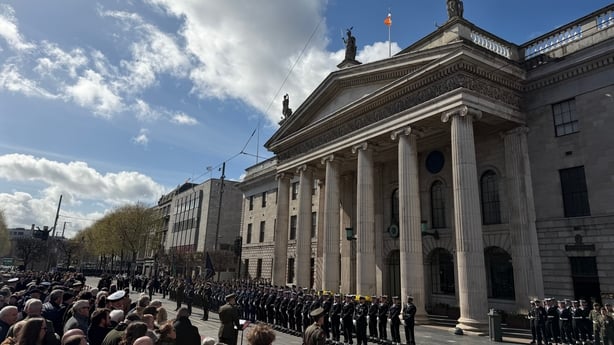
Tens of thousands of people lined O'Connell Street in Dublin on Easter Sunday as Ireland held its 110th State Commemoration of the 1916 Easter Rising, with President Catherine Connolly laying a wreath at the General Post Office in her first Easter commemoration as Uachtarán na hÉireann — a ceremony that carried particular resonance as Sinn Féin renewed its calls for a border poll on Irish unity.
The annual commemoration, which began at noon outside the GPO, brought together the country's most senior political and military figures. Taoiseach Micheál Martin, Tánaiste Simon Harris, Minister for Defence Helen McEntee, Lord Mayor of Dublin Ray McAdam, Northern Ireland First Minister Michelle O'Neill, and Sinn Féin leader Mary Lou McDonald were among those in attendance. The event was broadcast live on RTÉ.
Background
The Easter Rising of 1916 was a seminal event in modern Irish history. The insurrection, launched on Easter Monday, 24 April 1916, was an attempt by Irish republicans to end British rule in Ireland and establish an independent Irish Republic. Though the rebellion was suppressed by the British military within a week, the subsequent execution of its leaders galvanised public opinion against British rule, fuelling the Irish War of Independence (1919-1921) and ultimately leading to the establishment of the Irish Free State. The 1916 Proclamation of the Republic, read from the steps of the GPO by Pádraig Pearse, remains a foundational document of Irish republicanism and democratic ideals.
This year's commemoration was the first presided over by President Catherine Connolly, who was inaugurated as Ireland's 10th President on 11 November 2025. She is the third woman to hold the office, following Mary Robinson and Mary McAleese, and was elected with a historic 63.4% of first-preference votes — the largest personal mandate in the state's history. Born in Galway in 1957, Connolly is a barrister and clinical psychologist who served as an Independent TD for Galway West from 2016 and as the first female Leas-Cheann Comhairle of Dáil Éireann from 2020. A left-wing socialist and pacifist, she is a vocal supporter of Irish neutrality and a critic of increased militarisation within the European Union.
Key Developments
The ceremony featured a tri-service guard of honour from the Army, Naval Service, and Air Corps, a military brass band, and a pipe band, with over 200 Defence Forces personnel participating. The tricolour above the GPO was lowered to half-mast at noon, and the 1916 Proclamation of the Irish Republic was read aloud by Captain Eva Houlihan — the fourth woman to perform this reading at the GPO, 110 years after Pádraig Pearse first read it in the same location. The crowd applauded as the names of the seven signatories were read.
President Connolly laid a laurel wreath before the GPO portico, followed by a minute's silence. The national anthem was played, and the ceremony concluded with an Air Corps flyover. The 1916 Relatives Association held its own commemoration in the Garden of Remembrance on Saturday, 4 April.
The attendance of Northern Ireland First Minister Michelle O'Neill was a notable element of the day. O'Neill has previously articulated a distinction between attending official state commemorations for historical events like the 1916 Rising and her approach to commemorations related to the more recent conflict known as The Troubles — a nuanced position that reflects the protocol and political sensitivities associated with her office as First Minister for all communities in Northern Ireland.
Why It Matters
For Irish people north and south of the border, the Easter Rising commemoration is one of the most significant events in the national calendar. It is a moment to reflect on the journey from 1916 to the present, and to consider what the ideals of the Proclamation — equality, sovereignty, and the rights of all citizens — mean for Ireland today.
Sinn Féin used Easter commemorations across Ireland to intensify its campaign for a referendum on Irish unity. Speaking in Dublin, party leader Mary Lou McDonald stated that the current decade is the one "when Irish unity can be won" and criticised the Irish government for what she termed a "dereliction of duty" in failing to plan for a border poll. Sinn Féin MLA Deirdre Hargey, speaking in Belfast, asserted that the Irish and British governments "must set the terms for a border poll," calling for the immediate establishment of a citizens' assembly by the Dublin government to plan for unification.
Local Impact
In Belfast and across Northern Ireland, Easter Rising commemorations took place at republican memorials and community events throughout the bank holiday weekend. The 110th anniversary carries particular weight in the north, where the legacy of 1916 remains a live political question rather than a settled historical matter. The presence of First Minister O'Neill at the Dublin state ceremony — alongside Taoiseach Martin and the Irish President — is a visible symbol of the changed political landscape since the Good Friday Agreement, and of the growing normalisation of North-South political engagement at the highest levels.
For unionists and those from a British identity tradition in Northern Ireland, the commemoration and the accompanying calls for a border poll are a reminder of the contested nature of identity and sovereignty on the island — questions that the peace process has managed but not resolved.
What's Next
Easter events continued across the island throughout the bank holiday weekend. The question of a border poll is expected to remain a central issue in Irish politics throughout 2026, with Sinn Féin pressing both the Dublin and London governments to set out their positions on the conditions and timing of any future referendum on Irish unity.
Full coverage of the commemoration is available at RTÉ News and BBC News.